Force of Gravity Calculator
Solve Newton's law of universal gravitation F = G×m1×m2/r² for the attraction between two masses, or find weight W = m×g on Earth, the Moon, Mars, and other bodies with accurate surface gravity values.
🌌Real Gravity Presets
📝Gravity Inputs
Mass of the first object. Enter in the selected unit.
Mass of the second object.
Center-to-center separation, not surface gap.
Mass of the object you are weighing.
Used only when body is set to custom.
🔢Formula Snapshot
🪐Surface Gravity by Body
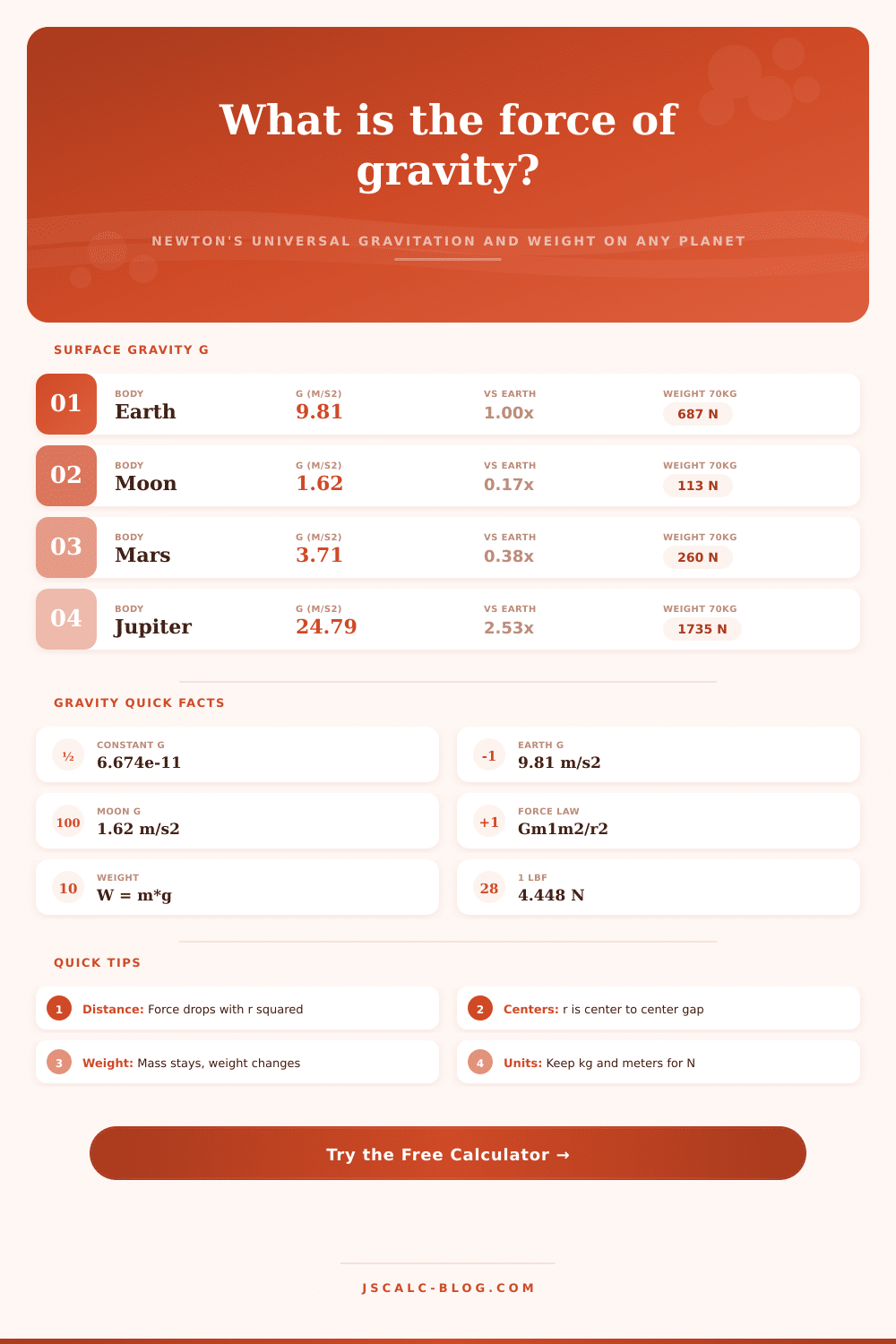
| Body | Surface g (m/s²) | vs Earth | Weight of 70 kg | Weight of 70 kg (lbf) |
|---|---|---|---|---|
| Sun | 274.0 | 27.93× | 19,180 N | 4,312 lbf |
| Jupiter | 24.79 | 2.527× | 1,735 N | 390 lbf |
| Neptune | 11.15 | 1.137× | 781 N | 176 lbf |
| Saturn | 10.44 | 1.064× | 731 N | 164 lbf |
| Earth | 9.81 | 1.000× | 687 N | 154 lbf |
| Venus | 8.87 | 0.904× | 621 N | 140 lbf |
| Uranus | 8.87 | 0.904× | 621 N | 140 lbf |
| Mars | 3.71 | 0.378× | 260 N | 58 lbf |
| Mercury | 3.70 | 0.377× | 259 N | 58 lbf |
| Moon | 1.62 | 0.165× | 113 N | 25 lbf |
| Pluto | 0.62 | 0.063× | 43 N | 10 lbf |
⚖Weight of Your Object Across Bodies
| Body | g (m/s²) | Weight (N) | Weight (lbf) | vs Earth Weight |
|---|---|---|---|---|
| Enter an object mass above to see its weight on every body. | ||||
🌍Gravitational Force Examples
| Scenario | Mass 1 | Mass 2 | Distance r | Force F | Note |
|---|---|---|---|---|---|
| Two 1 kg masses | 1 kg | 1 kg | 1 m | 6.67e-11 N | Tiny, needs sensitive tools |
| Two people hugging | 70 kg | 70 kg | 0.5 m | 1.31e-6 N | Far weaker than a breath |
| Person and Earth | 70 kg | 5.972e24 kg | 6.371e6 m | 686 N | This is your weight |
| Two cargo ships | 1e8 kg | 1e8 kg | 100 m | 66.7 N | Real but easily overcome |
| Earth and Moon | 5.972e24 kg | 7.342e22 kg | 3.844e8 m | 1.98e20 N | Holds the Moon in orbit |
| Sun and Earth | 1.989e30 kg | 5.972e24 kg | 1.496e11 m | 3.54e22 N | Keeps Earth circling |
| Apple and Earth | 0.1 kg | 5.972e24 kg | 6.371e6 m | 0.98 N | About 100 grams of weight |
| ISS and Earth | 4.2e5 kg | 5.972e24 kg | 6.791e6 m | 3.63e6 N | Still 90% of surface g |
📏Gravitational Constant Reference
| Symbol | Name | Value | Meaning |
|---|---|---|---|
| G | Gravitational constant | 6.674×10–¹¹ N·m²/kg² | Sets the strength of gravity |
| g | Earth surface gravity | 9.81 m/s² | Acceleration near Earth |
| M⊕ | Mass of Earth | 5.972×10²⁴ kg | Source of your weight |
| R⊕ | Radius of Earth | 6.371×10⁶ m | Center-to-surface distance |
| 1 lbf | Pound-force | 4.44822 N | Converts newtons to pounds |
| 1 kgf | Kilogram-force | 9.80665 N | Weight of 1 kg on Earth |
⚙Full Formula Breakdown
💡Practical Gravity Tips
Every moment of every day, gravity is affecting your life. But unless you’re dropping something, you don’t see it. Every second of your life, you are feeling the effects of it, but most of us thinks of it as this easy constant instead of a changing relationship between distance and mass. This calculator takes all that complicated algebra out of it for you.
All you have to do is plug in the numbers and know what they’re telling you about the things around you here on Earth (and beyond) in solar system. It calculates Newton’s law of universal gravitation: “Every particle of matter in the universe attracts every other particle with a force directly proportional to the product of their masses and inversely proportional to the square of distance between them.”
How Gravity Works and How to Use This Calculator
The other thing is that few of us understand the inverse-square relationship, which means that as you double the distance between two things, the gravitational pull doesn’t simply halve; it reduces to a quarter. Triple the distance? A ninth. The reason is clear: Why do planets orbits so closely around each other under influence of gravity yet find it impossible to stick two paperclips together on your desk? That rapid decay explains why gravity dominates planetary orbits but becomes negligible for small object like paperclips.
The tool asks for the distance in meters and mass in kilograms, that’s just good form for physics calculators, where not sticking with standardized units will lead to errors that can spiral out of control. If you prefer imperial units instead, no worries: the calculator will convert things behind-the-scenes and still spit out same accurate answer in either pounds-force or newtons. And knowing what a newton is makes the output numbers more grounded. A single newton is roughly equal to the weight of a small apple.
When the tool tells you that two hugging people exert only about one-millionth of a newton on each other, it shows why you have never felt any kind of gravitational tug from your partner. The force is there but it is dwarfed by muscle tension and friction. Weight is nothing more than gravity with a name. Because the acceleration caused by gravity is essentially constant near sea-level on Earth, we mistakenly mix up weight and mass. Your weight is different than it is in New York City, but your mass is always the same regardless of where you are.
That distinction is neatly explained in the reference table on the page for several bodies in space. You might weigh 70 kg on Earth. If you had the good luck to be moved to Mars, you’d still have 70 kg of mass, but the lower surface gravity of the Red Planet would mean you’d weigh much less. Why does that matter? It is important in engineering and also plays a role in sports. For example, a hammer thrown on the Moon goes further not because the person throwing it are stronger, but because the force pulling it down, opposing its momentum, is weaker.
Now, there’s one more number in the equation, and it’s a very small number called the gravitational constant (often written as G). This is a very small number, about six point six seven times ten to the negative eleventh power, that scales the whole thing. This smallness is what tells us just how weak gravity realy is among all the forces in nature. A sheet of paper will block a magnet but not gravity. Gravity reaches out across billions of kilometers without any obstruction at all.
Even though gravity is relatively weak at small scales, it adds up: Planets and stars are massive objects with huge amounts of material concentrated into small spaces, which creates significant pulls. With the calculator you can run through examples, from the slight pull between two cargo ships to the enormous force that holds the Earth firmly in its place around the Sun. This device transforms gravity from an idea into something real, something that can be manipulated and weighed and compared.
Without a PhD in astrophysics, we could of experiment with weight distribution among various planets and change distances to see how they affects force. And we learn that although gravity feels like a constant, an immovable force, it’s incredibly sensitive to both mass and distance. If you’ve ever wondered what it would feel like to livig in space, or simply want to calculate how much your favorite rock weighs on Jupiter. Those questions can be answered here. Gravity connects us all, quietly yet firmly.