Free Fall Calculator
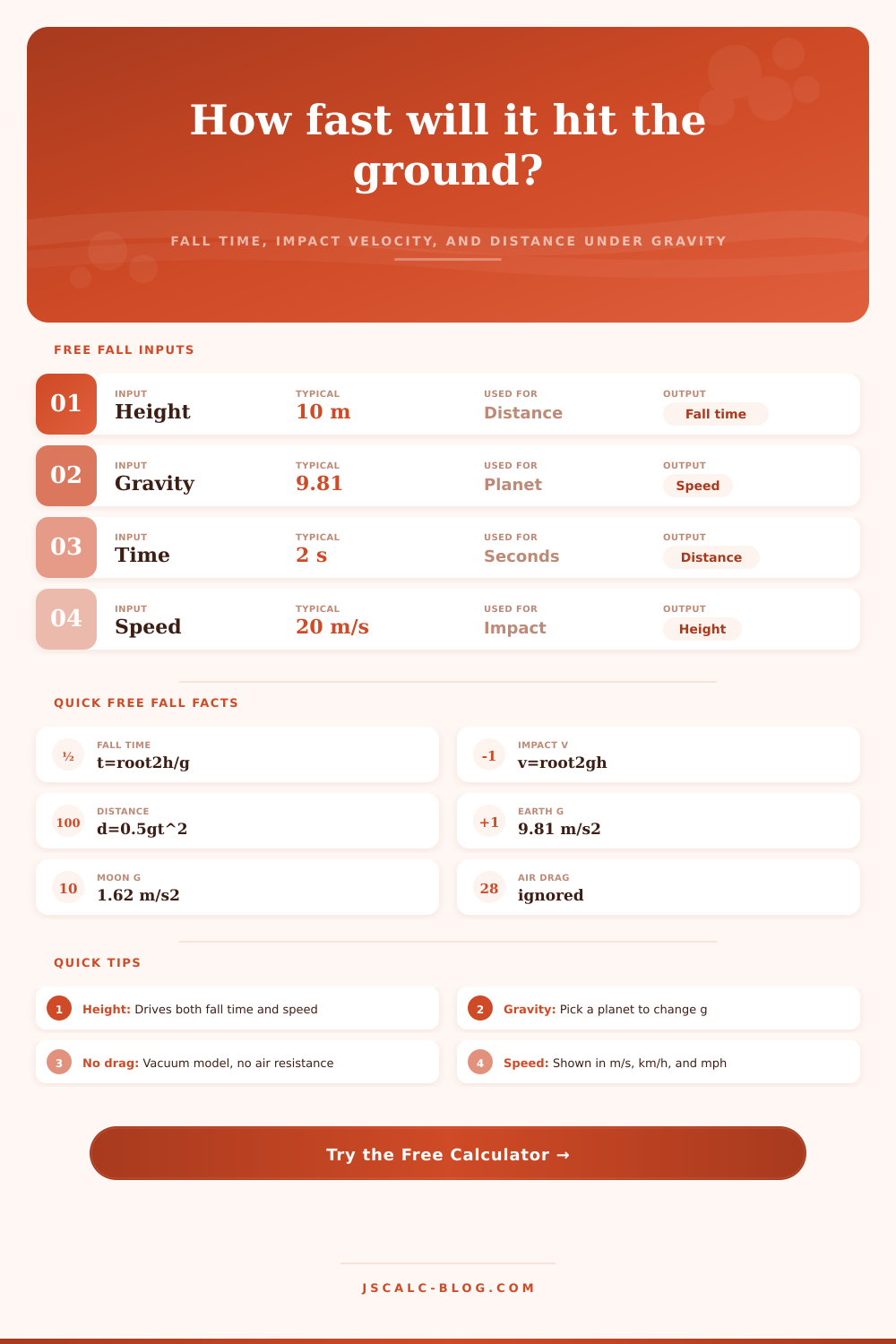
Drop an object with no air resistance and find its fall time, impact velocity, and distance fallen from any height under gravity. Solve for height, time, or impact speed on Earth or another planet.
🎯Free Fall Presets
📝Fall Inputs
Choose which value you already know.
Editable when gravity source is set to custom.
Seconds the object falls before impact.
Use 0 for an object simply released from rest.
Air resistance is ignored. This is an ideal vacuum free fall model, so results overstate real speed for light or wide objects.
🔢Formula Snapshot
📏Fall Distance by Time (Current g)
| Time (s) | Distance | Speed (m/s) | Speed (km/h) | Speed (mph) |
|---|---|---|---|---|
| Calculate to fill the distance-by-time table. | ||||
🏢Impact Velocity by Height (Current g)
| Height (m) | Height (ft) | Fall time (s) | Impact (m/s) | Impact (mph) |
|---|---|---|---|---|
| Calculate to fill the impact-by-height table. | ||||
🪐Gravity by Planet or Body
| Body | Gravity (m/s²) | Fall time 10 m | Impact 10 m (m/s) | Impact 10 m (mph) |
|---|---|---|---|---|
| Calculate to fill the planet comparison table. | ||||
🗂Free Fall Comparison Grid
| Scenario | Height | Gravity | Fall Time | Impact (m/s) | Impact (mph) |
|---|---|---|---|---|---|
| Diving board | 3 m | 9.81 | 0.78 s | 7.67 | 17.2 |
| Drop 10 m | 10 m | 9.81 | 1.43 s | 14.01 | 31.3 |
| Coin off tower | 50 m | 9.81 | 3.19 s | 31.32 | 70.1 |
| Tall building | 100 m | 9.81 | 4.52 s | 44.29 | 99.1 |
| High cliff | 200 m | 9.81 | 6.39 s | 62.64 | 140.1 |
| Moon drop 10 m | 10 m | 1.62 | 3.51 s | 5.69 | 12.7 |
⚙Full Formula Breakdown
📋Reference Values
| Quantity | Symbol | Common Value | Note |
|---|---|---|---|
| Standard gravity | g | 9.81 m/s² | Average value at Earth surface |
| Moon gravity | g | 1.62 m/s² | About one sixth of Earth |
| 1 meter | h | 3.281 ft | Height unit conversion |
| 1 m/s in km/h | v | 3.6 km/h | Multiply speed by 3.6 |
| 1 m/s in mph | v | 2.237 mph | Multiply speed by 2.23694 |
💡Practical Free Fall Tips
How does it work? Imagine standing atop a tower and dropping a coin on the floor below. You hear the clack as it lands. How long was it airborne? What velocity did it have when it collided with stone?
Humans is terrible at guessing acceleration; they assume things keep moving at constant speeds after release. Not true! The further an object fall, the faster it goes. Each second is like an additional layer of speed, accelerating until collision.
How Free Fall Works
Enter a number for “height” and “gravity,” then let the free fall calculator crunch numbers for you. No need to swap units by hand or guess coefficients. Here’s the basic gist of it: it doesn’t take linearly more time to go further and further away. It’s a simple idea that’s really robust.
For example, when you double the distance (drop) then it only takes maybe forty percent longer to reach ground. That’s because the time taken actualy scales based off the square root of the height. You can watch this and it still feels counterintuitive. On Earth, falling from a ten meter height take around 1.4 seconds. But if you drop something from a hundred meters high, it’ll only be falling for slightly more than four seconds. The extra ninety meters hardly added any time even though the object was falling much faster.
But what about impact velocity? Gravity is a constant accelerator closer to a planet’s surface. It increase linearly with time, so the longer the fall the faster you’ll be going when it ends. Acceleration due to gravity on Earth is roughly nine point eight one meters per second squared, which means each tick of the clock add that amount to your speed.
For comparison, the table of planetary references on the page puts all that together. Drop that coin on the Moon and it will only reach ten meters in a bit more than three seconds, then move slowly downward until finally falling with a mere glancing blow that won’t even leave a bruise. It falls violently on Jupiter, however, where the timeline gets crushed and a relatively small drop turns into a fast-moving collision in under a second.
The typical physics model simply doesn’t include air resistance, so most folks don’t really factor it in anymore. If it’s not there, then a feather and a bowling ball is treated equally. This calculator assumes a vacuum. But that’s where air makes a huge difference when considering wide or light things. While a coin cuts through the air cleanly, a piece of paper flutters and drifts. Think of these results as a theoretical limit… A maximum value that can never actualy be reached because drag slows things down. Unless you’re dropping something streamlined and dense such as stone or a lead sinker, real world collisions will usually occur slower then what you see here.
The tool works backwards too. Perhaps you know you only have two seconds to do something in a stunt. Or maybe you’d like to drop an egg without breaking it, but you don’t know what speed to throw it. Input the time (or even the velocity) into the solver which will spit out the height you require. That could of come in handy for checking engineering calculations, or just to satisfy your curiosity about your scale.
For example, a hundred meters seems tall. This changes once you put that number through the solver and learn that at Earth gravity, it would take barely over 5 seconds to cross it. Perspective shifts fast as soon as you quantify things.
There is also a place to enter how fast it starts falling. When most folks think falling, they picture something dropped from stillness. But throw it down and there’s more distance and speed right away; the equations accounts for that instant shove without effort. It is a small detail, but it makes a difference if accuracy matters.
If it’s gravity pulling something at all, it doesn’t matter what, only how far you have to pull on it. And that unstoppable tug converts potential energy into kinetic in the blink of an eye, in a reliable rush. Do it again: drop the coin. Watch it fall. It lands, clacking against the floor.