Waist to Hip Ratio Calculator
Divide your waist by your hip measurement to find your waist-to-hip ratio, your sex-specific WHO risk band, whether your body shape is apple or pear, and the waist change needed to reach the low-risk zone. Screening estimate, not medical advice.
📏Real WHR Presets
📝Your Measurements
Measure at the narrowest point, around the navel, exhaling gently.
Measure around the widest part of the buttocks and hips.
Used to estimate the hip or waist change to reach this WHR.
🔢Formula Snapshot
📊WHO Risk Bands by Sex
| Group | Low Risk | Moderate Risk | High Risk | Body Shape Trend |
|---|---|---|---|---|
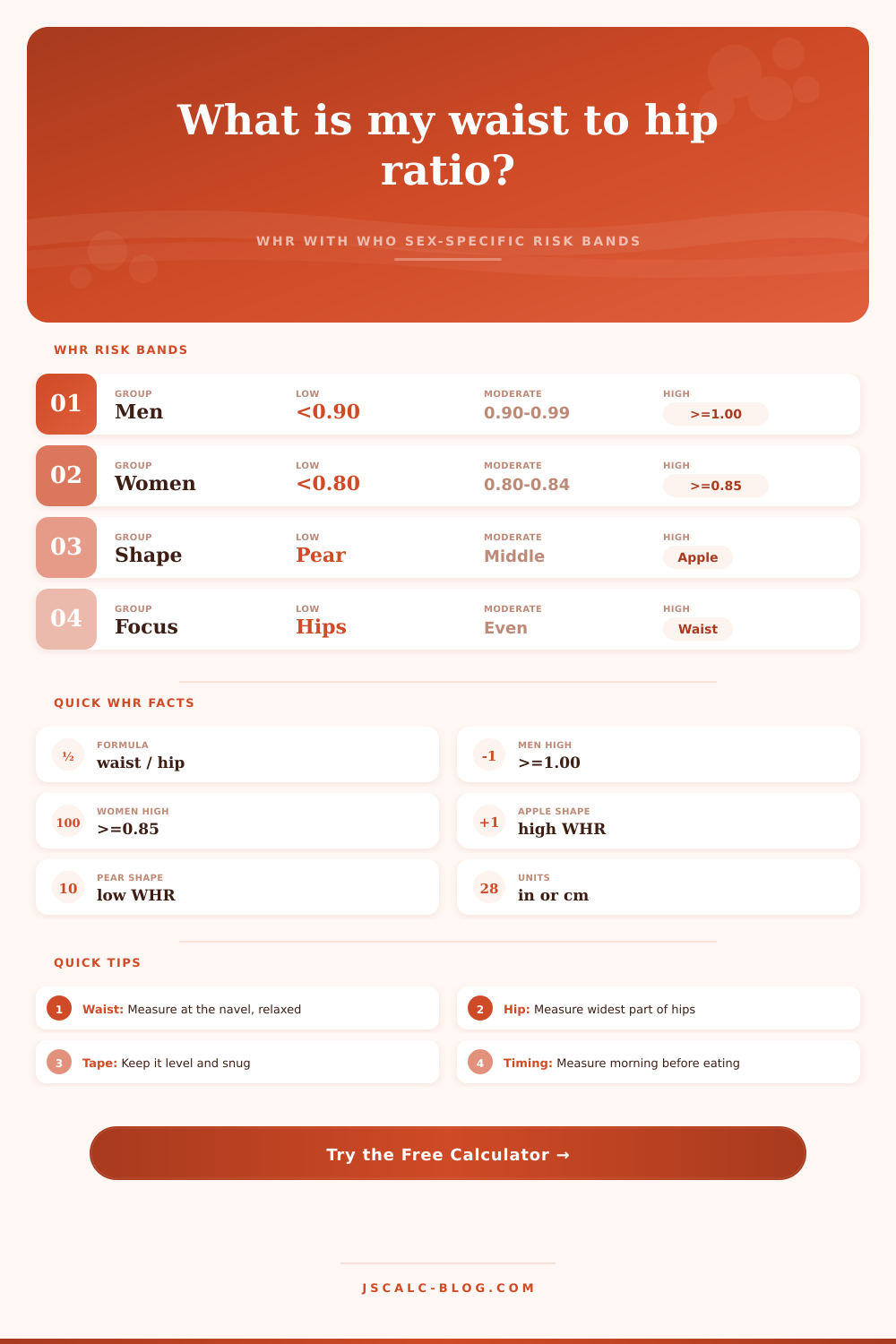
| Men | Below 0.90 | 0.90 to 0.99 | 0.95 and above | Pear to apple |
| Women | Below 0.80 | 0.80 to 0.84 | 0.85 and above | Pear to apple |
🍏Apple and Pear Body Shape Reference
| Shape | Where Fat Sits | Men WHR | Women WHR | What It Suggests |
|---|---|---|---|---|
| Pear | Hips and thighs | Below 0.90 | Below 0.80 | Lower central fat, low band |
| Balanced | Even spread | 0.90 to 0.95 | 0.80 to 0.84 | Middle band, watch trend |
| Apple | Around the abdomen | 0.95 and up | 0.85 and up | More central fat, high band |
| Strong apple | Deep belly fat | 1.00 and up | 0.90 and up | Highest central pattern |
📐WHR vs Waist Size Reference
| Hip Size | Waist for 0.80 | Waist for 0.85 | Waist for 0.90 | Waist for 1.00 |
|---|---|---|---|---|
| 36 in | 28.8 in | 30.6 in | 32.4 in | 36.0 in |
| 40 in | 32.0 in | 34.0 in | 36.0 in | 40.0 in |
| 44 in | 35.2 in | 37.4 in | 39.6 in | 44.0 in |
| 90 cm | 72.0 cm | 76.5 cm | 81.0 cm | 90.0 cm |
| 100 cm | 80.0 cm | 85.0 cm | 90.0 cm | 100.0 cm |
| 110 cm | 88.0 cm | 93.5 cm | 99.0 cm | 110.0 cm |
🗂Risk Interpretation Comparison Grid
| Profile | Sex | Waist | Hip | WHR | Band |
|---|---|---|---|---|---|
| Lean male | Male | 34 in | 40 in | 0.85 | Low |
| Average male | Male | 36 in | 40 in | 0.90 | Moderate |
| Central male | Male | 40 in | 40 in | 1.00 | High |
| Lean female | Female | 28 in | 40 in | 0.70 | Low |
| Average female | Female | 33 in | 40 in | 0.83 | Moderate |
| Central female | Female | 36 in | 40 in | 0.90 | High |
| Metric male | Male | 90 cm | 100 cm | 0.90 | Moderate |
| Metric female | Female | 85 cm | 100 cm | 0.85 | High |
⚙Full Formula Breakdown
📋Measurement Reference Values
| Step | Where | How | Why It Matters |
|---|---|---|---|
| Waist | Around the navel | Level tape, exhale, do not suck in | Sets the numerator of the ratio |
| Hip | Widest buttock point | Feet together, tape parallel to floor | Sets the denominator of the ratio |
| Posture | Standing relaxed | Weight even on both feet | Keeps readings repeatable |
| Tape tension | Snug on skin | Firm without compressing tissue | Avoids over or under reading |
| Timing | Morning | Before eating or drinking | Reduces day-to-day variation |
💡Practical WHR Tips
However, this size doesn’t take into account that some part of our bodies are made up of more fat while others has more muscle. That’s why waist-to-hip ratio can be a helpful way to check body composition. Rather than looking at overall weight, waist-to-hip ratio looks at where your weight sit on your body. By dividing your waist measurement by your hip measurement, which means total weight doesn’t matter, the calculator give you a good idea of your body fat distribution. Subcutaneous fat, which resides in your thighs and hips, has different properties than visceral fat, which wrap around your organs. To help you better understand the number result, know what those numbers mean.
You also need to take these measurements correctly. A lot of folks think they know where their waist is, but don’t. When you measure your waist, stand with a level tape, breathe out gently and place it around your body at your navel. An honest measurement isn’t going to be one that has your belly sucked in. For hips, take this measurement at the widest part (generally over your butt). Use the same units of measure for both, e.g., both measured in inches or both in centimeters. It doesn’t matter which unit of measure you use because they cancel out in the ratio, but staying consistent will give you an accurate starting place.
How to Measure Your Waist and Hips
What do those numbers mean? To help determine risk, the World Health Organization sets certain cutoffs. Women are low-risk with a ratio below 0.80, while men is low-risk with a ratio below 0.90. Those numbers come from epidemiological research that has shown that greater amounts of central body fat connect with increased risk of type 2 diabetes and heart disease, among other metabolic problems.
A number that lands you in the moderate- or high-range mean your body is storing excess energy as a rounder midsection, also known as having an “apple-shaped” physique. Though description isn’t flattering, it’s critical health info that deserves your consideration. So many folks get hung up on shrinking their waists without paying attention to the number at their hips. The math gets wonky with that ratio. A bigger hip measurement (even when the waist doesn’t change) will decrease the ratio. This can happen from strength training. Adding muscle to your legs or butt will increase your hip measurement and reduce your ratio. That isn’t always because you decreased your visceral fat, but rather because you increased your hip circumference.
And that’s exactly what you see in the numbers instanty on the calculator. That doesn’t mean you’re healthier metabolically. Having big hips can never make up for eating poorly. Your waist size, the numerator. Is what matters most here. Reduce that number and ratio goes down. How many inches should you lose around your waist? The calculator will show amount required to put you in the safe zone. Use this as a practical planning measure. Rather than having a vague idea that you want a slimmer tummy, you have a specific number to strive toward. If you’re just outside the range, perhaps dropping an inch or two from your waistline could push you over to the healthier side. You know; it’s one digit. One digit!
Genetics and age also play roles. Age and genetics also play a role that no calculator can fully capture. As you get older, you naturaly lose muscle and gain more body fat. That usually happens around the midsection. Even if your scale weight doesn’t change, your ratio may increase. It’s something older folks need to watch out for, since as we get older our metabolism slow down. Less flexible) and belly fat is more harmful. If you’re an athlete who is really strong from training, your waist measurement could be higher (meaning bigger) than someone else’s but that’s not necessarily fat… It’s muscular strength around your core.
This ultimately isn’t a medical diagnosis but rather a screening tool. It is a snapshot of how much energy you store in your body. Instead of getting hung up on day-to-day changes, use it as a way to monitor trends over time. Record your measurements each morning before breakfast so the data will be consistent. When your ratio starts trending upwards, check your diet and activity levels. When it’s stable or trending downward, you’re probably headed in the right direction.
The bathroom scale masks information revealed by the tape measure. Believe the shape, not the weight.