Fraction to Decimal Calculator
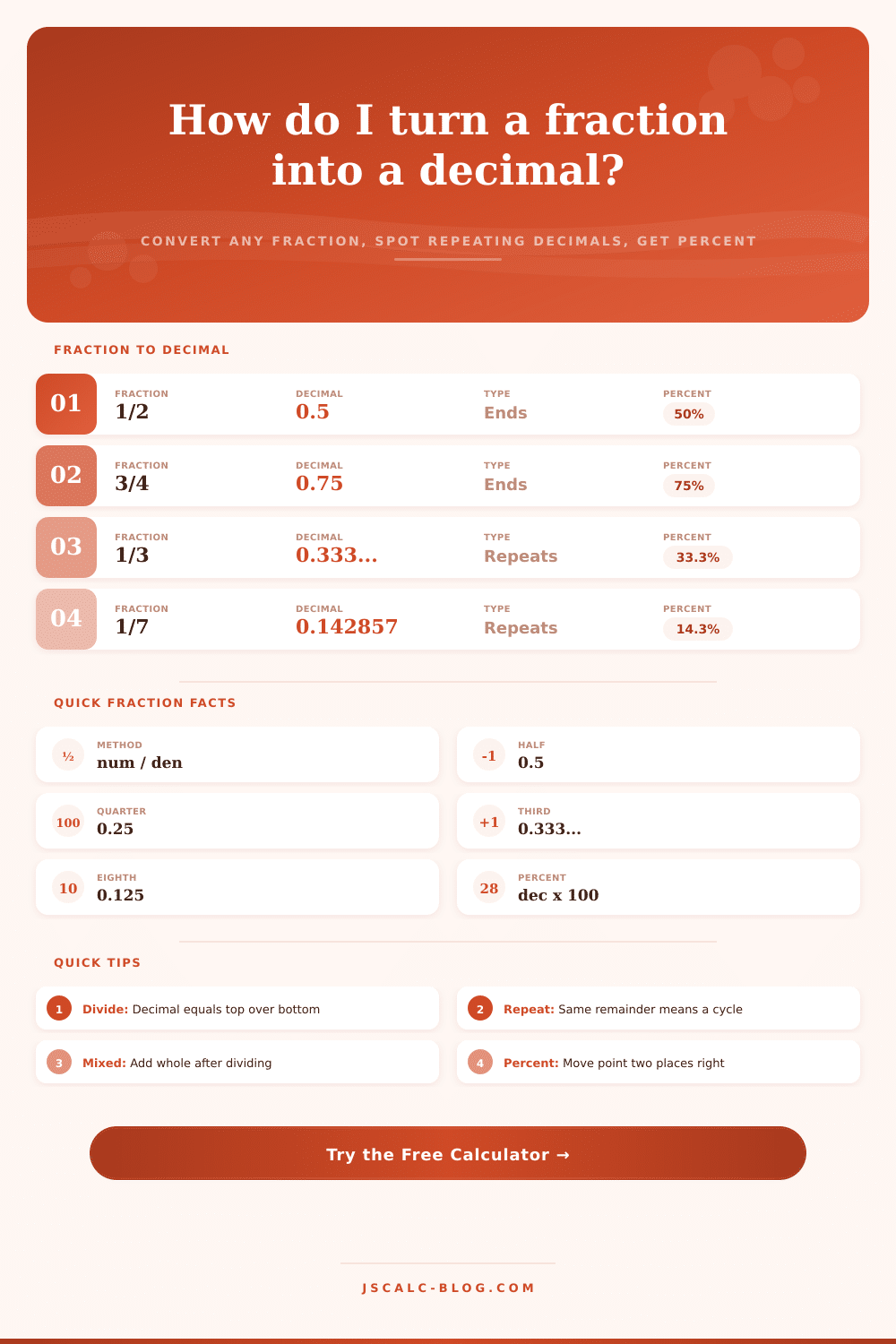
Convert any proper, improper, or mixed fraction into a decimal by dividing the numerator by the denominator, detect terminating versus repeating patterns with true long division, and read the percent equivalent.
🎯Real Fraction Presets
📝Fraction Inputs
Leave 0 for a plain proper or improper fraction.
Cannot be zero. A negative sign flips the result.
🔢Conversion Snapshot
📏Common Fractions Reference
| Fraction | Decimal | Percent | Type |
|---|---|---|---|
| 1/2 | 0.5 | 50% | Terminating |
| 1/3 | 0.333... | 33.33% | Repeating (3) |
| 1/4 | 0.25 | 25% | Terminating |
| 2/3 | 0.666... | 66.67% | Repeating (6) |
| 3/4 | 0.75 | 75% | Terminating |
| 1/5 | 0.2 | 20% | Terminating |
| 1/6 | 0.1666... | 16.67% | Repeating (6) |
| 1/8 | 0.125 | 12.5% | Terminating |
| 3/8 | 0.375 | 37.5% | Terminating |
| 5/8 | 0.625 | 62.5% | Terminating |
| 1/9 | 0.111... | 11.11% | Repeating (1) |
| 1/10 | 0.1 | 10% | Terminating |
| 1/16 | 0.0625 | 6.25% | Terminating |
📐Inch Fraction to Decimal
| Inch Fraction | Decimal Inch | Millimeters | Notes |
|---|---|---|---|
| 1/16 | 0.0625 | 1.5875 mm | Smallest common mark |
| 1/8 | 0.125 | 3.175 mm | Two sixteenths |
| 3/16 | 0.1875 | 4.7625 mm | Three sixteenths |
| 1/4 | 0.25 | 6.35 mm | Quarter inch |
| 3/8 | 0.375 | 9.525 mm | Six sixteenths |
| 7/16 | 0.4375 | 11.1125 mm | Seven sixteenths |
| 1/2 | 0.5 | 12.7 mm | Half inch |
| 5/8 | 0.625 | 15.875 mm | Ten sixteenths |
| 3/4 | 0.75 | 19.05 mm | Twelve sixteenths |
| 7/8 | 0.875 | 22.225 mm | Fourteen sixteenths |
🔁Repeating Decimal Examples
| Fraction | Decimal | Repetend | Cycle Length | Percent |
|---|---|---|---|---|
| 1/3 | 0.(3) | 3 | 1 digit | 33.33% |
| 1/6 | 0.1(6) | 6 | 1 digit | 16.67% |
| 1/7 | 0.(142857) | 142857 | 6 digits | 14.29% |
| 1/9 | 0.(1) | 1 | 1 digit | 11.11% |
| 1/11 | 0.(09) | 09 | 2 digits | 9.09% |
| 1/12 | 0.08(3) | 3 | 1 digit | 8.33% |
| 5/6 | 0.8(3) | 3 | 1 digit | 83.33% |
| 2/7 | 0.(285714) | 285714 | 6 digits | 28.57% |
🗂Fraction Type Comparison Grid
| Example | Fraction | Improper | Decimal | Percent | Pattern |
|---|---|---|---|---|---|
| Proper ends | 3/4 | 3/4 | 0.75 | 75% | Terminating |
| Proper repeats | 1/3 | 1/3 | 0.(3) | 33.33% | Repeating |
| Eighth | 5/8 | 5/8 | 0.625 | 62.5% | Terminating |
| Improper | 11/4 | 11/4 | 2.75 | 275% | Terminating |
| Mixed number | 1 1/2 | 3/2 | 1.5 | 150% | Terminating |
| Long cycle | 1/7 | 1/7 | 0.(142857) | 14.29% | Repeating |
| Two thirds | 2/3 | 2/3 | 0.(6) | 66.67% | Repeating |
| Twentieth | 9/20 | 9/20 | 0.45 | 45% | Terminating |
⚙Full Formula Breakdown
📋Reference Values
| Denominator | Behavior | Why | Example |
|---|---|---|---|
| 2, 4, 8, 16 | Always terminates | Powers of 2 only | 7/16 = 0.4375 |
| 5, 10, 20, 25 | Always terminates | Factors of 2 and 5 | 9/20 = 0.45 |
| 3, 6, 9, 12 | Usually repeats | Prime factor 3 | 1/3 = 0.(3) |
| 7, 11, 13 | Always repeats | Prime not 2 or 5 | 1/7 = 0.(142857) |
| Mixed 2 and 5 plus other | Delayed repeat | Non-repeat then cycle | 1/6 = 0.1(6) |
💡Practical Fraction Tips
Fraction Division, The calculator will handle dividing fractions without making you try to figure out conversion or coefficient. Just put your numbers into it and it will divide any proper, improper, or mixed fraction to show exact percent equivalent.
Repeating Decimal Detection… It detects repeating decimals using real long division and also shows the exact percent equivalent. Time saver if you want to know if 1/7 of an inch is significant for that fitting or whether or not three-eights of a cup fit in your bowl.
How the Fraction Calculator Works
Arithmetic are at play here. The calculator simply divides the top (the numerator) of a fraction by the bottom (the denominator). And if it’s a mixed number… Such as two and three-quarters; the calculator will convert that to an improper fraction for starters. It take the whole number part, multiplies by the denominator and then adds the numerator. This keeps scale the same before dividing. For most folks, this is where they lose their way mentally, but not the tool, which handle this neatly so you can concentrate on the answer instead.
Some decimals do not cleanly terminate; they loop endlessly. Decimal numbers whose denominators, when reduced, contain only prime factors 2 or 5 (e.g., 2’s, 4’s, 8’s) terminates. That’s why we have halves, quarters, and eighths that fit easy within our base-ten number system. Any prime factor other than two or five in the denominator makes the decimal a repeating decimal: the calculator continues dividing out the numerator but it keeps track of remainders. Whenever it get back to the same remainder, it knows it has cycled through a set of digits, so the digits between those remainders repeat. It draws a line on this pattern so you’ll know its exact even though it has an endless tail.
In real-world examples such as carpentry and cooking, this distinction make all the difference. Is it an approximation? Or do you know for sure? Here’s why: A third of a cup isn’t actualy equal to 0.33 cups; the numbers go on forever. To determine where to round, decide how many decimal places makes sense given your need for accuracy versus practicality. Rounding works fine when baking cookies. When computing interest rates or calibrating machinery, accuracy counts.)
Confusing: Mixed numbers are confusing, since they appear to be two different number. To remove any confusion, the input fields shows the mixed number separated into its whole and fractional parts. One and a half is entered by typing 1 in the whole field and then 1/2 in the fraction fields. This prevents errors where users enter “1 1/2” as a single value with a space. In those cases, systems doesn’t know how to handle it.
Quick reference tables: common conversion factors that you look up. These include fractions such as 3/4 turning into 0.75 and 75 percent. They also include things like inches to millimeters. These come in handy if you do a lot of DIY projects and need to convert between metric units but don’t know the exact conversions by heart. Perform a sanity check by comparing your complicated fraction with a table entry to make sure you understand what you’re working with.
Moving the decimal point two places to the right is called percent conversion. It’s an easy move that converts a part-to-whole situation into a rate or comparison. In financial contexts, it’s often easier to understand 1/7 as 14.29 percent rather then just as the fraction 1/7. The calculator displays the number both ways… Switch between them when one make more sense for what you’re doing.
They’re about understanding the relationships among numbers instead of rote memorization of tables. It’s about knowing when to round, when it doesn’t matter, and when repeat patterns. Knowing how they relate to each other gives you context so that tool becomes the answer. Seeing fractions as ratios explains why those numbers appears, which makes sense of the math. That applies when you measure a board or split a bill.