Condensed Logarithm Calculator
Enter a sum or difference of log terms, each with a coefficient and an argument, and this tool condenses them into one single logarithm. It applies the power rule to fold coefficients into exponents, sends plus terms to the numerator and minus terms to the denominator, and evaluates the result when every argument is a number.
🎯Real Condensing Presets
📝Log Terms to Condense
Number in front, e.g. 2 or 1/2.
A symbol like x or a number like 8.
Leave 0 to skip this term.
A symbol like y or a number.
Set above 0 to use this term.
A symbol like z or a number.
Optional fourth term.
A symbol or number.
🔢Rule Snapshot
📋The Three Condensing Rules
| Rule Name | Expanded Form | Condensed Form | What It Does |
|---|---|---|---|
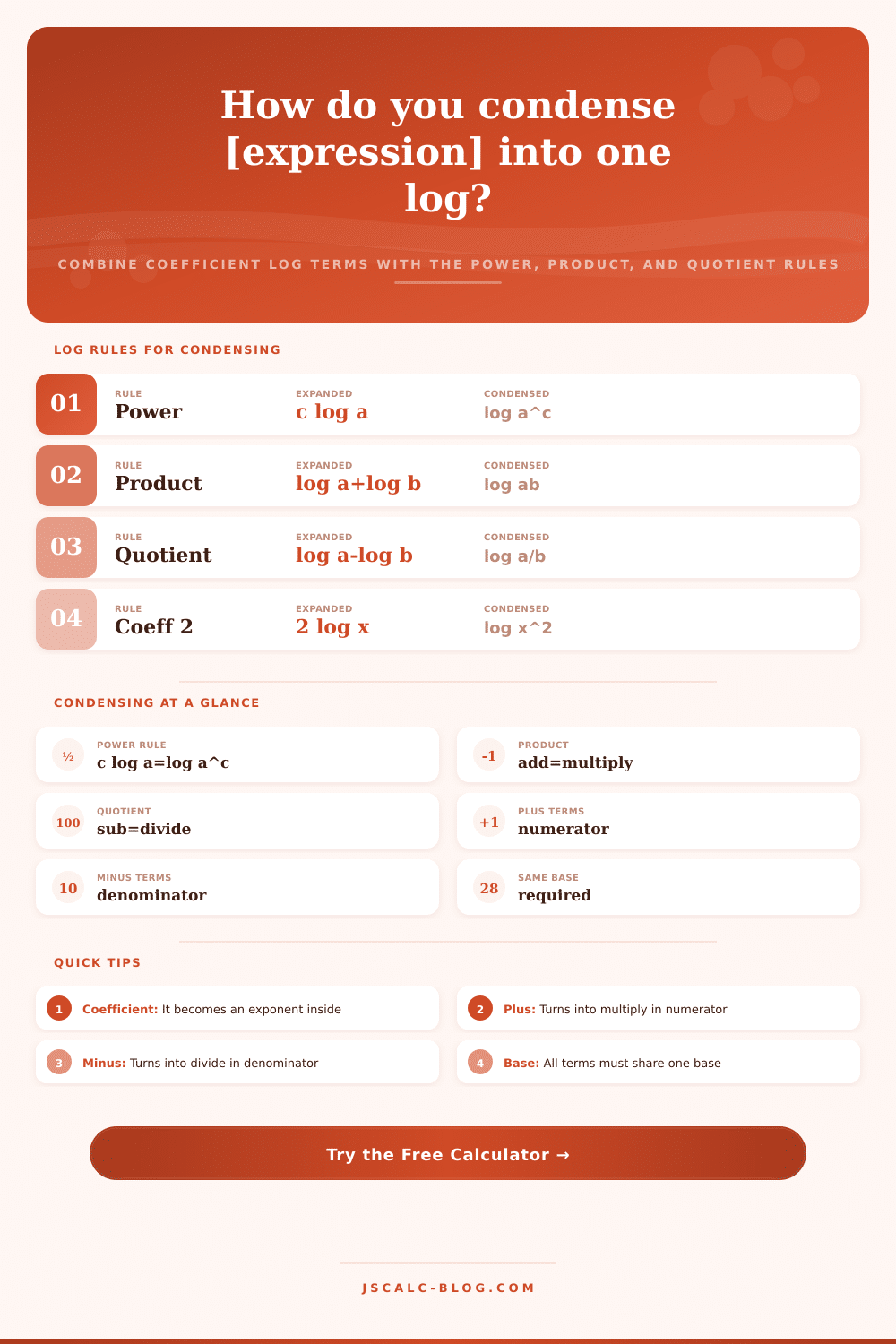
| Power rule | c · log a | log a^c | Coefficient becomes exponent |
| Product rule | log a + log b | log (a b) | Sum becomes a product |
| Quotient rule | log a − log b | log (a / b) | Difference becomes a quotient |
| Combined | 2 log x + log y | log (x^2 y) | Power then product |
| Combined | log x − 3 log y | log (x / y^3) | Power then quotient |
| Full form | 2 log x + log y − log z | log (x^2 y / z) | All three rules at once |
📊Coefficient to Exponent Examples
| Coefficient Term | Power Rule | Inside the Log | Numeric Check |
|---|---|---|---|
| 2 log x | log x^2 | x squared | 2 log 3 = log 9 |
| 3 log x | log x^3 | x cubed | 3 log 2 = log 8 |
| 1/2 log x | log x^(1/2) | square root of x | 1/2 log 9 = log 3 |
| 1/3 log x | log x^(1/3) | cube root of x | 1/3 log 27 = log 3 |
| -1 log x | log x^-1 | 1 over x | -log 4 = log 0.25 |
| 4 ln x | ln x^4 | x to the fourth | 4 ln 2 = ln 16 |
📏Expand Versus Condense
| Single Log | Expanded (spread out) | Direction to Condense | Rule Used |
|---|---|---|---|
| log (x y) | log x + log y | add back to multiply | Product |
| log (x / y) | log x − log y | subtract back to divide | Quotient |
| log x^3 | 3 log x | move 3 back inside | Power |
| log (x^2 y) | 2 log x + log y | power then product | Power + Product |
| log (x / y^2) | log x − 2 log y | power then quotient | Power + Quotient |
| ln (a b / c) | ln a + ln b − ln c | combine all terms | All three |
🗃Step by Step Condensing Grid
| Expression | Step 1 Power | Step 2 Numerator | Step 3 Denominator | Condensed Form |
|---|---|---|---|---|
| 2 log x + log y | log x^2 + log y | x^2 · y | 1 | log (x^2 y) |
| log a − log b | no change | a | b | log (a / b) |
| 3 ln x − 2 ln y | ln x^3 − ln y^2 | x^3 | y^2 | ln (x^3 / y^2) |
| log 8 + log 5 | no change | 8 · 5 = 40 | 1 | log 40 |
| 1/2 log 9 | log 9^(1/2) | 3 | 1 | log 3 |
| 2 log 3 + log 2 | log 3^2 = log 9 | 9 · 2 = 18 | 1 | log 18 |
| log x + log y − log z | no change | x · y | z | log (x y / z) |
| 4 ln m − ln n | ln m^4 | m^4 | n | ln (m^4 / n) |
| log2 16 − log2 4 | no change | 16 | 4 | log2 4 |
| 1/3 log 27 + log 2 | log 27^(1/3) = log 3 | 3 · 2 = 6 | 1 | log 6 |
⚠Common Condensing Mistakes
| Mistake | Wrong Result | Correct Result | Why |
|---|---|---|---|
| Adding as add | log x + log y = log(x+y) | log (x y) | Sum means multiply |
| Coeff stays out | 2 log x = 2 log x | log x^2 | Coeff is an exponent |
| Mixed bases | log x + ln y = one log | cannot combine | Bases must match |
| Minus as minus | log a − log b = log(a−b) | log (a / b) | Difference means divide |
| Exponent on all | 2(log x + log y) split wrong | log (x^2 y^2) | Distribute the 2 first |
| Dropping base | log2 mixed with log10 | keep base 2 | Base carries through |
⚙How Condensing Works
💡Condensing Tips
Logarithms are extended in text books into long strings of individual terms. That way algebra seems manageable because it breaks complicated expressions down into little bits. Eventually though you have to put those bits back together again. You do that when you check your work or solve an equation.
Condensing is the opposite of expanding, and it turns a sum or difference into one fraction within a logarithm. That’s all the computer does anyway, leaving you time to concentrate on logic.
How to Condense Logarithms
Rule #1: Move the coefficients inside the log. Coefficients are exponents. They’re not just multipliers; they’re exponents. So if you see 2 log x, the 2 becomes an exponent on the x. That changes expression to log (x squared). Apply the power rule each time and don’t leave the coefficient outside! It will break all the following steps. The same thing happens with fractional coefficients; they becomes roots. One-half of the log of nine equals the log of three. Nine to the one half power is three. Type that fraction into the tool and let it move it inside for you.
After each coefficient shifts as its own exponent, it is simply a matter of following signs to get your answer. It’s all about the product rule (when you have plus signs) and the quotient rule (when you have minus signs). Simply stated, plus signs mean multiply. Terms with a plus sign becomes the numerator. Minus signs mean divide; the terms with a minus sign goes into the denominator. All of this adds up to a single fraction inside a log expression. That’s only true, though, if you did the powers part right first.
This approach requires the same base in all terms. For example, mixing a natural log and a base ten log doesn’t work because each one measure growth relative to a different reference point. This approach requires the same common base (either base e), base ten, or any other number; and ensures that. Mixing bases is something that won’t even compute unless you convert each to the other using change of base identity.
This all condenses to give a result that can be evaluated. For instance: Log eight + log five = Log forty by the product rule. This has a value of approximately 1.602 in base ten. If you let your calculator do this for you, then it will calculate the value for you. However, if one or more of the arguments is a symbol such as x, the expression remain symbolic and you get back the algebraic form rather than a decimal. That’s useful on exams when the exact form is worth more then some approximate decimal.
The big mistakes tend to congregate in one of three errors. 1) You write log x + log y = log of x plus y, which isn’t correct because the sum of logs turns into product inside. 2) You raise the entire argument to the coefficient power rather than leaving it outside, breaking the logic. 3) You don’t consolidate when the bases is different, because you’re ignoring the mismatch. That’s why there are lots of wrong answers on tests and homework problems.
Avoiding those traps requires keeping separate the numerator and denominator, and keeping the power step explicit. The pitfalls are highlighted on the page’s reference table to help you catch them early. Order of operations and patience are critical to condensing. Powers goes first, followed by collecting the plus signs at the top and the minus signs at the bottom. Then write out the answer as one log. It’s like solving a puzzle. There’s only one way for the pieces to fit. Once you get the right sequence inside your head, the algebra is no longer guesswork. You’re not questioning if this goes up or down, because you know that a minus always goes down. That kind of clarity makes what could of been a tedious exercise into a skill you can rely upon.
It’s the beginning of advanced log equations. It also provides an elegant way to solve for variables by shrinking a large equation down into a single log. That eliminates having three separate equation fighting each other. You get it all boiled down to one equation instead.
The cool thing about this tool is not just that you can check your mental math. Understanding how the terms shift around gives you something to hold onto as you do more complex algebra. Sums are products. Differences are quotients. Coefficients turns into exponents. If you have this pace in your head, then the algebra begin to fall together.