Logarithm Function Calculator
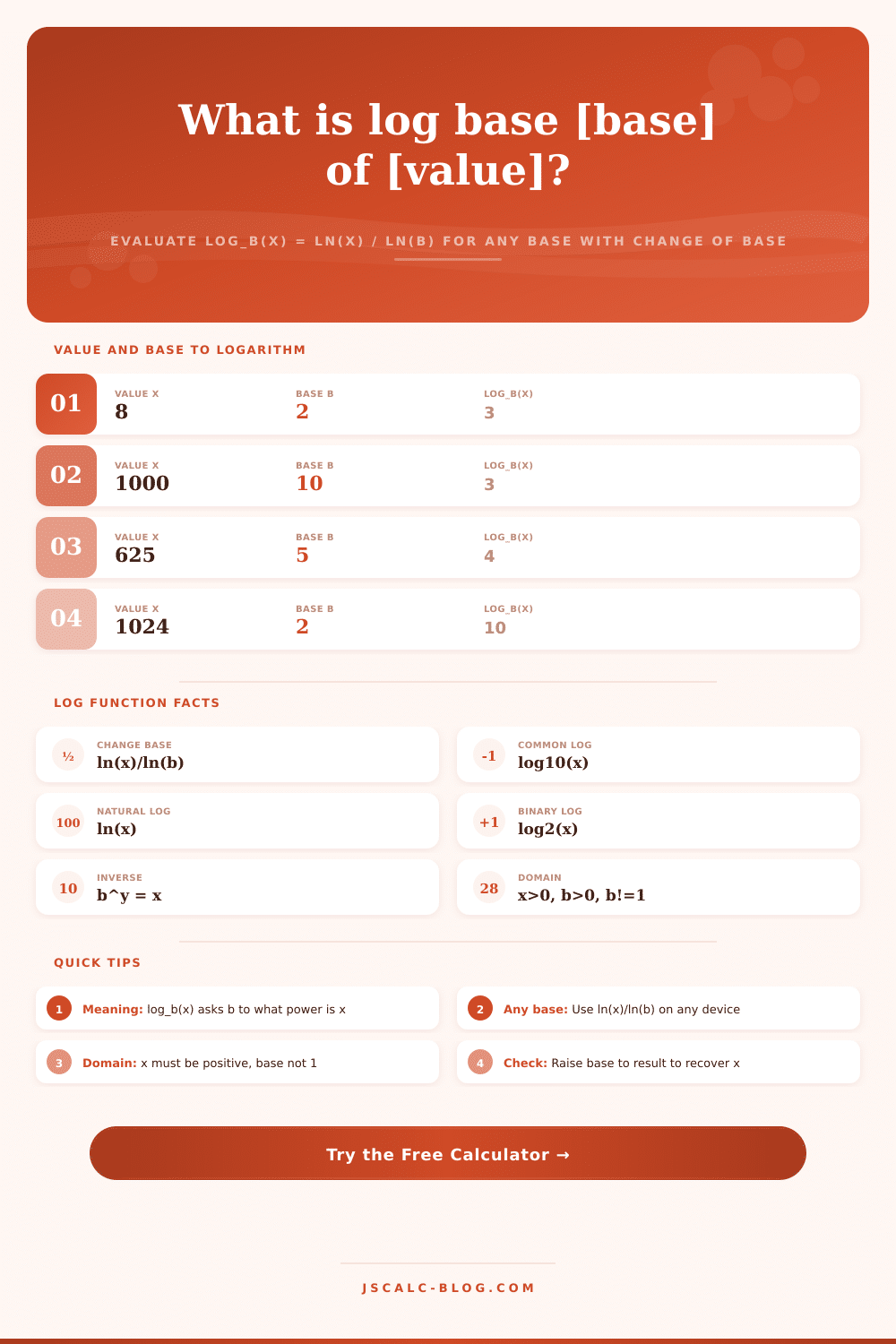
Evaluate the logarithm of any value x to any base b using the change-of-base formula log_b(x) = ln(x) / ln(b). Get quick common log (base 10), natural log (base e), and binary log (base 2) modes, see the natural and common logs side by side, and verify every answer with the inverse check b to the power of the result equals x.
🔢Choose a Mode
🎯Real Logarithm Presets
📝Logarithm Inputs
The number you take the logarithm of. Must be greater than 0.
Pick a common base or choose Custom to type your own.
The base of the logarithm. Must be positive and not equal to 1.
Inverse mode: given y = log_b(x), the tool finds x = b^y.
Controls rounding on every result card and breakdown.
How large or tiny results are shown on the cards.
🔢Formula Snapshot
📋Common Logs of Powers of Ten
| Value x | As Power of 10 | log10(x) | Reads As |
|---|---|---|---|
| 0.001 | 10 to the -3 | -3 | Negative three |
| 0.01 | 10 to the -2 | -2 | Negative two |
| 0.1 | 10 to the -1 | -1 | Negative one |
| 1 | 10 to the 0 | 0 | Zero |
| 10 | 10 to the 1 | 1 | One |
| 100 | 10 to the 2 | 2 | Two |
| 1000 | 10 to the 3 | 3 | Three |
| 1000000 | 10 to the 6 | 6 | Six |
📊Binary Logs of Powers of Two
| Value x | As Power of 2 | log2(x) | Common Use |
|---|---|---|---|
| 1 | 2 to the 0 | 0 | One bit state |
| 2 | 2 to the 1 | 1 | 1 bit |
| 4 | 2 to the 2 | 2 | 2 bits |
| 8 | 2 to the 3 | 3 | 3 bits |
| 16 | 2 to the 4 | 4 | 1 nibble |
| 256 | 2 to the 8 | 8 | 1 byte |
| 1024 | 2 to the 10 | 10 | 1 kibi |
| 65536 | 2 to the 16 | 16 | 16-bit range |
🧬Natural Logs of e Powers
| Value x | As Power of e | ln(x) | Approx x |
|---|---|---|---|
| 1 / e | e to the -1 | -1 | 0.3679 |
| 1 | e to the 0 | 0 | 1.0000 |
| e | e to the 1 | 1 | 2.7183 |
| e squared | e to the 2 | 2 | 7.3891 |
| e cubed | e to the 3 | 3 | 20.086 |
| 10 | e to the 2.3026 | 2.3026 | 10.000 |
| 2 | e to the 0.6931 | 0.6931 | 2.0000 |
| 0.5 | e to the -0.6931 | -0.6931 | 0.5000 |
🗃Logarithm Comparison Grid
| Value x | log2(x) | ln(x) | log10(x) | log5(x) | log_b Formula |
|---|---|---|---|---|---|
| 1 | 0 | 0 | 0 | 0 | ln(x)/ln(b) |
| 2 | 1 | 0.6931 | 0.3010 | 0.4307 | ln(2)/ln(b) |
| 5 | 2.3219 | 1.6094 | 0.6990 | 1 | ln(5)/ln(b) |
| 8 | 3 | 2.0794 | 0.9031 | 1.2920 | ln(8)/ln(b) |
| 10 | 3.3219 | 2.3026 | 1 | 1.4307 | ln(10)/ln(b) |
| 25 | 4.6439 | 3.2189 | 1.3979 | 2 | ln(25)/ln(b) |
| 100 | 6.6439 | 4.6052 | 2 | 2.8614 | ln(100)/ln(b) |
| 1000 | 9.9658 | 6.9078 | 3 | 4.2920 | ln(1000)/ln(b) |
| 1024 | 10 | 6.9315 | 3.0103 | 4.3068 | ln(1024)/ln(b) |
📏Logarithm Identities
| Identity | Rule | Example | Result |
|---|---|---|---|
| Product | log(xy) = log x + log y | log2(4 x 8) | 2 + 3 = 5 |
| Quotient | log(x/y) = log x - log y | log2(16 / 2) | 4 - 1 = 3 |
| Power | log(x^n) = n log x | log2(8^2) | 2 x 3 = 6 |
| Change base | log_b x = ln x / ln b | log2(8) | 2.079/0.693 = 3 |
| Log of 1 | log_b(1) = 0 | log10(1) | 0 |
| Log of base | log_b(b) = 1 | log5(5) | 1 |
| Inverse | b^(log_b x) = x | 2^(log2 8) | 8 |
⚙How the Calculation Works
💡Logarithm Tips
Logarithms is one of those nasty bits of algebra from high school that make you think, “Ugh, why does everything need to be so dense and abstract?” However, if you consider what a logarithm is doing then suddenley it makes sense. A logarithm are answering a particular question involving powers. Log base 2 of 8 means (what power must 2 be raised to), to yield 8? Once stated like that, there’s no mystery left.
This page’s calculator will do the math for you, instead of having to try to work out exponents in your head while simultaneously solving for x. But it’s the fact that they can shrinks enormous ranges down to values we can manage that makes logs so valuable. Logarithms aren’t just for earthquake; they’re used for sound volume, pH (acidity), and more because actual value is either far too large or far too small to be meaningful. Even if you don’t measure things like earthquakes on the Richter scale, you need ’em.
How to Use the Logarithm Calculator
Base 2 runs computer science. Each cut of a dataset in half by binary search depends on its logarithmic depth. Your cell-phone calculator may offer just base 10 or natural log, but tool has handy shortcuts so you can jump back and forth between common bases with a tap. Then you can do anything else you want to do with change of base. Except push buttons, which would of taken time and risk error.
And so we come to the change-of-base formula: the engine under the hood. Log base b of x equals ln(x) divided by ln(b). That’s all: a simple ratio. But it is a powerful one. Because with it, you can calculate any logarithm, you just need natural logs. And sure enough, one of the result cards include the explicit division: ln(8) over ln(2), landing squarely on 3. It is not magic after all; it is simply arithmetic that you didn’t have to perform manually.
It is helpful for understanding when it matters what base you use and it is helpful if you are verifying your own calculations. It makes the abstract formula concrete. This brings me to another observation about the tool: you don’t simply recieve one number. Instead, it gives you an inverse check: if you raise the result to power of the original base, do you get your starting value back? That’s an important discipline to develop when using exponents. For example, if log base 3 of 27 = 3, then 3 cubed should equal 27. The calculator check that for you automatically. It’s a minor detail, but it instills confidence in the answer. There’s no need to question whether you mistakenly read a decimal point or switched the order of your inputs. The check catches them beforehand so that they can’t ruin any later calculations.
Logarithms has a limit. It is a hard limit. And the tool respect that limit. In the real number system, there’s no such thing as taking the log of zero or a negative number. No matter how high you raise a positive number to the power, you won’t get a negative result. And the calculator doesn’t give you garbage data: it flags it immediately. This helps prevent one of the most common errors students make. If you’re trying to force a log where there isn’t one, it likely mean that you don’t understand the relationship being expressed based off multiplication and addition. By respecting the domain, you keep your math honest.
The reference tables they added to the page provide more than just calculations; they are useful charts for quickly seeing things like how many bits a kibibyte contains. Memorize these patterns: powers of ten line up with their common logs, while values like 1024 lines up with their binary logs. You’ll see them everywhere in tech, so get used to seeing them. With the knowledge that 1024 has a log base 2 of 10, you know off the top of your head the bit-depth of a kilobyte without picking up a device. Raw data becomes intuitive.
So how does this work? Think of this calculator as a verification partner: plug in some numbers, observe how the change-of-base formula breaks down the problem and make sure the inverse check works out. It doesn’t matter if you’re solving a homework assignment or attempting to debug an algorithm, you’ll learn more by knowing why the answer is what it is instead of simply having the answer. Logarithms are about perspective and scale. When you get there, math stop being a chore and begins to look like a map.