Negative Exponent Calculator
Enter a base and a negative exponent and this tool rewrites a^(-n) as its reciprocal 1/a^n, evaluates it, and reports the answer as an exact reduced fraction and a decimal. It handles integer, fraction, and decimal bases, flips fraction bases with (a/b)^(-n) = (b/a)^n, and walks through every flip-and-make-positive step.
🎯Real Negative Exponent Presets
📝Base and Negative Exponent
Choose how you want to type the base value.
Enter n; the tool applies the minus, giving a^(-n).
A whole number such as 2, 10, or -3.
Top of the fraction base, for example 3 in 3/4.
Bottom of the fraction base, for example 4 in 3/4.
A decimal such as 0.5, 0.25, or 1.25.
Both forms always appear; this sets the status wording.
Controls rounding of the decimal result.
Toggles the breakdown panel inside the results.
🔢Rule Snapshot
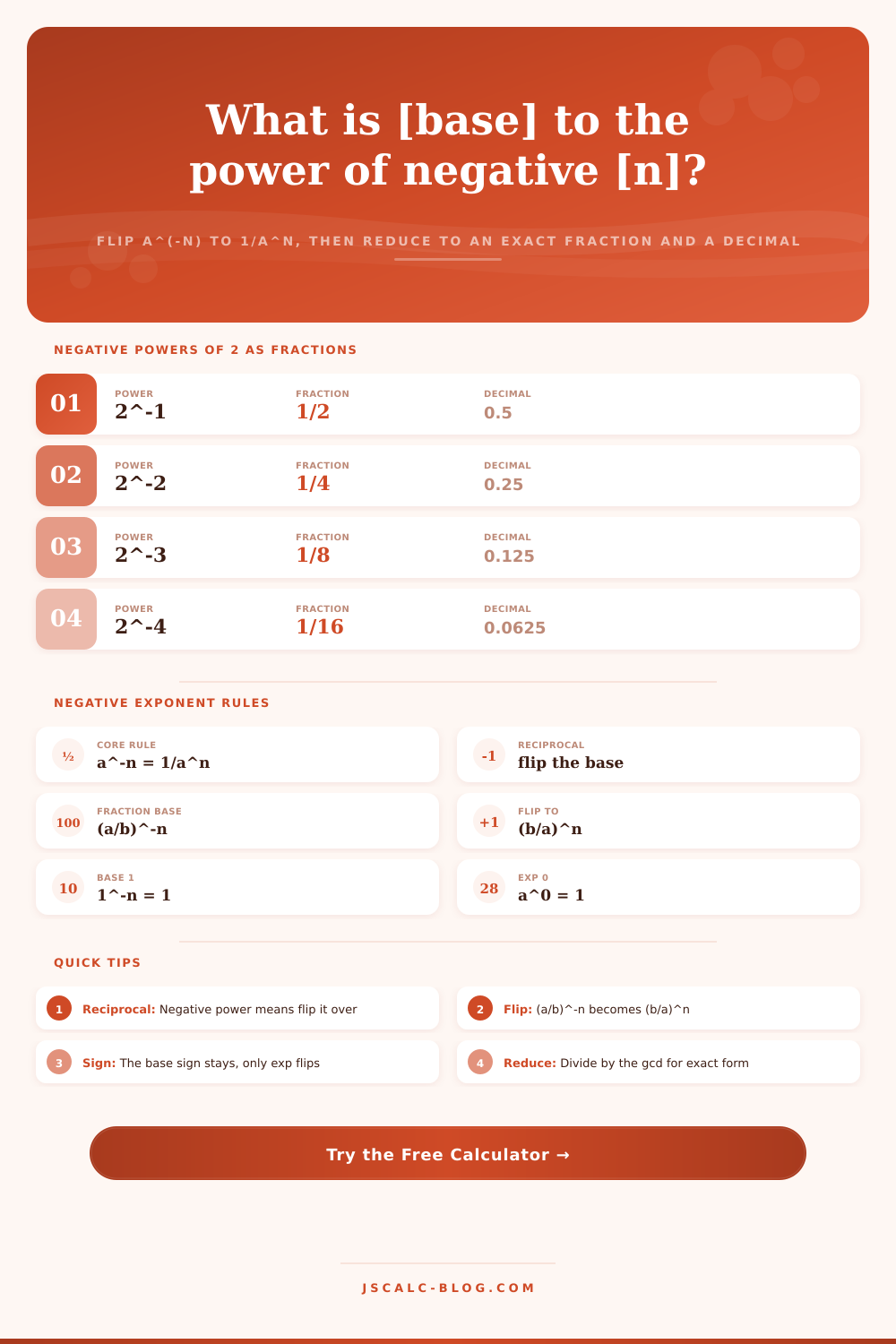
📋Negative Powers of 2
| Expression | Reciprocal Form | Exact Fraction | Decimal |
|---|---|---|---|
| 2^-1 | 1 / 2^1 | 1/2 | 0.5 |
| 2^-2 | 1 / 2^2 | 1/4 | 0.25 |
| 2^-3 | 1 / 2^3 | 1/8 | 0.125 |
| 2^-4 | 1 / 2^4 | 1/16 | 0.0625 |
| 2^-5 | 1 / 2^5 | 1/32 | 0.03125 |
| 2^-6 | 1 / 2^6 | 1/64 | 0.015625 |
| 2^-8 | 1 / 2^8 | 1/256 | 0.00390625 |
| 2^-10 | 1 / 2^10 | 1/1024 | 0.000976563 |
📊Negative Powers of 10 and Scientific Notation
| Expression | Exact Fraction | Decimal | Scientific |
|---|---|---|---|
| 10^-1 | 1/10 | 0.1 | 1 x 10^-1 |
| 10^-2 | 1/100 | 0.01 | 1 x 10^-2 |
| 10^-3 | 1/1000 | 0.001 | 1 x 10^-3 |
| 10^-4 | 1/10000 | 0.0001 | 1 x 10^-4 |
| 10^-5 | 1/100000 | 0.00001 | 1 x 10^-5 |
| 10^-6 | 1/1000000 | 0.000001 | 1 x 10^-6 |
| 10^-9 | 1/1e9 | 0.000000001 | 1 x 10^-9 |
🔄Fraction Base Flip Examples
| Start | Flip the Base | Exact Fraction | Decimal |
|---|---|---|---|
| (1/2)^-1 | (2/1)^1 | 2/1 | 2 |
| (1/2)^-3 | (2/1)^3 | 8/1 | 8 |
| (2/3)^-2 | (3/2)^2 | 9/4 | 2.25 |
| (3/4)^-2 | (4/3)^2 | 16/9 | 1.777778 |
| (3/5)^-1 | (5/3)^1 | 5/3 | 1.666667 |
| (5/2)^-2 | (2/5)^2 | 4/25 | 0.16 |
| (2/3)^-3 | (3/2)^3 | 27/8 | 3.375 |
🗃Base and Exponent Comparison Grid
| Base a | Exponent | Reciprocal 1/a^n | a^n | Exact Fraction | Decimal |
|---|---|---|---|---|---|
| 2 | -1 | 1 / 2^1 | 2 | 1/2 | 0.5 |
| 2 | -4 | 1 / 2^4 | 16 | 1/16 | 0.0625 |
| 3 | -2 | 1 / 3^2 | 9 | 1/9 | 0.111111 |
| 4 | -2 | 1 / 4^2 | 16 | 1/16 | 0.0625 |
| 5 | -3 | 1 / 5^3 | 125 | 1/125 | 0.008 |
| -2 | -3 | 1 / (-2)^3 | -8 | -1/8 | -0.125 |
| 10 | -2 | 1 / 10^2 | 100 | 1/100 | 0.01 |
| 6 | -2 | 1 / 6^2 | 36 | 1/36 | 0.027778 |
| 7 | -1 | 1 / 7^1 | 7 | 1/7 | 0.142857 |
📑Negative Exponent Identities
| Identity | Meaning | Example |
|---|---|---|
| a^-n = 1/a^n | Move to denominator | 2^-3 = 1/8 |
| a^-1 = 1/a | Plain reciprocal | 5^-1 = 1/5 |
| (a/b)^-n = (b/a)^n | Flip the fraction | (3/4)^-2 = 16/9 |
| 1^-n = 1 | One to any power | 1^-9 = 1 |
| (-1)^-n | Sign toggles by n | (-1)^-3 = -1 |
| a^0 = 1 | Zero exponent rule | 7^0 = 1 |
| a^-n = 1 / a^n | Base sign preserved | (-2)^-2 = 1/4 |
⚙How the Flip Works
💡Negative Exponent Tips
The task of a negative exponent is simple: Take the reciprocal. That’s all this calculator does. Type in your number and negative exponent and it rewrites expression, putting a 1 over the base raised to positive version of exponent. Then it computes the resulting value and shows it as decimal and also as an exact reduced fraction. It only attempts to turn negative exponents into fractions with positive exponents. Each step is straightforward and easy to understand. Every solution are crystal-clear.
It isn’t a general symbolic engine, just what you need. And here’s the defining rule: To raise a base to the power of minus n is equal to one divided by raising that same base to the power of n. Note that the minus sign doesn’t mean you should of get a negative answer. The minus sign means something different. Flip this term upside-down by moving it from top of a fraction to the bottom, and change its exponent to its positive version. Evaluate what’s left when the exponent has become positive as usual. Hence, two to the negative third power isn’t negative eight; it’s one over eight, or one over two cubed. Only if there’s a negative base do you get a negative answer, not just from negative exponent alone.
How Negative Exponents Work
Other online calculators gives you a decimal that goes on forever. That’s all well and good if you just want to know what the number comes out to, but not very helpful if your working through a math problem at school. The correct answer to this, three to the negative second power, isn’t zero-point-one-one-one repeating; it’s the tidy fraction one-ninth. This calculator does that fraction instantly.
It raises the base to positive exponent using whole-number multiplication to form a fraction. It turns it into a fraction. Then, it uses a greatest common divisor helper to reduce it to its simplest form, where top and bottom numbers have no factors in common. And there you go: your answer in lowest terms, with the decimal version displayed right next to it for comparison.
Not all real-world problems begin with a neat whole number, though, so the calculator support three types of bases. The most familiar examples are classic integers (two, ten), or even negative ones (negative two). Then there’s the fraction type, for inputs including separate numerator and denominator fields. This is where the flip rule realy comes into play. First, the calculator converts any decimal-based base choice, say, zero-point-five, into a precise fraction behind the scenes. It also calculates that power, resulting in exactly four rather than a rounded approximation. Switching between base types merely alters the layout on screen to best suit whatever sort of problem you have in mind.
Here is the handy trick with fractional bases: to raise a fraction (or any base) to a negative exponent, simply invert it (swap the top and bottom numbers), remove the minus sign, then raise the whole thing to same value as original power. So three-fourths to the negative second power becomes four-thirds squared, or 16/9. The calculator shows that inverted version of problem directly on the result card. This makes the trick second nature and eliminates the clumsy-looking stacked fractions you get if you try to use the reciprocal rule before inverting.
It prints out four cards each time it runs through a calculation. The first is the exact reduced fraction, which is the main answer on most math homework. The second is decimal answer, with as many digits to the right of the decimal point as you choose to show. The third is the equivalent version with only positive exponents; this middle step shows how negative exponent disappeared. The fourth card contain the flipped version, which is kept in case we ever need it with fraction bases. An optional step-by-step panel appear beneath the cards. This panel contains the rewrite, the evaluation, the reduction, and finally the decimal version of the division. Copy the reasoning onto your own paper if you like.
Certain bases have certain behaviors. One raised to any power will always equal one. That’s a one base. Negative one raised to an even power equals one; to an odd power it equals negative one. It just toggles back and forth. If you raise a negative base to a power, the sign remains with the base throughout the computation. For example, negative two to the negative third power equals negative one-eighth. Negative two to the negative third is one over negative two cubed, which is negative eight.
Zero is the only base that’s off limits. You can’t divide by zero, so raising zero to a negative power would of be impossible. Scientific notation, unit prefixes, half-life formulas, they all involve negative exponents. The error students most frequently make is to treat the negative like it’s part of the base. They end up getting the incorrect negative result. This calculator saves you the arithmetic. It also shows the reciprocal step clearly, where exact fraction is shown and reduced automatically to build the correct habit.
Choose a preset, toggle to the base type of your problem, and look confidently at both the decimal and the fraction. Take the reciprocal.