Exponent Rule Calculator
Pick a law of exponents, enter a base and its powers, and see the simplified symbolic form together with the exponent arithmetic. Covers the product, quotient, power of a power, power of a product, power of a quotient, zero, negative, and fractional rules, and gives a numeric value whenever the base is a concrete number.
🎯Real Exponent Rule Presets
📝Rule and Operands
The inputs below change to match the rule you choose.
Use a letter for a symbolic answer, or a number to also get a value.
Only used by the product and quotient power rules.
First power. In (a^m)^n this is the inner exponent.
Second power. In (a^m)^n this is the outer exponent.
Controls how the numeric value is displayed.
Uncheck to keep the answer purely symbolic.
🔢Rule Cheat Sheet
📋The Eight Laws of Exponents
| Law | General Form | Example | Simplifies To |
|---|---|---|---|
| Product rule | a^m · a^n = a^(m+n) | x^3 · x^4 | x^7 |
| Quotient rule | a^m / a^n = a^(m-n) | 2^7 / 2^3 | 2^4 = 16 |
| Power of a power | (a^m)^n = a^(mn) | (x^2)^5 | x^10 |
| Power of a product | (ab)^n = a^n b^n | (xy)^3 | x^3 y^3 |
| Power of a quotient | (a/b)^n = a^n / b^n | (x/y)^4 | x^4 / y^4 |
| Zero exponent | a^0 = 1 | 9^0 | 1 |
| Negative exponent | a^-n = 1 / a^n | x^-3 | 1 / x^3 |
| Fractional exponent | a^(m/n) = nth root of a^m | 8^(2/3) | cube root of 8^2 = 4 |
📊Powers of 2, 3, 5, and 10
| Exponent | 2^n | 3^n | 5^n | 10^n |
|---|---|---|---|---|
| 0 | 1 | 1 | 1 | 1 |
| 1 | 2 | 3 | 5 | 10 |
| 2 | 4 | 9 | 25 | 100 |
| 3 | 8 | 27 | 125 | 1000 |
| 4 | 16 | 81 | 625 | 10000 |
| 5 | 32 | 243 | 3125 | 100000 |
| 6 | 64 | 729 | 15625 | 1000000 |
| 7 | 128 | 2187 | 78125 | 10000000 |
√Fractional Exponents to Roots
| Fractional Form | Root Meaning | Example | Value |
|---|---|---|---|
| a^(1/2) | square root of a | 9^(1/2) | 3 |
| a^(1/3) | cube root of a | 27^(1/3) | 3 |
| a^(1/4) | fourth root of a | 16^(1/4) | 2 |
| a^(2/3) | cube root of a squared | 8^(2/3) | 4 |
| a^(3/2) | square root of a cubed | 4^(3/2) | 8 |
| a^(1/5) | fifth root of a | 32^(1/5) | 2 |
| a^(5/2) | square root of a to fifth | 4^(5/2) | 32 |
| a^(-1/2) | 1 over square root of a | 25^(-1/2) | 0.2 |
⚠Common Exponent Mistakes
| Situation | Wrong | Correct | Reason |
|---|---|---|---|
| x^3 · x^4 | x^12 | x^7 | Multiply base, ADD powers |
| (x^2)^5 | x^7 | x^10 | Power of power MULTIPLIES |
| x^5 / x^2 | x^(5/2) | x^3 | Divide base, SUBTRACT powers |
| 5^0 | 0 | 1 | Any nonzero base to 0 is 1 |
| x^-2 | -x^2 | 1 / x^2 | Negative means reciprocal |
| (x + y)^2 | x^2 + y^2 | x^2 + 2xy + y^2 | A sum is not a product |
| 3x^2 | (3x)^2 | 3 · x^2 | Power binds to x only here |
🗃Rule Comparison Grid
| Rule Name | Formula | Operation on Powers | Example | Result | When to Use |
|---|---|---|---|---|---|
| Product | a^m · a^n | add m + n | x^3 · x^4 | x^7 | Multiplying same base |
| Quotient | a^m / a^n | subtract m - n | 2^7 / 2^3 | 2^4 | Dividing same base |
| Power of power | (a^m)^n | multiply m × n | (x^2)^5 | x^10 | Exponent on an exponent |
| Power of product | (ab)^n | distribute n | (xy)^3 | x^3 y^3 | Power over a product |
| Power of quotient | (a/b)^n | distribute n | (x/y)^4 | x^4 / y^4 | Power over a fraction |
| Zero | a^0 | collapses to 1 | 9^0 | 1 | Any nonzero base to 0 |
| Negative | a^-n | flip and negate | x^-3 | 1 / x^3 | Moving factors across bar |
| Fractional | a^(m/n) | root and power | 8^(2/3) | 4 | Radicals as exponents |
⚙How the Rules Work
💡Exponent Rule Tips
Exponents get concrete when you realize they are just shorthand for repeated multiplication, which is essentially its own kind of notation. But like all notations, they has their own set of grammatical rules, with some exceptions made along the way. For example, you might know how to solve nine = 3 x 3, but then you’re thrown for a loop multiplying $x^3$ times $x^4$. Because multiplication tends to increase numbers, you’d expect result to be 12. But rules of exponents aren’t quite so straightforward.
This tool deals with one of those pinch points in understanding: it applies the exponent rules symbolically, meaning not only will you recieve the solution (e.g., 12), but also see how the arithmetic work out changing from an exponent. That’s what transforms a calculator into something more than a calculator.
How to Learn Exponent Rules Easily
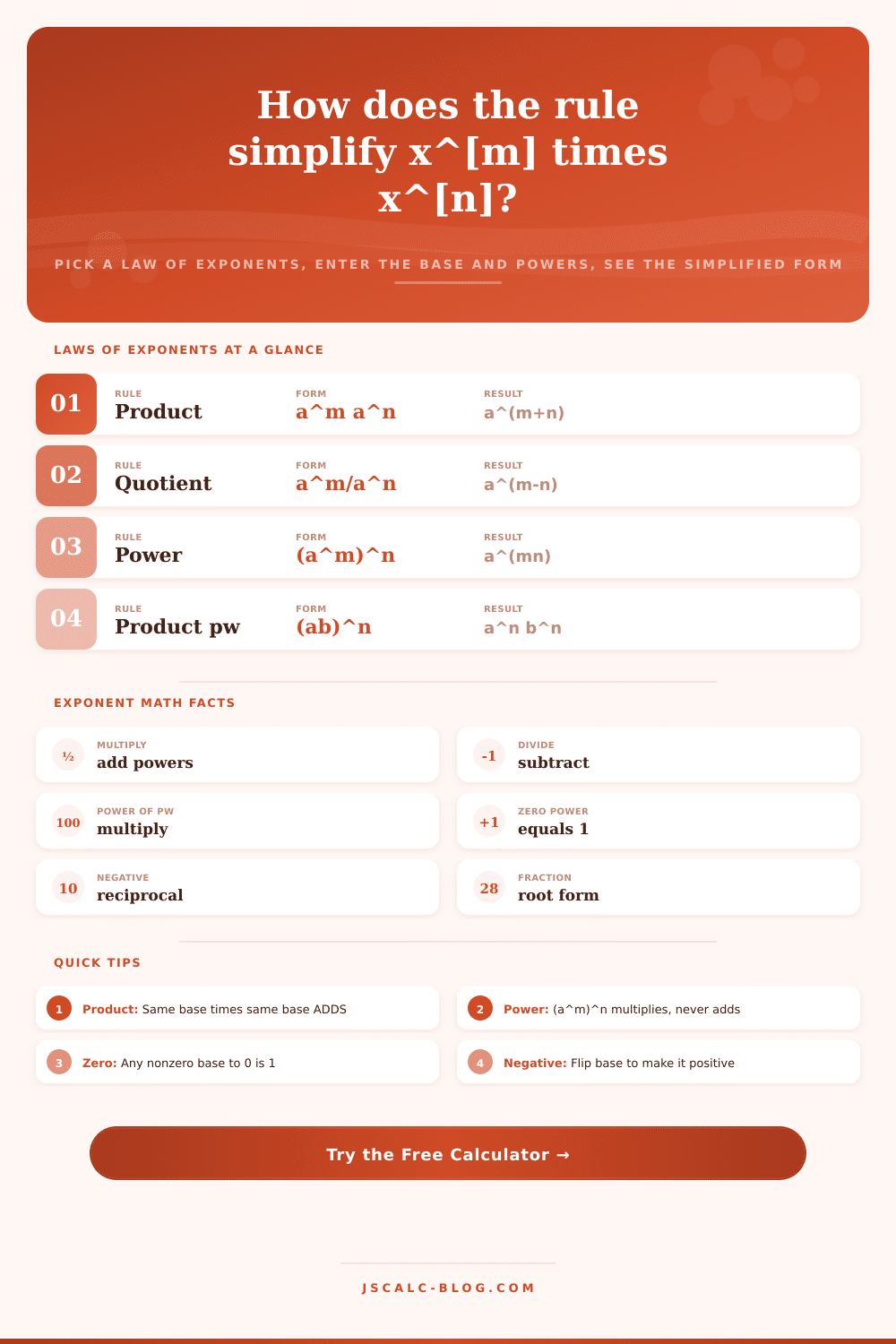
These work according to eight basic rules, each stemming from stacking and canceling of factors. Multiplying powers with same base involves counting total factors, that’s what you’re doing when you multiply three $x$’s by four $x$’s: you have seven $x$’s. Hence, product rule adds exponents. Likewise, the quotient rule operates in reverse, and again this makes sense if you think about dividing. You remove common factors when you divide. So the difference between top and bottom is exactly the number you have remaining.
These two rules form the base. Once you know those, the rest of it slot into place. In fact most of the confusion arises because we now have an exponent atop another exponent. This is power of a power rule. Here, exponents multiply. There’s the trap. Because we’re thinking about combining things, people want to add, but in this case you’re doing a process twice (or as many times as there are layers). Doing something five times doesn’t mean adding five and two. It means stacking.
To that end, I built the calculator above so it will let you select which law you’re applying and then plug in the values to match. You can’t choose until you’ve determined what kind of problem you have: are you multiplying terms with same base? Add! Do you have an exponent within another exponent? Multiply! By doing this, calculator changes how many input boxes appear to make sure that you’re not attempting to fit a square peg in a round hole.
If you choose the power of a product rule, for example, it asks you for two bases because you’re going to have to distribute the outer exponent across all the factors contained within parentheses. It’s a tiny bit of design, but it helps build intuition.
The exponents in zero and negative form seem like random things your teacher wants you to memorize when all along there was a pattern that makes total sense. Any nonzero base to the zero power is one. Why? Because if you divide something by itself, then you get one and exponent parts cancel each other out. That’s not magic. It’s a sanity check. To take any term and put a negative exponent on it simply flips it across the numerator/denominator line. You can see how the calculator did that: $1/x^3$. No more weird minus sign stuck onto the base!
Fractional exponents are the link between roots and powers. If denominator is 2, then that’s a square root. If denominator is 3, then that’s a cube root. And numerator indicates what power to raise it to. It’s a shorthand way of writing out a radical expression.
The errors here aren’t usually arithmetical, but classificatory: students attempt to use the product rule when their terms has different bases, or attempt to distribute across a sum rather than a product. $(x + y)^2$ doesn’t equal $x^2 + y^2$. It’s not how distribution works! On the page itself, the reference tables contrast wrong solutions with right solutions and explain why. This visually supports the solution and allows you to rewire your mental model: you don’t just learn formulas, you see what makes one answer right and another wrong.
When you see a nested exponent, you are repeating a process, so you see the nested exponent and think, multiply. If you see multiplication of like terms with same base, you think, add. This moves us beyond just memorizing into seeing how things are built. Exponents are the basis of change in algebra, calculus, and science. Whether it’s population growth models, or simplifying polynomials, getting exponents correct is not negotiable. An error in exponent results in a massive difference different than the expected outcome. The tool allows you to check each step before such a difference occurs.
Depending on whether you are doing homework or solving a real-world problem, you have the flexibility to enter a number for a value or a letter for a symbolic result. It’s all about building confidence in the mechanics so you could of focused on the bigger mathematical picture. Try your own expressions, and start with the presets to see the rules in action. As you use the tool, laws of exponents stop being a list to memorize and turn into a set of tools you can see working in real time.