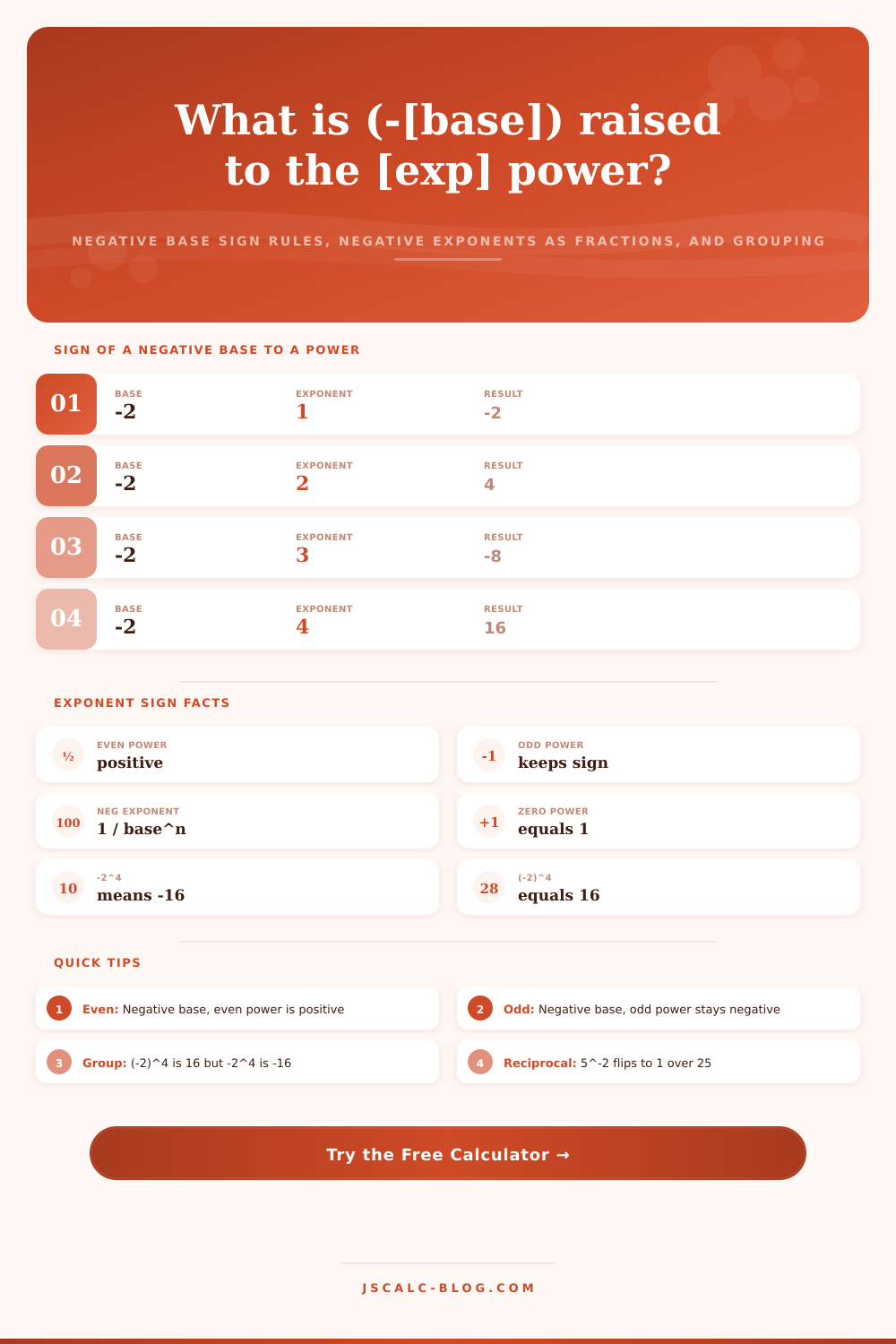
Exponent Calculator With Negatives
Evaluate a base raised to a power when either value can be negative. See why a negative base with an even exponent turns positive and an odd exponent stays negative, how a negative exponent becomes the reciprocal one over base to the power, and exactly how the grouping in (-2)^4 differs from -2^4 under the order of operations.
🎯Sign Rule Presets
📝Base and Exponent Inputs
The number being raised to a power, such as -2 or 5.
The power, such as 4, -2, or 0.5 for a root.
Chooses between (-2)^4 = 16 and -2^4 = -16.
Controls rounding on the decimal result card.
Auto-detected: even, odd, negative, zero, or fractional.
Fraction form appears for negative integer exponents.
Standard power functions return NaN for these roots.
Very large or tiny results switch to scientific form.
🔢Rule Snapshot
📋Sign of (-a) to the nth Power
| Exponent n | Parity | Sign of (-a)^n | Example (-2)^n |
|---|---|---|---|
| 1 | Odd | Negative | -2 |
| 2 | Even | Positive | 4 |
| 3 | Odd | Negative | -8 |
| 4 | Even | Positive | 16 |
| 5 | Odd | Negative | -32 |
| 6 | Even | Positive | 64 |
| 7 | Odd | Negative | -128 |
| 8 | Even | Positive | 256 |
🔄Negative Exponent to Fraction
| Expression | Reciprocal Step | Fraction | Decimal |
|---|---|---|---|
| 2^-1 | 1 / 2^1 | 1/2 | 0.5 |
| 2^-3 | 1 / 2^3 | 1/8 | 0.125 |
| 5^-2 | 1 / 5^2 | 1/25 | 0.04 |
| 10^-3 | 1 / 10^3 | 1/1000 | 0.001 |
| (-2)^-2 | 1 / (-2)^2 | 1/4 | 0.25 |
| (-2)^-3 | 1 / (-2)^3 | -1/8 | -0.125 |
| (-3)^-2 | 1 / (-3)^2 | 1/9 | 0.1111 |
| (-5)^-3 | 1 / (-5)^3 | -1/125 | -0.008 |
⚖Grouping: (-a)^n vs -a^n
| Base a | Exp n | (-a)^n | -a^n | Same Sign? |
|---|---|---|---|---|
| 2 | 2 | 4 | -4 | No |
| 2 | 3 | -8 | -8 | Yes |
| 2 | 4 | 16 | -16 | No |
| 3 | 2 | 9 | -9 | No |
| 3 | 3 | -27 | -27 | Yes |
| 5 | 2 | 25 | -25 | No |
| 10 | 4 | 10000 | -10000 | No |
| 4 | 3 | -64 | -64 | Yes |
📊Negative Power Comparison Grid
| Base | n = -1 | n = -2 | n = -3 | n = -4 | Pattern |
|---|---|---|---|---|---|
| -2 | -1/2 | 1/4 | -1/8 | 1/16 | Sign alternates |
| -3 | -1/3 | 1/9 | -1/27 | 1/81 | Sign alternates |
| -5 | -1/5 | 1/25 | -1/125 | 1/625 | Sign alternates |
| -10 | -1/10 | 1/100 | -1/1000 | 1/10000 | Sign alternates |
| 2 | 1/2 | 1/4 | 1/8 | 1/16 | Always positive |
| 3 | 1/3 | 1/9 | 1/27 | 1/81 | Always positive |
| 5 | 1/5 | 1/25 | 1/125 | 1/625 | Always positive |
| 10 | 1/10 | 1/100 | 1/1000 | 1/10000 | Always positive |
⚙How the Evaluation Works
💡Common Sign Mistakes
The negative exponent calculator with negatives is like two calculators in one, both what number is the expression equal to, but also why is it carrying that particular sign? The latter is where we frequently get tripped up as both learners and educators and that’s what this calculator concentrates on. It takes your possibly less than zero base along with your maybe fractional exponent or negative exponent and spits back out not only numeric result but also why the sign came out how it did. This includes the reciprocal rule and whether negative signs are grouped inside or outside powers.
Outside powers) Exponent” simply refers to raising a number to some power, which in turn just means you multiply that number times itself (repeatedly). Each time you multiply with a negative base however, the result change from negative to positive. So two negatives will produce a positive when multiplied together because pairs of factor cancel out to a plus. It’s this fact that powers even/odd rule: Because an even exponent has an equal number of negative factors that all pair up, it cancels them all out and gives a positive answer. An odd exponent doesn’t have any pairing to cancel out the negatives, leaving one leftover unpaired negative factor to make the entire thing come out as negative. For instance, (-2) to the third = -8, and (-2) to the fifth = -32.
How Negative Exponents Work
It’s not a negative number. It’s a direction to find the reciprocal. Here’s the definition: A negative exponent means you take the reciprocal of the number raised to its positive power. For example 5 to the power minus 2 is 1 over 5 squared, which is 1 over 25. 04 in decimal form. Compare them side by side and accept both as true.
The most common exponent mistake in the world is not really about arithmetic at all; it’s about the order of operations. It’s about the order of operations; exponents bind more tightly than a preceding minus sign. So if you type -2^4 into your calculator, you don’t mean the negative of 2 to the fourth power (which would be -(2 times 2 times 2 times 2)), you mean the negative of 2 to the fourth power, so you get a result of -16. To indicate that minus sign belongs to the base, you have to use parentheses: only when you type (-2)^4 do you get a positive 16. The two expressions look similar enough to cause confusion, but their results are on opposite sides of zero.
Every grouping table has a listing of -a to the n, which I’ve included beside to the n as well, so there’s no surprise about the difference in contrast; also this calculator show you both interpretations on their own dedicated result card, with an explicit grouping selector where you can compare them.
Sometimes, when we combine fractional exponents with negative bases, there’s no real answer at all. When you raise something to the power of one half, what do you get? You get a square root. When you raise something to the power of one third, you get a cube root. Odd roots of negative numbers are found in the real numbers because it turns out that a negative number does have a real cube root. For example, the cube root of -8 is -2, since -2 times -2 times -2 gives you -8. On the other hand, even roots of negative numbers don’t exist in the world of the reals, since no real number will be squared to give you a negative answer, so (-4) to the power one half remains undefined here.
Instead of returning a meaningless error code like standard programming power functions do, it recognize that there is an odd real root and gives you back the proper negative result. It also flags even roots of negatives as undefined, which avoids giving you a wrong answer in silence.
There are four cards for each evaluation. One is the actual number. We round this to however many decimal places you want, and if it gets really large or really close to zero, we change it to scientific notation. Second is the sign explanation, i.e., what rule was used? This asks whether the minus sign is outside the power or follows the odd/even rule. The third card is the reciprocal as a tidy one over a whole number when the exponent is a negative integer, i.e., when the fraction form is in play. Fourth, comparing the two groupings side by side ensures you always notice the difference between (-a) to the n and -a to the n.
Below the cards, there is a step-by-step breakdown. It turns the negative exponent into a reciprocal, checks the sign of the base, calculates the power, and then checks if it is valid in the real domain. Among other things, it has preset buttons that load the cases people are most likely looking up. For example, -8 is equal to (-2) cubed, and -16 is equal to (-2) to the fourth. Also, 16 is equal to (-2) to the fourth, which is why they’re set to be different. Other examples include 1 over 25 being equal to 5 to the minus 2, and 1 over 9 being equal to the alternating (-3) to the minus 2. Finally, -2 is equal to the real cubed root of (-8) to the one third, and there’s even the undefined even root of (-4) to the one half.
You can enter your own number into any field and see calculations fill in all the blanks immediately. You can watch the sign flip when you go from an odd to an even exponent. You can also see it change from an ungrouped to a grouped base. It makes an instant check on whether a spreadsheet formula means what you think it does. It helps teach the even and odd rule of exponents. It also checks homework.
Whatever its use, this negative exponent calculator keeps the sign logic honest, and the fractions exact.