Car Property Tax Calculator
Estimate the annual personal-property tax on a vehicle from its market value, the local assessment ratio, and a millage or percent tax rate. See the monthly cost, the effective rate as a share of market value, and a multi-year projection as the car depreciates. Rules differ widely by state and county, so treat every figure as a planning estimate.
🚕Choose a Mode
🎯Real Vehicle Presets
📝Vehicle and Tax Inputs
Current fair market or book value of the car.
Share of value that is taxed. Use 100 to tax full value.
1 mill = $1 per $1,000 = 0.1 percent.
Enter mills (e.g. 25) or a percent to match the unit above.
0 for a new car. Used to label the projection years.
Percent the market value drops each year in the projection.
How many future years of tax to total up.
Optional floor. If tax is below this, the fee is charged.
Pick the direction for the millage converter.
Enter mills or percent to match the direction above.
Shows the dollar tax that rate produces on this value.
Controls rounding on the dollar result cards.
🔢Formula Snapshot
🔄Mills to Percent Conversions
| Millage | Percent | Decimal | Tax per $10,000 assessed |
|---|---|---|---|
| 5 mills | 0.5% | 0.005 | $50 |
| 10 mills | 1.0% | 0.010 | $100 |
| 15 mills | 1.5% | 0.015 | $150 |
| 20 mills | 2.0% | 0.020 | $200 |
| 25 mills | 2.5% | 0.025 | $250 |
| 40 mills | 4.0% | 0.040 | $400 |
| 60 mills | 6.0% | 0.060 | $600 |
| 80 mills | 8.0% | 0.080 | $800 |
📉How Value Drops With Age
| Age (years) | Value at 15%/yr | Share of Original | Assessed at 6% ratio |
|---|---|---|---|
| 0 (new) | $30,000 | 100% | $1,800 |
| 1 | $25,500 | 85% | $1,530 |
| 2 | $21,675 | 72% | $1,301 |
| 3 | $18,424 | 61% | $1,105 |
| 4 | $15,660 | 52% | $940 |
| 5 | $13,311 | 44% | $799 |
| 7 | $9,617 | 32% | $577 |
| 10 | $5,909 | 20% | $355 |
📋Sample Assessment Ratios
| Assessment Ratio | On $20,000 Value | Assessed Value | Tax at 25 mills |
|---|---|---|---|
| 100% (full value) | $20,000 | $20,000 | $500 |
| 60% | $20,000 | $12,000 | $300 |
| 40% | $20,000 | $8,000 | $200 |
| 33% | $20,000 | $6,600 | $165 |
| 10.5% | $20,000 | $2,100 | $53 |
| 6% | $20,000 | $1,200 | $30 |
| 4% | $20,000 | $800 | $20 |
🗄Annual Tax by Value and Millage
| Market Value (full assess.) | 10 mills | 20 mills | 30 mills | 40 mills | 60 mills |
|---|---|---|---|---|---|
| $8,000 | $80 | $160 | $240 | $320 | $480 |
| $12,000 | $120 | $240 | $360 | $480 | $720 |
| $18,000 | $180 | $360 | $540 | $720 | $1,080 |
| $25,000 | $250 | $500 | $750 | $1,000 | $1,500 |
| $30,000 | $300 | $600 | $900 | $1,200 | $1,800 |
| $40,000 | $400 | $800 | $1,200 | $1,600 | $2,400 |
| $55,000 | $550 | $1,100 | $1,650 | $2,200 | $3,300 |
| $70,000 | $700 | $1,400 | $2,100 | $2,800 | $4,200 |
⚙Formula Breakdown
💡Vehicle Tax Tips
How much is my car worth in taxes? A car property tax calculator answer the popular question (especially if you’re thinking about moving states). While most people think there’s only a sales tax and registration fee, some regions also has an annual personal-property tax on your existing car. This fee. Which covers having your name on the title, not simply driving it, gets added onto all other expenses.
Enter market value of your vehicle, the tax rate, and the local assessment ratio into the tool. It calculates the annual bill and its monthly equivalent, plus the effective rate as a percentage of vehicle value. It also provides a long-term forecast for several years as the vehicle loses value. Keep in mind that rules for vehicle taxation vary widely by county/state; this tool is designed for planning purposes, not as an official calculation.
How to Calculate Your Car Property Tax
You’re used to being taxed on real-estate property, but many counties and states extends this concept to mobile property such as trailers, boats, trucks and cars. The government assesses an official value of your vehicle each year, applies a rate (the “assessment ratio”), and then multiplies that by a tax rate to give you a bill. Where it differs from the real estate scenario is that your car go down in value instantly. As your car loses value, the amount the county taxes you tend to go down with it. So you may end up paying more for the same car’s tax in year one versus year five.
The main goal is moving from market value to assessed value. That’s where many jurisdictions don’t tax the full value of your car; they take a fraction. Here’s how it works: Assessment Value = (Market Value x Ratio of Assessment). So if you live somewhere with a six-percent ratio and buy an SUV for thirty grand, its assessed value is only eighteen hundred bucks. If you live somewhere that taxes at one-hundred percent, then it would of been taxed on the entire thirty thousand. This is why the ratio is the most important input to get correct, it sets the base on which all other math will rest.
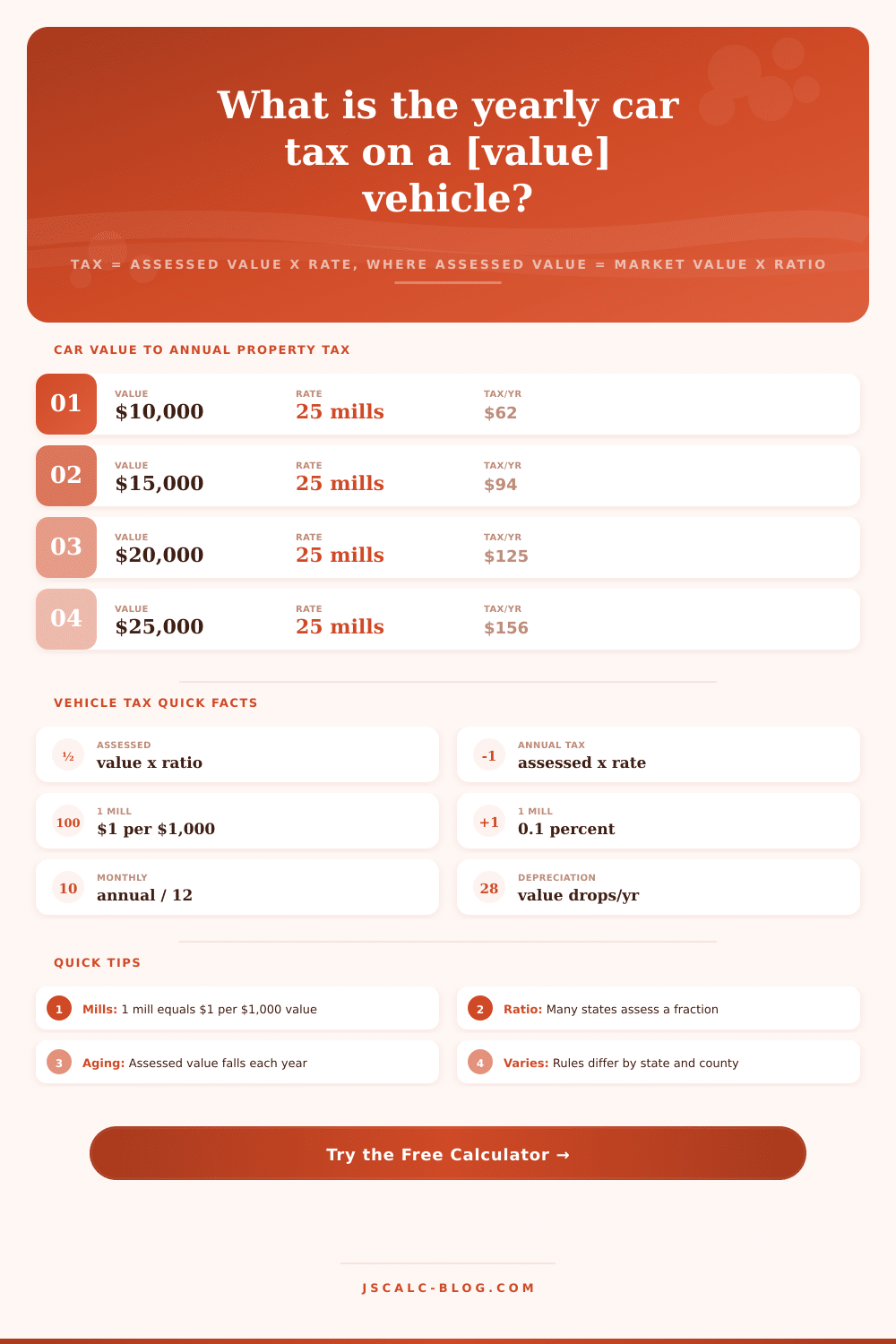
Many counties also quote their vehicle taxes as a millage rate expressed in “mills,” confusing those who have only seen percentages. A mill is defined as a tax rate of one dollar for every one thousand dollars of assessed value, which is the same as one tenth of one percent. Therefore, if the rate is stated as twenty-five mills, it’s equivalent to a decimal multiplier of zero point zero two five, or two point five percent. Don’t worry about the conversion, the calculator does that for you, but it helps to understand how they’re connected so you can check the math yourself. You might find that your county quotes the rate in percent instead. In this case, just toggle the units and the math will remain consistent.
The yearly tax, then, is just the assessment times the decimal rate. Six percent on the thirty-thousand-dollar SUV multiplies out to be eighteen hundred bucks, which at a twenty-five mill rate equals forty-five dollars. Some counties imposes a flat or minimum fee, even on very low-value cars, to ensure they get at least a little something from them. The tool has this as an optional input. When the calculated tax is less than the minimum, the calculator inputs the minimum and flags it in the breakdown:
But those other two additional result cards make planning easier. The monthly equivalent is just your annual tax divided by 12, which means you know exactly what to save each month, without ever being surprised when that big yearly bill arrives. The effective rate takes the annual tax and divides it by the total market value, showing you exactly what percentage of the actual vehicle value you’re paying every single year, regardless of the tax rate/ratio combo. That effective rate is actualy the most fair comparison between two places. It could be that Place A has higher millage but lower ratio than Place B, yet they both end up close to the same effective amount.
However, because a car represents a shrinking asset, a one-year picture understates the long run. Apply your preferred annual depreciation rate each year. Recompute the tax for the following years based on that depreciated value and sum them up to get the projection. If your car drops in value by 15% per year, then its taxable base declines over time. When you’re debating between buying a more expensive but newer car versus buying used, this can help you decide. The more expensive car incurs a larger tax for a few years until depreciation reduces the difference.
There are ten real-world scenarios. They range from an eighteen thousand dollar used sedan to a thirty-thousand dollar SUV assessed at six percent. These are all loaded into presets that pop right up so you start with something reasonable. Each fills the fields and recalculates so you can adjust from a sensible starting point. Plus the reference tables provide context beyond what any one calculation provides.
The reference tables include a comparison grid of various assessments and millage rates alongside their resulting annual tax, a look at how a car depreciates over time, example assessment ratios, and conversion tables for going back and forth between mills and percent. The reason we say all of these are estimates: Every county and state values cars differently. Some don’t even have a vehicle property tax; some roll that kind of fee into their registration costs. Some assess based off percentage (often expressed as “mills”); others do so based on some other ratio. They also set different exemptions and minimums.
Use this calculator to see how things work, play out various scenarios, or plan a year ahead. However, always check with your local assessor to find the actual rate and assessed value before counting on any number for real-world purposes. Better to prepare for the bill than to get surprised by it.