Rental Property Sale Tax Calculator
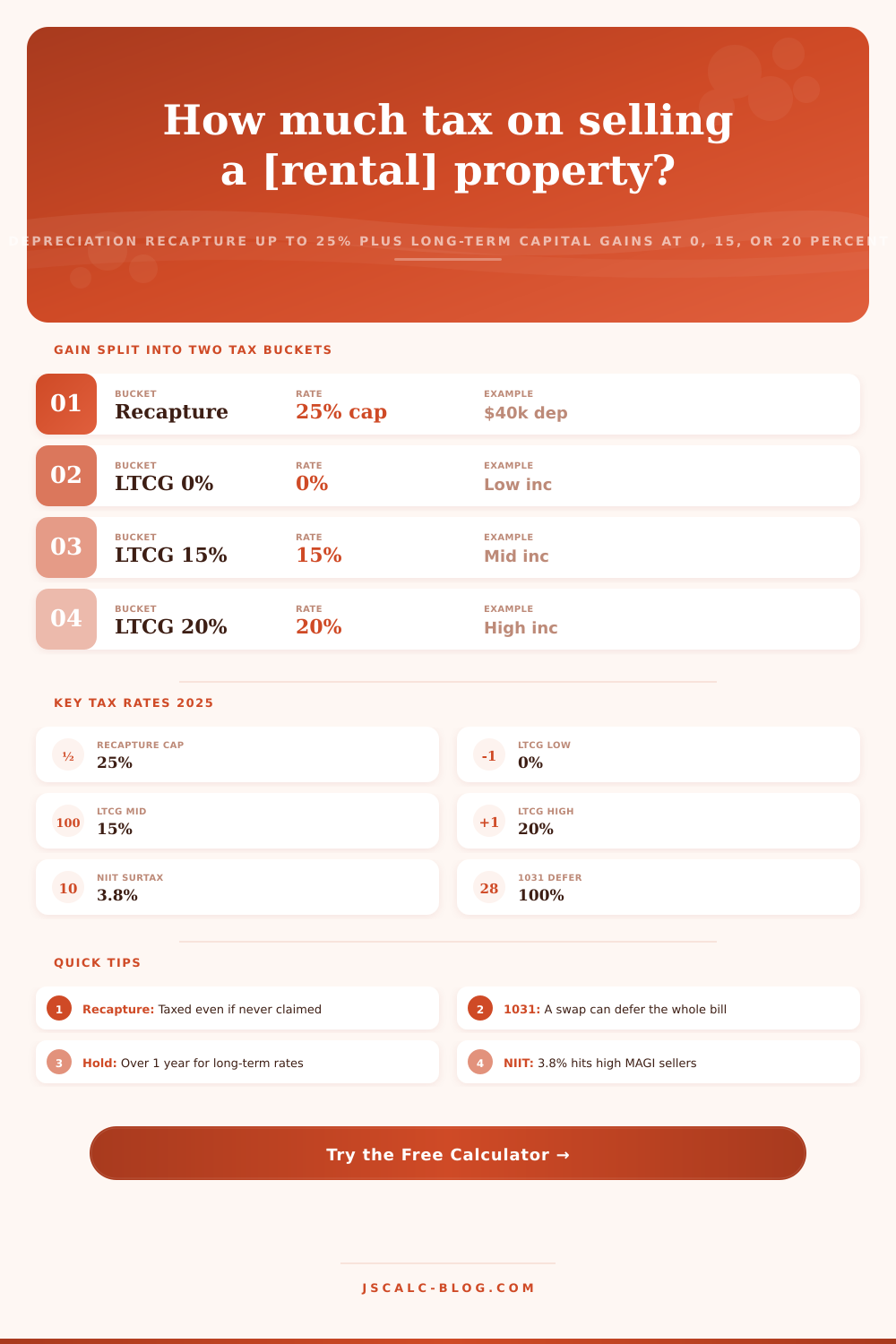
Estimate the tax owed when you sell an investment or rental property. This tool separates your gain into depreciation recapture taxed at up to 25 percent under Section 1250 and long-term capital gain taxed at 0, 15, or 20 percent, then adds the 3.8 percent Net Investment Income Tax and any state tax to show total tax and net proceeds after tax.
🎯Real Sale Scenario Presets
📝Sale & Basis Inputs
What you paid to acquire the property.
New roof, additions, major renovations that add to basis.
Total depreciation claimed (or allowable) while renting.
Gross contract price the buyer pays.
Agent commission, transfer tax, closing fees.
Over 1 year qualifies for long-term rates.
Sets the long-term gains and NIIT thresholds.
Taxable income before this sale, to pick the 0/15/20% band.
Flat state rate applied to the whole gain. Use 0 if none.
Net Investment Income Tax on high earners.
🔢Tax Snapshot
📊2025 Long-Term Capital Gains Brackets
| Rate | Single | Married Joint | Head of Household | Married Separate |
|---|---|---|---|---|
| 0% | Up to $48,350 | Up to $96,700 | Up to $64,750 | Up to $48,350 |
| 15% | $48,351 - $533,400 | $96,701 - $600,050 | $64,751 - $566,700 | $48,351 - $300,000 |
| 20% | Over $533,400 | Over $600,050 | Over $566,700 | Over $300,000 |
💵Net Investment Income Tax (NIIT) 3.8% MAGI Thresholds
| Filing Status | MAGI Threshold | Surtax Rate | Applies To |
|---|---|---|---|
| Single | $200,000 | 3.8% | Lesser of net gain or MAGI over line |
| Married filing jointly | $250,000 | 3.8% | Investment income above threshold |
| Head of household | $200,000 | 3.8% | Rental sale gain counts as NII |
| Married filing separately | $125,000 | 3.8% | Lower threshold, plan carefully |
📋Recapture, Rates & the 1031 Alternative
| Item | Rate or Rule | What It Means | Note |
|---|---|---|---|
| Section 1250 recapture | Up to 25% | Depreciation is taxed back on sale | Ordinary rate capped at 25% |
| Long-term gain | 0/15/20% | Remaining gain after recapture | Held over 1 year |
| Short-term gain | Ordinary | Held 1 year or less | Taxed like wages |
| NIIT surtax | 3.8% | Extra tax on high-MAGI investors | On top of income tax |
| 1031 exchange | Defer 100% | Swap into like-kind property | 45 / 180 day rules |
| Installment sale | Spread | Report gain over several years | May keep bracket lower |
🗃Income vs Rate vs Tax Comparison Grid
| Other Income | Filing Status | LTCG Band | Sample Gain | Est. Cap-Gains Tax | NIIT Added |
|---|---|---|---|---|---|
| $35,000 | Single | 0% | $100,000 | $0 | $0 |
| $90,000 | Single | 15% | $100,000 | $15,000 | $3,800 |
| $250,000 | Single | 20% | $100,000 | $20,000 | $3,800 |
| $60,000 | Married Joint | 0% | $120,000 | $0 | $0 |
| $180,000 | Married Joint | 15% | $120,000 | $18,000 | $1,900 |
| $620,000 | Married Joint | 20% | $120,000 | $24,000 | $4,560 |
| $70,000 | Head of House | 15% | $80,000 | $12,000 | $0 |
| $300,000 | Head of House | 20% | $80,000 | $16,000 | $3,040 |
| $45,000 | Single | 15% | $50,000 | $7,500 | $0 |
| $900,000 | Married Joint | 20% | $250,000 | $50,000 | $9,500 |
⚙How the Math Works
💡Smart Selling Tips
Selling a rental property often feels like winning lottery until you see your tax bill. That’s because the IRS doesn’t view investment real estate in quite the same way as your main home. It carves up your profit into two different buckets, which has different tax rates. This calculator shows you how much you’ll owe, well before you sign anything.
This is your adjusted cost basis. The basis isn’t simply what you paid for the home. It is what you paid plus any major improvements you’ve made, such as adding on or putting in a new roof. Then, subtract the depreciation you took each year. The depreciation reduces your basis, thereby artificially increasing your gain upon sale. And this is precisely why the government want a portion of it. That’s your adjusted basis.
How to Calculate Your Rental Property Taxes
Then subtract it from total amount you received when you sold. That’s your total gain, after adjusting for the commission and closing costs (which can cost thousands of dollars before we start talking about taxes). From there, the math split into two parts: one piece for depreciation recapture. If you depreciated anything during ownership, however long ago, the government taxes that back out of your pocket at a rate as high as 25 percent; regardless of your ordinary income tax rate. Yes, even if you didn’t take the deduction, the IRS will collect based on how much they let you deduct.
The other piece are your capital gains. The Long-Term Capital Gains Bucket includes the appreciation from your purchase price plus any upgrades. It’s taxed at lower rates (zero, fifteen, or twenty percent) if it was sold after a year of ownership. This rate depend on your income level. Lowest income earners might owe no tax on this bucket, while highest earners will owe the highest rate. The calculator will layer your other income on top of those brackets to calculate your exact rate (because you’ll be somewhere on that scale).
The other not-so-obvious tax that can catch well-off folks: the Net Investment Income Tax (a.k.a. The “hidden tax”). If your modified adjusted gross income is more than $200k for singles, or $250k for joint filers, you’ll get hit with a 3.8 percent surcharge on top of that. Even if your regular salary doesn’t land above that line, one big property sale could put you there, and over the edge, in a given year. On top of that, most states will tax the gain at ordinary income rates, which can be a wild variation from state to state.
In this case, the tool breaks it down for you. The total gain. Then comes the recapture tax. Next comes the capital gains tax + surtax (if applicable). And lastly, here’s how much cash you’ll have in hand after paying all those taxes. That gives you a target number that will help you know whether you can tolerate a straight sale or explore some of the alternatives.
For example: a 1031 exchange lets you defer this entire tax payment. As long as you swap into another investment property within tight deadlines, you gets to keep all the money. This is an extremely useful tool for keeping capital, but only with the right timing and discipline.
This takes away the mystery from a complicated transaction. Now, when you sell, you know exactly how much money lands in your bank account (after state + IRS). Now you can weigh the options: reinvest? You could hold longer. Or you can sell quickly. Crunch the numbers based off the outset to make an informed decision. Your exit strategy can mean a difference of tens of thousands of dollars… And that’s always better than being reactionary.
It turns a daunting tax system into a practical financial decision. This is actualy more easier than it looks if you plan ahead, though most people should of known sooner. It makes the whole process feel much more comfortabley.