Fraction to Whole Number Calculator
Convert an improper fraction into a whole number when it divides evenly, or into a mixed number when it does not. See the division, remainder, reduced fraction part, decimal value, and rounded whole in full detail.
🎯Real Fraction Presets
📝Fraction Inputs
The number being divided, above the bar.
The number you divide by. Cannot be zero.
🔢Conversion Snapshot
📊Which Numerators Give a Whole Number
For the current denominator, only numerators that are exact multiples reduce to a whole number. Everything in between becomes a mixed number.
| Numerator | Fraction | Whole? | Whole Value | Remainder | Mixed Number |
|---|---|---|---|---|---|
| Enter a denominator above to see the divisibility pattern. | |||||
✖Times Table for the Denominator
These products are exactly the numerators that make a whole number. If your numerator appears here, the fraction divides evenly.
| Multiplier | Calculation | Product (Numerator) | Fraction | Equals Whole |
|---|---|---|---|---|
| The times table appears after calculation. | ||||
🗂Improper Fraction Comparison Grid
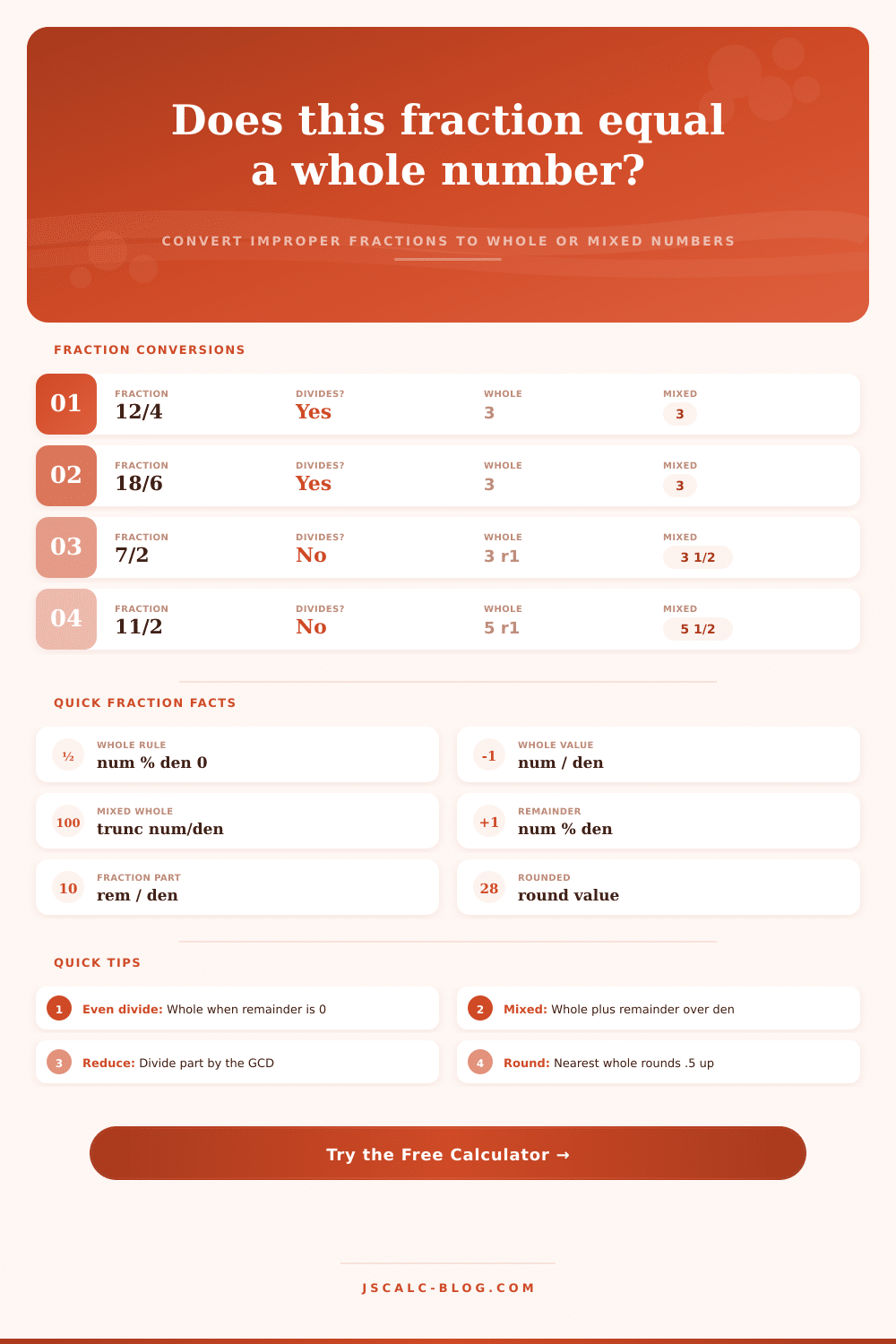
| Fraction | Divides Evenly | Whole Part | Remainder | Fraction Part | Mixed Number | Decimal |
|---|---|---|---|---|---|---|
| 12 ⁄ 4 | Yes | 3 | 0 | – | 3 | 3.00 |
| 18 ⁄ 6 | Yes | 3 | 0 | – | 3 | 3.00 |
| 7 ⁄ 2 | No | 3 | 1 | 1 ⁄ 2 | 3 1⁄2 | 3.50 |
| 11 ⁄ 2 | No | 5 | 1 | 1 ⁄ 2 | 5 1⁄2 | 5.50 |
| 15 ⁄ 4 | No | 3 | 3 | 3 ⁄ 4 | 3 3⁄4 | 3.75 |
| 20 ⁄ 5 | Yes | 4 | 0 | – | 4 | 4.00 |
| 5 ⁄ 3 | No | 1 | 2 | 2 ⁄ 3 | 1 2⁄3 | 1.67 |
| 48 ⁄ 8 | Yes | 6 | 0 | – | 6 | 6.00 |
| 100 ⁄ 25 | Yes | 4 | 0 | – | 4 | 4.00 |
| 22 ⁄ 8 | No | 2 | 6 | 3 ⁄ 4 | 2 3⁄4 | 2.75 |
⚙Full Formula Breakdown
📋Remainder Interpretation Reference
| Situation | What It Means | Whole Result | Mixed Result |
|---|---|---|---|
| Remainder is 0 | Numerator is a multiple of denominator | Exact whole number | Same as the whole number |
| Remainder is not 0 | Fraction sits between two whole numbers | Only by rounding | Whole plus a proper fraction |
| Numerator < denominator | Proper fraction less than one | Rounds to 0 or 1 | Whole part is 0 |
| Numerator = denominator | Fraction equals exactly one | Whole number 1 | Same as 1 |
| Remainder shares a factor | Fraction part can be reduced | Unchanged | Simplified fraction part |
| Denominator is 1 | Already a whole number | Equals the numerator | Same as the numerator |
💡Practical Fraction Tips
Two friends, seven slices of pizza, and you want to make sure everybody gets their fair share. Next time you’re ordering whole pies, you want to know exactly how many you’ll need. That’s where fractions come in.
On the job site (or really just about anywhere), it’s not often clean. More than likely, there is an improper fraction in your hand that has to become real. Plug your numbers into the calculator above, let it do the math, and save yourself the guesswork of knowing if that leftover sliver actualy equals one more whole unit.
How This Fraction Calculator Helps You
Division is the simplest idea at work here but remainders mess with our minds. Early on we’re taught that fractions represent part-whole relationships. What we tend to lose sight of is that they are also division problems looking for a chance to happen. If the top (numerator) of the fraction divide cleanly into the bottom (denominator), life is good and you have a nice round number on your hands. More commonly, however, there’s some leftover: The remainder is what creates friction in the system. It’s what’s left over from cutting up your lumber or what didn’t fit in last sauce-filled bowl. Understanding what this remainder means are key.
This is common denominator. That’s why most folks would of quit right there with their mixed number, no need to look further if they don’t think it can simplify. After all, who wants to have a pile of fifteen halves? No problem; the tool will display that for you as seven and a half. But what about a pile of sixteen sevenths? That messier leftover seems like something best left alone…until you realize it has shrunk.
The calculator’s got that covered: It finds highest common denominator (the Greatest Common Divisor) and whisks away the clutter. Suddenly, the real size of the piece jumps out at you. Why does that matter? Because when fractions aren’t reduced, they hides the relationship between the pieces. Maybe you consider 2/4 to be a tiny sliver. Reduce it to 1/2 and suddenly it reveals itself to be a substantial chunk.
Then there’s rounding. In the world of theory math, you keep that level of precision. But in the real world, building something or making dinner for family often requires a whole number. How will you round? One more nail is the solution… so round up? Rounding down a little won’t hurt it. So round down? The user can select whether to round up (ceiling) or down (floor). That tiny choice make all the difference on the output. If you round.4 down, you save resources, but round.5 up and you’re covered. It isn’t a math question; it’s a question of risk tolerance. Would you rather be a bit too low, or would it matter if there is wastage?
Consider also page’s times table feature. This lets you know what the top number can be and still get a tidy whole number at the bottom of fraction. With a six as the denominator? Good bets are twelve, eighteen, and twenty-four. Those all goes in without a trace. That predictability is part of the power of the calculator, it helps you think ahead. You’re working with an ingredient that comes in thirds? Scale things up to multiples of three so everything stays nice and neat. This avoids sloppy fractions sneaking into your process. It turns a calculating device into a planning one.
Then there’s the other view: the decimal view. It’s easy to see that 5/7 equals 0.71. That clicks. It turns the symbol of a fraction into a solid point along the number line. When you see the decimal alongside the mixed number, it builds your intuition. You begin to see that 1/8 doesn’t matter when talking about big numbers, whereas 3/4 is almost one. Before you need to use the tool, the dual view lets you make an estimate faster.
In the end, fractions are all about understanding the parts. It could be understanding measurements for cooking or splitting the check with friends. You want to know what’s going on. And with this tool, you don’t have to worry about those annoying divisions… Just focus on the decision in front of you. Once you see how these numbers emerge, you start to believe them. It becomes clear what happened along the way. When you’re dealing with a stubborn fraction next time, think about what was left over. What didn’t make it? Sometimes that leftover piece provide the clue to getting to the bottom line.