Simplify Fraction Calculator
Reduce any fraction to its lowest terms using the greatest common divisor, follow the Euclid and prime-factor steps, then read the mixed number, decimal, percent, and a full list of equivalent fractions.
🎯Real Fraction Presets
📝Fraction Inputs
May be negative; the sign is kept on the numerator.
Cannot be zero; a zero bottom is undefined.
🔢Simplify Snapshot
🧮Prime Factor Steps
| Part | Value | Prime Factorization | Factor Count |
|---|---|---|---|
| Enter a numerator and denominator above to factor them into primes. | |||
| Shared Prime | In Top | In Bottom | Times Taken | Running GCD |
|---|---|---|---|---|
| Shared prime factors that build the GCD appear here after calculation. | ||||
🔗Equivalent Fractions
| Multiplier | Numerator | Denominator | Equivalent | Decimal |
|---|---|---|---|---|
| Equivalent fractions of the simplified result are listed after calculation. | ||||
🗂GCD Examples Comparison Grid
| Fraction | Top Primes | Bottom Primes | GCD | Lowest Terms | Decimal |
|---|---|---|---|---|---|
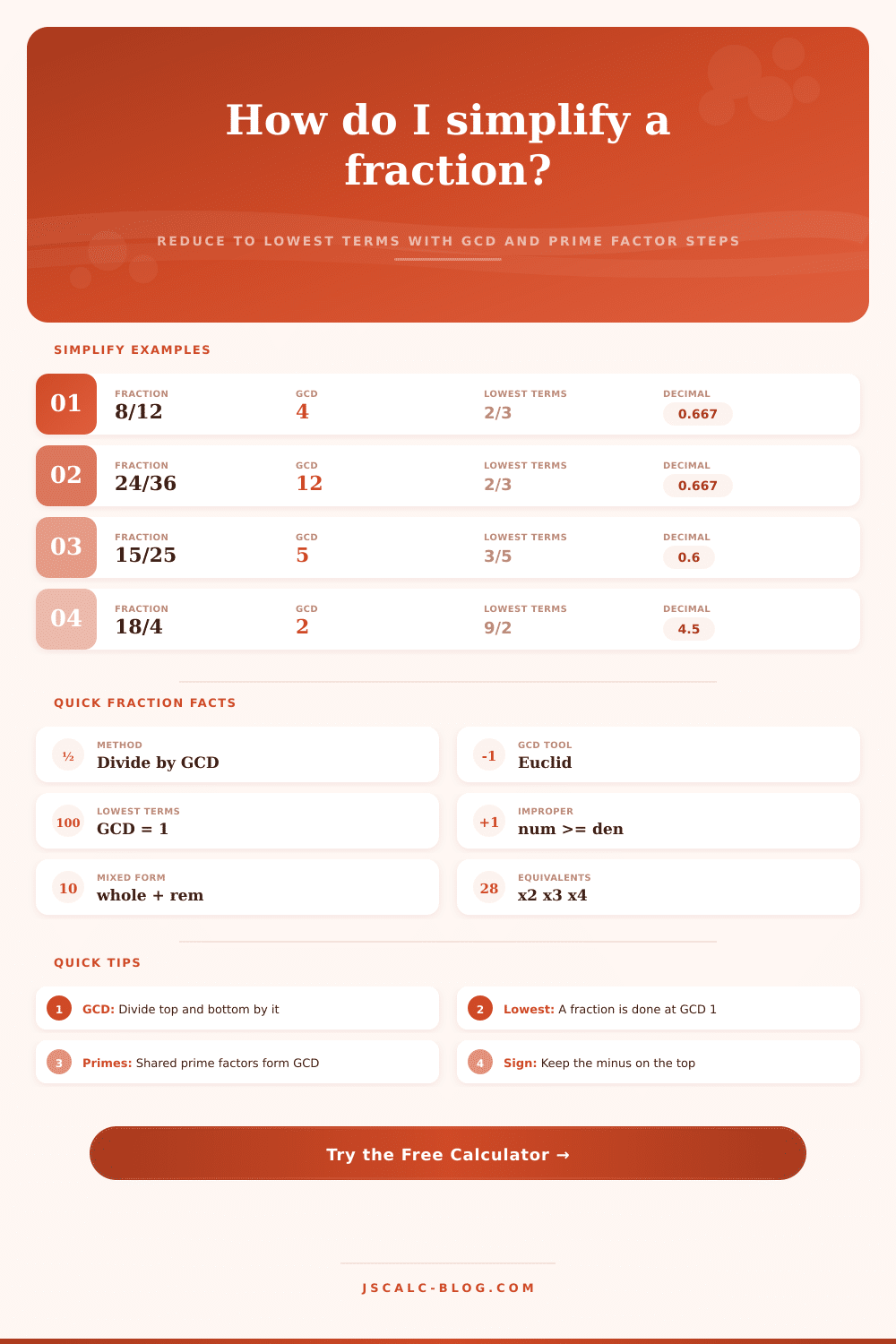
| 8/12 | 2 × 2 × 2 | 2 × 2 × 3 | 4 | 2/3 | 0.667 |
| 24/36 | 2³ × 3 | 2² × 3² | 12 | 2/3 | 0.667 |
| 15/25 | 3 × 5 | 5 × 5 | 5 | 3/5 | 0.600 |
| 9/27 | 3 × 3 | 3³ | 9 | 1/3 | 0.333 |
| 144/216 | 2⁴ × 3² | 2³ × 3³ | 72 | 2/3 | 0.667 |
| 50/100 | 2 × 5² | 2² × 5² | 50 | 1/2 | 0.500 |
| 18/4 | 2 × 3² | 2 × 2 | 2 | 9/2 | 4.500 |
| 7/9 | 7 | 3 × 3 | 1 | 7/9 | 0.778 |
⚙Full Formula Breakdown
📋Common Simplifications Reference
| Original | GCD | Lowest Terms | Mixed / Whole |
|---|---|---|---|
| 2/4, 3/6, 5/10 | 2, 3, 5 | 1/2 | 0.5 |
| 3/9, 4/12, 10/30 | 3, 4, 10 | 1/3 | 0.333 |
| 6/8, 9/12, 15/20 | 2, 3, 5 | 3/4 | 0.75 |
| 4/10, 6/15, 20/50 | 2, 3, 10 | 2/5 | 0.4 |
| 8/12, 16/24, 40/60 | 4, 8, 20 | 2/3 | 0.667 |
| 10/4, 15/6, 25/10 | 2, 3, 5 | 5/2 | 2 1/2 |
| 12/8, 18/12, 30/20 | 4, 6, 10 | 3/2 | 1 1/2 |
💡Practical Fraction Tips
Everyday scenarios such as cooking where we measure out ingredients and dividing pizza involve fractions. When we cut material for a construction project or double recipe, we’re using fractions too. The ratio calculator simplify those fractions into their simplest form. Then it display the steps so you can follow along with how 8/12 turned into 2/3. That way you can see math behind the answer.
How do we simplify a fraction? Find something they have in common. All fractions is made up of two part: the numerator and the denominator. What’s the biggest number that can divides into them both evenly, leaving no remainder? That number you divide by will reduce the size of your fraction but not change its value. When you know what the biggest factor are, it makes simplification process really efficient.
Why Simplifying Fractions Matters
A shortcut: You could guess that some small number goes into 24/36. Guess that it’s a half and then that it’s a quarter, etc… and come up with fraction 2/3. That’s fast. Except for one problem. If you guess wrong and do not keep going until you have simplest form of your fraction, you will end up with the wrong answer.
The quick way (and correct way) relies on prime factorization (or the Euclidean algorithm). Prime factorization mean breaking numbers down to the smallest components possible. Then you can easly spot what fraction they share in common. It almost seems less like guessing and more like sorting. To understand what it means, you need to know how answer’s written.
Dividing things greater than one whole can yield an improper fraction, meaning number at top of fraction is bigger than the number on bottom. That also occurs when you add fractions together. It’s often clearer to convert such a thing into a mixed number instead. Four and a half cakes sounds better than 4.5 cakes which is nine halves of cake. The tool will do this for you if you have it set to display them as mixed numbers.
New students don’t understand that they can write a fraction in infinitely many equivalent form, and sometimes it confuses them that there’s more than one form. 1/2 = 10/20 because multiplying both sides by ten results in same value. These two fractions is equal in value, although they don’t look the same. Knowing which fractions are equivalent comes in handy when you are asked to add two or more fraction with unlike denominators. Before you combine them, you must get common denominator. The reference table on this page show such patterns for common examples.
Manual reduction is a way of building number sense that no machine can replicate. Even though a digital calculator can crunch simple equations in seconds, learning manual reduction build number sense that technology cannot replicate. Reducing fractions are an important skill that helps you spot impossible answers faster. It also help us understand conversions like “How many tablespoons are there in a 1/3 cup?”. If we know that thirds correspond to twelfths, then we don’t need to pull out our phones and look it up (or hope we have cell service).
In math, you are rewarded for paying attention and doing things correctly. If you do even the slightest thing wrong in the divisor, it all shift. When you simplify, always make sure to multiply new numerator and denominator together to see if they gets you back where you started. That way, what you did becomes not just a calculation but a verified truth.
Breaking down fractions is clarifying: It takes out the noise and shows what’s really going on, the relationship of one thing to another. Whether you’re calculating a recipe, figuring out how much wood to buy or paying bills, the less complicated something is, the easier it would of been to make a good choice. The next time you’re faced with an unruly fraction, find common divisor tying everything together. Divide by that number and the rest should fall neatly into place. To appreciate this technique, you have to practice it until you do.