Date Difference Calculator
Find the exact span between two dates as years, months, and days, then see the same gap converted into total weeks, days, hours, and minutes, with weekday and weekend counts and a full calendar-borrowing breakdown.
🎯Real Date Presets
📝Date Inputs
Used only when include time of day is set to yes.
A later end time adds hours; an earlier one trims them.
🔢Method Snapshot
🔄Difference In Every Unit
| Unit | Amount | Whole + Remainder | How It Is Derived |
|---|---|---|---|
| Enter two dates above to see the span converted into every unit. | |||
🗓Weekday And Weekend Grid
| Measure | Start Date | End Date | Across Span | Note |
|---|---|---|---|---|
| Weekday names and counts appear here after calculation. | ||||
📅Month Length Reference
| Month | Common Year | Leap Year | Borrow Value |
|---|---|---|---|
| January | 31 days | 31 days | Full month is 31 |
| February | 28 days | 29 days | 28 or 29 when borrowed |
| March | 31 days | 31 days | Full month is 31 |
| April | 30 days | 30 days | Full month is 30 |
| May | 31 days | 31 days | Full month is 31 |
| June | 30 days | 30 days | Full month is 30 |
| July | 31 days | 31 days | Full month is 31 |
| August | 31 days | 31 days | Full month is 31 |
| September | 30 days | 30 days | Full month is 30 |
| October | 31 days | 31 days | Full month is 31 |
| November | 30 days | 30 days | Full month is 30 |
| December | 31 days | 31 days | Full month is 31 |
🌲Leap Year Reference
| Year | Divisible By 4 | Century Rule | Leap Year? |
|---|---|---|---|
| 2000 | Yes | Divisible by 400 | Yes, 366 days |
| 2020 | Yes | Not a century | Yes, 366 days |
| 2024 | Yes | Not a century | Yes, 366 days |
| 2025 | No | Not a century | No, 365 days |
| 2026 | No | Not a century | No, 365 days |
| 2100 | Yes | Century, not / 400 | No, 365 days |
⚙Full Method Breakdown
📋Reference Values
| Item | Value | Where It Applies | Notes |
|---|---|---|---|
| Milliseconds per day | 86,400,000 | Raw day subtraction | 24 × 60 × 60 × 1000 |
| Days per week | 7 | Weeks conversion | Remainder shown as days |
| Hours per day | 24 | Hours conversion | Time delta added if enabled |
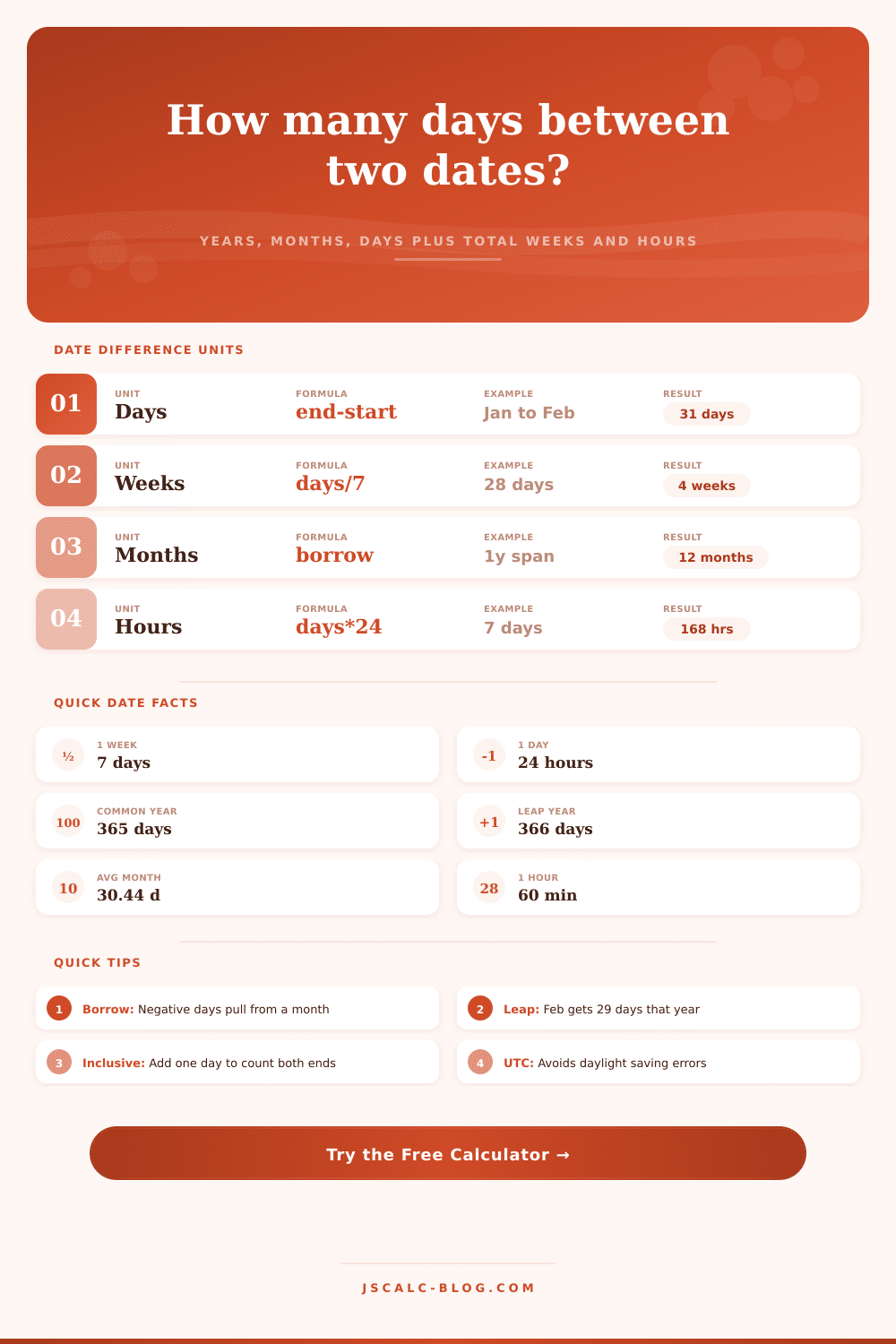
| Average month | 30.44 days | Rough month estimate | 365.25 / 12 for averages |
| Common vs leap year | 365 or 366 | February length | Feb gains a day in leap years |
💡Practical Date Tips
Time seems easy to measure, until you do. Two months sound like a long way between Jan & Mar, unless Feb has more than 28 days that particular year, does it? How about counting just the nights, vs. Do you count the first and last day? Or do you count those too? In hours, thats what lease contracts ask.
Months don’t match up evenly. Our minds trick us into treating them like an even block of time, yet theyre irregular values. Plug in your dates here, and let calculator crunch the numbers. You won’t have to guess whether it was a 30- or 31-day month, which makes that bonus week just another week.
Why Counting Days Is Tricky
The underlying misunderstanding is typicaly how we define a month. Project management and finance will smooth out the rough spots with an average month that is thirty-point-four-four days long. Averages don’t apply to birthdays or to contracts though. Those follows your calendar. When you work with Gregorian calendar‘s quirkiness to figure out distance between two dates, you’re doing so using real thing.
Why should it gives you one number, one total number of days? Instead, it split up the answer into separate years, months, and days. Because that’s what actualy happens as time passes. When the end date land before the beginning, it steals those days back from prior months.
You should of also consider leap years. To maintain alignment of the seasons with solar year, every four years we tack on an additional day to February. If you’re not careful, this adjustment will throw off simple subtractive approaches. When calculating across February 29th, you’ll need to remember those twenty-four extra hours. As you can see in table on this page, length of each month vary depending on whether it is a leap year or a common year. Fail to take this into account and you’ll be compounding your error over time.
A project that span ten years may appear as three thousand six hundred fifty days on paper. But thats counting two leap years, which means you’re really working with three thousand six hundred sixty-two days. An extra week can be difference between getting that project completed by its deadline or having to pay a penalty fee.
A second hidden snare has to do with whether an event is inclusive or exclusive. For example, if you’re booking a hotel room for three nights, does that equal four days or three? Hotels tend to go by nights, and most of us thinks of it as nights too. However, if you’re tracking who shows up for weekend festival, say Friday through Sunday, you may wish to count those start/end days. This toggle switch that value by just a single day.
Sounds like nothing, but that extra day can swing things greatly in terms of warranty periods or payroll calculations. Always be sure you know what convention apply to your particular situation or contract before accepting the raw number on face value.
There’s one more wrinkle: timezones. Local time can shift by an hour twice a year as clocks leap ahead and fall behind. Behind the scenes, Coordinated Universal Time do the main work so we don’t have to deal with those artificial jumps in our calculations. As a result, there will always be eighty-six-point-four million milliseconds in a day. This stays true no matter what politicians decide about when sun goes down.
Why does the tool rely on UTC? That is why you might get different numbers here different than if you try this manually on your phone. We want to make sure the whole thing stay consistent over its range, so that nobody loses or gains hours because of clock shifts.
Time interval measurement isn’t really an exercise in arithmetic; it’s a matter of definition. What does one unit of time look like for your needs? Are we talking about days lived, or nights spent sleeping? Are we counting calendar months, or some average duration? Once you’ve established those rules, the rest falls into place: numbers comes easy. Your context supplies the meaning; the tool adds the precision. It matters not only that the answer is correct, but also that you know how to frame the question. That transforms a simple date check into something useful: planning data that stands up to scrutiny.