Fuel Economy Calculator
Turn distance and fuel used into real mileage, convert instantly between MPG, L/100km, and km/L, switch US and UK gallons, and estimate the fuel a trip needs or the range left in your tank.
⛽Real Driving Presets
📝Fuel Economy Inputs
Switching mode reveals the fields each calculation needs.
Economy mode: distance covered on the fuel below.
Economy mode: fuel burned over the distance above.
Enter a figure such as 30 MPG or 8 L/100km.
Uses the distance unit selected above.
Uses the fuel unit selected above; drives the range estimate.
🔢Conversion Constants
🔄MPG to L/100km & km/L Table
| MPG (US) | L/100km | km/L | MPG (UK) | Rating Band |
|---|---|---|---|---|
| 10 | 23.52 | 4.25 | 12.0 | Very poor |
| 15 | 15.68 | 6.38 | 18.0 | Poor |
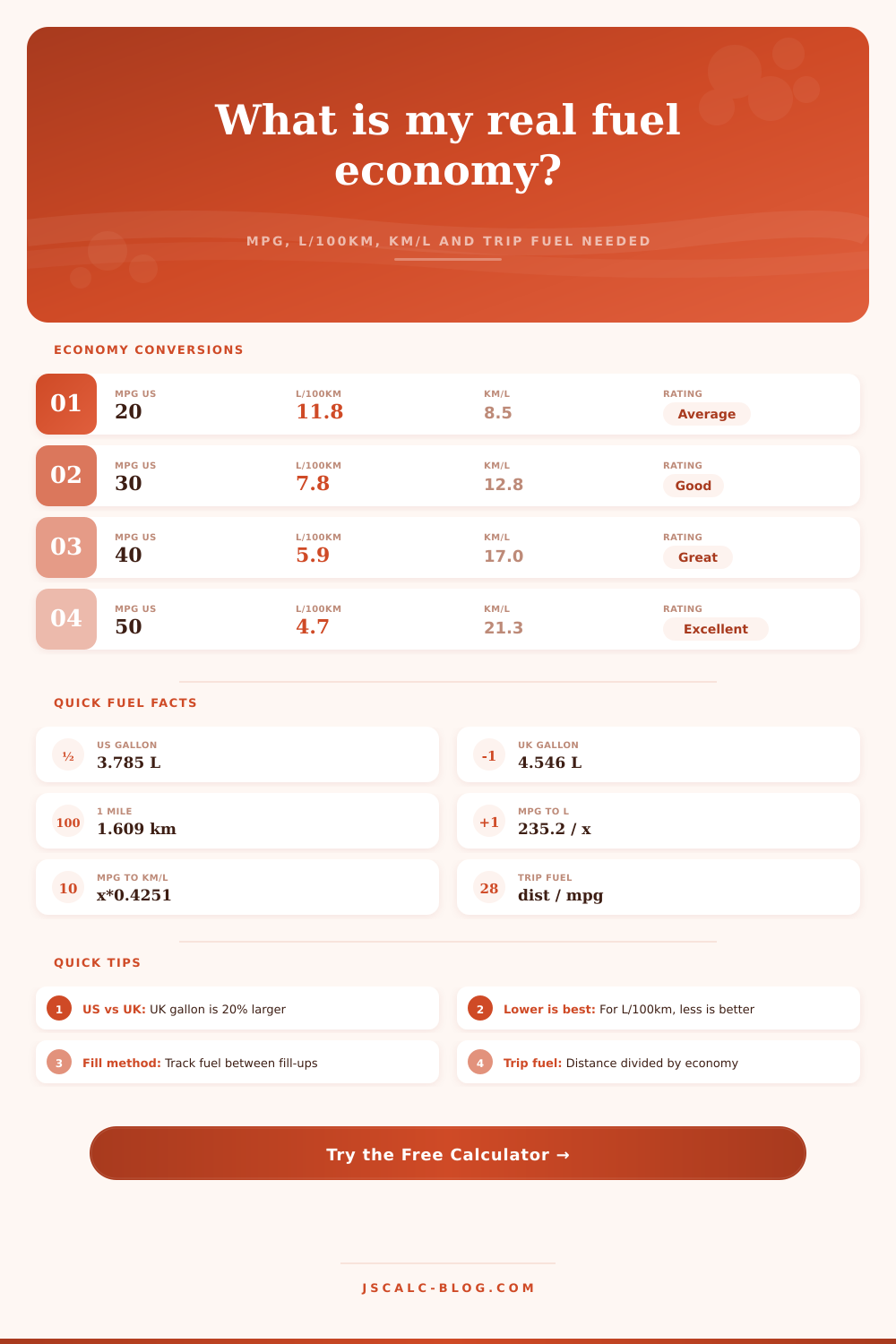
| 20 | 11.76 | 8.50 | 24.0 | Average |
| 25 | 9.41 | 10.63 | 30.0 | Average |
| 30 | 7.84 | 12.75 | 36.0 | Good |
| 35 | 6.72 | 14.88 | 42.0 | Good |
| 40 | 5.88 | 17.01 | 48.0 | Great |
| 50 | 4.70 | 21.26 | 60.0 | Excellent |
| 60 | 3.92 | 25.51 | 72.1 | Excellent |
📊Fuel Economy Rating Bands
| Rating | MPG US Range | L/100km Range | km/L Range | Typical Vehicle |
|---|---|---|---|---|
| Very poor | Under 15 | Over 15.7 | Under 6.4 | Large truck, big V8 |
| Poor | 15 – 20 | 15.7 – 11.8 | 6.4 – 8.5 | SUV, older sedan |
| Average | 20 – 28 | 11.8 – 8.4 | 8.5 – 11.9 | Midsize sedan |
| Good | 28 – 38 | 8.4 – 6.2 | 11.9 – 16.2 | Compact, small diesel |
| Great | 38 – 48 | 6.2 – 4.9 | 16.2 – 20.4 | Efficient compact |
| Excellent | Over 48 | Under 4.9 | Over 20.4 | Hybrid, plug-in |
🛢US Gallon vs UK Gallon vs Liter
| Volume | US Gallons | UK Gallons | Liters | Note |
|---|---|---|---|---|
| 1 US gallon | 1.000 | 0.833 | 3.785 | US fuel standard |
| 1 UK gallon | 1.201 | 1.000 | 4.546 | Imperial, ~20% larger |
| 1 liter | 0.264 | 0.220 | 1.000 | Metric fuel standard |
| 5 US gallons | 5.000 | 4.163 | 18.927 | Small jerry can |
| 10 liters | 2.642 | 2.200 | 10.000 | Partial fill |
| 50 liters | 13.209 | 10.999 | 50.000 | Full tank many cars |
🗺Distance & Comparison Grid
| Vehicle Class | MPG US | MPG UK | L/100km | km/L | km per US Gal |
|---|---|---|---|---|---|
| Full-size pickup | 18 | 21.6 | 13.07 | 7.65 | 28.96 |
| Midsize SUV | 24 | 28.8 | 9.80 | 10.20 | 38.62 |
| Family sedan | 32 | 38.4 | 7.35 | 13.60 | 51.50 |
| Compact hatch | 38 | 45.6 | 6.19 | 16.16 | 61.16 |
| Small diesel | 45 | 54.0 | 5.23 | 19.13 | 72.42 |
| Full hybrid | 52 | 62.4 | 4.52 | 22.11 | 83.68 |
| Plug-in hybrid | 58 | 69.6 | 4.06 | 24.66 | 93.33 |
⚙Full Formula Breakdown
📋Reference Values
| Item | Value | Where It Is Used | Direction |
|---|---|---|---|
| US gallon to liters | 3.785411784 | Fuel unit conversion | Multiply gallons |
| UK gallon to liters | 4.54609 | Imperial fuel conversion | Multiply gallons |
| Mile to km | 1.609344 | Distance conversion | Multiply miles |
| MPG US ↔ L/100km | 235.215 | Economy conversion | Divide into constant |
| MPG US to km/L | 0.425144 | Economy conversion | Multiply MPG |
| MPG US to MPG UK | 1.20095 | Gallon-basis shift | Multiply US MPG |
💡Practical Fuel Economy Tips
You stare at the digital readout as you click off the pump handle. It’s an arbitrary number; it could be points scored by some team you had no interest in following. You’re sure that you filled up three hundred miles back, but who remembers how much gas they’ve used? Mental math is for parking lots when people is cooling down their cars, not for when they’re trying to remember exactly what mileage they got.
This is why knowing how efficient your car really is are far more important than assuming it will live up to the sticker’s optimistic estimate. This is mostly because most people use the mileage numbers provided by the manufacturer. And those numbers comes from controlled testing done on some track somewhere that’s not like driving on the road at all. Throw in some traffic, turn on the AC, or toss a bunch of groceries into the back seat, no amount of driving like that would drop your mileage as fast than a mechanical failure would.
Why Knowing Your Car’s Fuel Use Is Important
Once you enter in how much gas you used and how far you drove, this calculator does math for you. It even converts units automatically, since the auto world talks in three languages depending on who’s asking. Before we begin, here’s what you need to know: it all depends on which metric you’re looking at, bigger isn’t necessarily better.
In America, where most people are familiar with miles per gallon, you want to go further on less gas. That’s an intuitive way to think about it. In much of the world (and in Europe) they measure efficiency using liters per one hundred kilometers. And in that case you want fewer liters, i.e., a smaller number. At least it makes sense once you realize that fuel cost money. It might not seem right at first, but it makes sense logically because you want to use fewer liter to cover that same distance. So that’s why you’ll see both shown together on this page. That way you can compare cars across market boundaries without stumbling into conversion gotchas.
The same can be said for gallons: This word also trips people up. Depending on where you read about it (the United States? The United Kingdom?), its usage refers to either a gallon that’s around 20% smaller or 20% bigger then the other’s. While the headline number might seem like the same thing, a car rated at thirty miles per US gallon isn’t as good as a car rated at thirty miles per imperial gallon. Before comparing your numbers to what you see posted online or making any sort of decision, always look and see which standard is being referred to. It’ll save you a lot of confusion when budgeting and planning for your trip.
And beyond converting between miles per gallon and liters per 100km, calculating it is one of the easiest ways to determine if your driving habits cost too much money, or if your car’s age is taking its toll on you. For instance, have you noticed that your MPG has decreased several points during the past year? That could mean that your tires is losing air (or maybe they’re worn out), your spark plugs aren’t firing properly anymore, or your air filters are in desperate need of cleaning.
All you have to do is plug in your numbers every time you fill up, no math needed! Once you’ve got enough data, you can begin spotting trends…trends that you would of seen from just one trip. To give context to your own numbers, the page has a reference table that spells out what kinds of mpg you should expect from different classes of vehicles. For example, knowing that a compact hybrid should get around fifty mpg and a full size pickup averages about eighteen puts things in perspective. You’ll know not to be frustrated because your pickup truck wasn’t made for highway sipping. You’ll also know when your sedan may want some TLC if its fuel economy has fallen into the poor range with no obvious cause, such as aggressive acceleration or towing.
So in the end, it’s all about knowing what to do and not trying to be perfect. There is no way around traffic jams. There is also no way around a cold snap, which reduces efficiency as the heater push the engine harder. You have no control over those things. But you DO have control over things like tire pressure, how hard you brake during long drives, and how much you idle. Making little changes like this add up over thousands of miles without spending another dime.
Actualy, it makes sense once you realize that fuel costs money. It might not seem right at first, but it makes sense logically because you want to use fewer liters to cover that same distance. It could of been easier if the moddern cars was better. Making little changes like this add up over thousands of miles without spending another dime. You should of seen how much fuel a luxurius car dissapears.