Retirement Date Countdown Calculator
Find your exact retirement date from your birthdate and target age, then count down the years, months, days, weeks, and estimated work days remaining until the day you clock out for good.
🎯Retirement Countdown Presets
📝Countdown Inputs
Used in age mode and to show your current age.
Used when method is explicit target date.
Leave as today, or set a what-if date.
Subtracted from work days for a truer figure.
🔢Countdown Snapshot
🗂Retirement Age Comparison Grid
| Retire Age | Retire Date | Years Left | Days Left | Work Days | Weekends Left |
|---|---|---|---|---|---|
| Enter your birth date and reference date to build the comparison grid. | |||||
Rows use your birth date and reference date above. Work days assume the selected week length minus holidays and leave.
📆Common Retirement Ages
| Milestone | Age | Why It Matters | Typical Style |
|---|---|---|---|
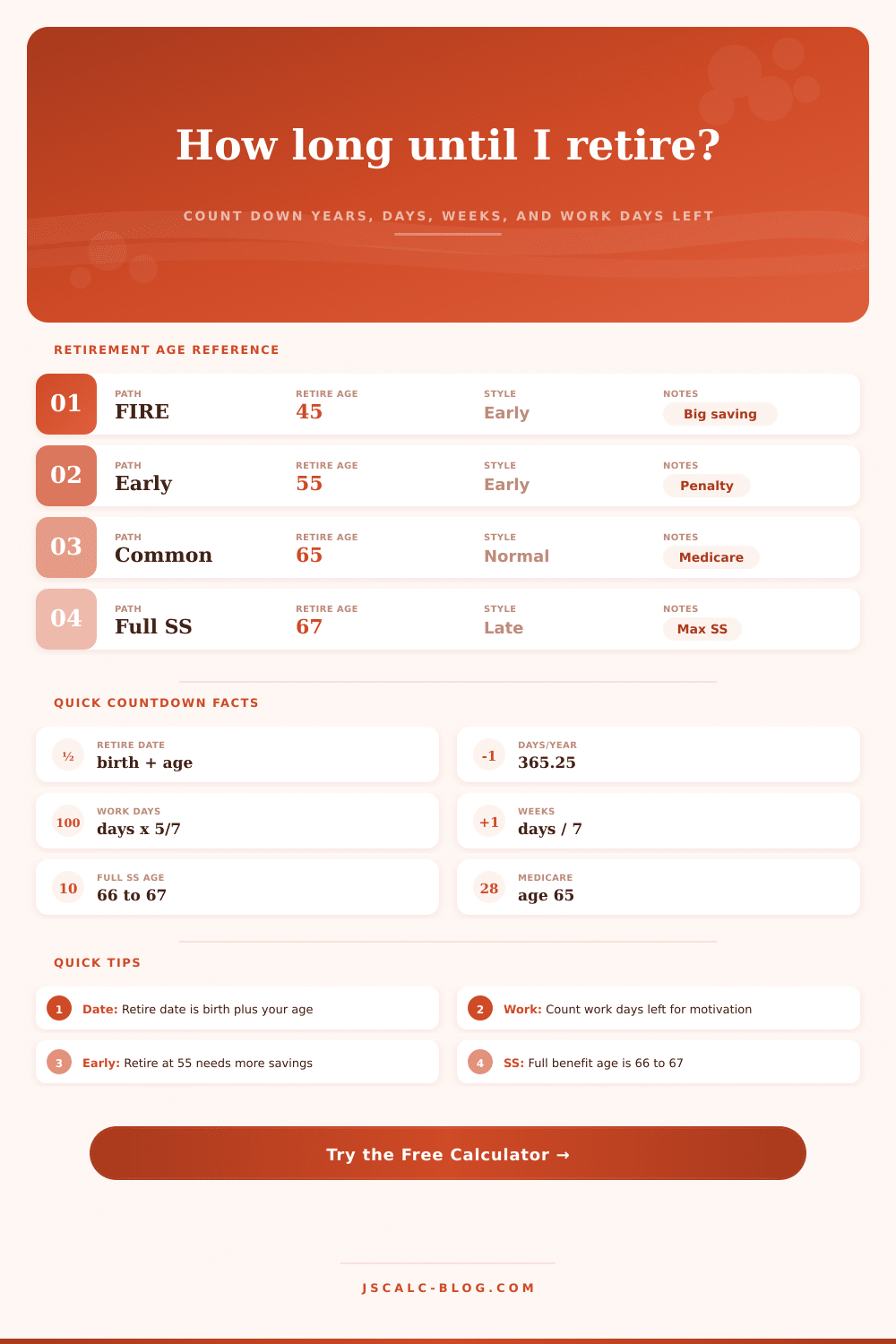
| FIRE target | 45 | Financial independence, retire early | Aggressive saving and investing |
| Early retirement | 55 | Rule of 55 for some 401(k) plans | Early exit, bridge to benefits |
| 401(k) access | 59.5 | Penalty-free retirement withdrawals | Tax-advantaged draws begin |
| Early Social Security | 62 | Earliest reduced SS benefits | Reduced monthly payment |
| Medicare | 65 | Federal health coverage eligibility | Very common retirement age |
| Full retirement age | 66 to 67 | Full Social Security benefit | Standard full-benefit exit |
| Delayed credits | 70 | Maximum Social Security benefit | Highest monthly payment |
👤Social Security Full Retirement Age
| Birth Year | Full Retirement Age | Months Past 66 | Note |
|---|---|---|---|
| 1943 to 1954 | 66 years | 0 | Flat full age of 66 |
| 1955 | 66 and 2 months | 2 | Two-month step up |
| 1956 | 66 and 4 months | 4 | Rising by two months |
| 1957 | 66 and 6 months | 6 | Halfway to 67 |
| 1958 | 66 and 8 months | 8 | Rising by two months |
| 1959 | 66 and 10 months | 10 | Almost at 67 |
| 1960 and later | 67 years | 12 | Full age of 67 |
⏳Years to Days Reference
| Years Left | Approx Days | Approx Weeks | Approx Months | Work Days (5-day) |
|---|---|---|---|---|
| 1 year | 365 days | 52 weeks | 12 months | ~241 days |
| 3 years | 1,096 days | 157 weeks | 36 months | ~722 days |
| 5 years | 1,826 days | 261 weeks | 60 months | ~1,204 days |
| 10 years | 3,653 days | 522 weeks | 120 months | ~2,408 days |
| 15 years | 5,479 days | 783 weeks | 180 months | ~3,612 days |
| 20 years | 7,305 days | 1,044 weeks | 240 months | ~4,816 days |
| 30 years | 10,958 days | 1,565 weeks | 360 months | ~7,224 days |
Work days assume five work days per week minus about 20 holiday and leave days per year.
⚙How The Date Math Works
💡Retirement Countdown Tips
If you’re reading this, chances are good that you aren’t counting down to retirement in years. You’re counting it down in paychecks. And while they may seem interchangeable, difference between them is far more important then you realize. A calendar year is an idea that marches past regardless of whether you’re at work or not. A work day is a concrete chunk of time that expect (and often needs) your attention and patience. Change the measure from former to latter, and finish line no longer feels so distant. It begins to appear as a climbable hill.
That’s what makes a countdown tool worth having. It take the vague idea of someday and transforms it into a specific number of Mondays left to survive. Once you know how many days you have left until retirement (the tool up top does this for you), it’s time to use the math. What will those days represent for your financial runway? What will those days represent for your financial runway? That’s where the math comes into play. You’ll input a few pieces of information and calculator will do the rest.
Why Counting Paychecks Helps Your Retirement Plan
It’s not just about knowing you might have eight thousand days left; it’s about learning what those days mean to your financial runway. First, there are a couple difficult decisions that need to be made upfront, they’re part of the inputs. Do you want to retire at age sixty-seven and collect all your available Social Security benefits? Or do you want to start dipping your toe in water back at age fifty-five? Those two dates aren’t random numbers you punch onto a form. Those dates represents wildly different levels of required savings.
When you move your retirement by a decade, you don’t simply lengthen your period of spending by a decade, you also take away a decade of compound growth from your retirement portfolio. And that’s a one-two punch that trips most people up. The other thing to really pay attention to is the work day calculation. You can change your schedule to account for personal leave and holidays. That alone have a big impact on the number.
If you get three weeks off per year, then that’s twenty-one days that will never be included in the grind. So it makes the countdown seem closer when we remove those days. It happens when we’re just counting the days we’ve been forced to sit in our office chair. That’s a small tweak. But it helps your morale. It feels much more tangible to watch the number go down by five every single week than to watch another year pass on the calendar. It changes passive waiting into active progress.
And speaking of the date math, there’s another factor: health coverage. Sixty-five is when most people become eligible for Medicare. So it’s a popular goal for those planning an early retirement, provided they’re not covered by some other means. If you plan to leave the workforce before Medicare eligibility at sixty-five, you’ll need a bridge strategy. This is clearly laid out in the reference table on the page, which demonstrate the connection between various ages and benefit availability.
Retire at age fifty-two? Collect nada until reaching a specific age. Should you wait longer to max out your monthly payout instead? Neither option are incorrect, but each suits a different lifestyle. One prizes freedom today. The other prizes security tomorrow. There’s a second type of psychological benefit from the progress bar, which is just plain cool: when you’re in your forties and fifties, right as it starts feeling like mid-life fatigue sets in, seeing how far along you’ve come on the progress bar can also helps fight that impulse.
The progress bar lets you know you aren’t starting from scratch. You’re closing the book. Knowing this provides closure, which makes it easier to push through those last few miles. No need to sprint till the end. Just keep running till time expires. And lastly, understand that your retirement date is not set in stone. It’s a hypothesis.
Markets goes up and down. People get sick and things happen in life. Your personal goals may shift. The number is a starting place, a baseline from which to plan. But it doesn’t determine your fate. Plug it into the calculator. Establish your target. And then use judgment to change it based off what actualy occurs.
The objective is not to nail down the precise date. The objective is to reach a point where your money works for you instead of you working for it. If you have this endgame clearly in sight, each day won’t feel like an endless slog. Instead, it will be a finite journey with a known exit. All you should of do is tally up the steps.