Countdown to Pregnancy Calculator
Estimate your ovulation date, days until ovulation, the six-day fertile window, and a possible due date if you conceive this cycle, using your last period date, cycle length, and luteal phase.
🐣Real Cycle Presets
📝Your Cycle Details
Used to count the days until ovulation.
Typical range is 21 to 35 days.
The gap from ovulation to the next period; 14 is the default.
Projects fertile windows across future cycles.
Educational estimate only. This tool is not medical advice, contraception, or a diagnosis. Talk to a healthcare provider about your fertility.
🔢Cycle Math Snapshot
📅Projected Fertile Windows
| Cycle | Period Starts | Ovulation | Fertile Start | Fertile End | Due If Conceived |
|---|---|---|---|---|---|
| Enter your details above to project upcoming fertile windows. | |||||
🗂Cycle Length vs Ovulation Day
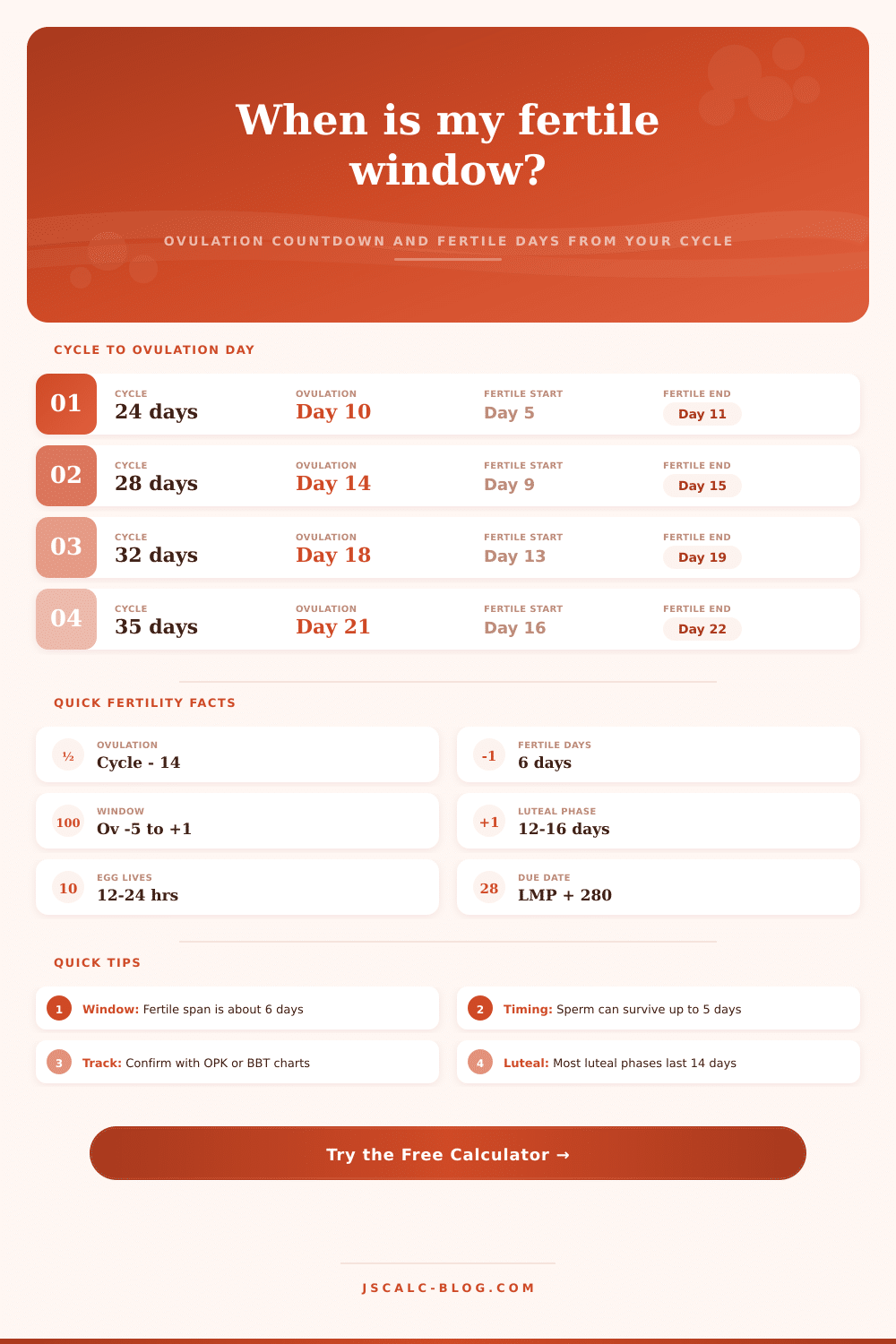
| Cycle Length | Ovulation Day | Fertile Start Day | Fertile End Day | Luteal Used |
|---|---|---|---|---|
| 24 days | Day 10 | Day 5 | Day 11 | 14 days |
| 26 days | Day 12 | Day 7 | Day 13 | 14 days |
| 28 days | Day 14 | Day 9 | Day 15 | 14 days |
| 30 days | Day 16 | Day 11 | Day 17 | 14 days |
| 32 days | Day 18 | Day 13 | Day 19 | 14 days |
| 34 days | Day 20 | Day 15 | Day 21 | 14 days |
| 35 days | Day 21 | Day 16 | Day 22 | 14 days |
🕛Luteal Phase Norms & Egg Facts
| Fertility Factor | Typical Value | What It Means | Timing Effect |
|---|---|---|---|
| Luteal phase | 12 to 16 days | Ovulation to next period | Longer luteal shifts ovulation earlier |
| Short luteal | Under 10 days | May reduce implantation time | Worth discussing with a provider |
| Egg lifespan | 12 to 24 hours | Window after release | Fertile end is ovulation +1 day |
| Sperm lifespan | Up to 5 days | Survival in fertile mucus | Fertile start is ovulation -5 days |
| Fertile window | About 6 days | Highest conception odds | Peaks the two days before ovulation |
👶Conception to Due Date
| Milestone | Days From LMP | Weeks | Notes |
|---|---|---|---|
| Ovulation | Day 14 | Week 2 | Conception usually here |
| Implantation | Day 20 to 26 | Week 3 to 4 | Roughly 6 to 12 days post-ovulation |
| Missed period | Day 28 | Week 4 | Test window opens |
| End first trimester | Day 91 | Week 13 | 13 weeks complete |
| Estimated due date | Day 280 | Week 40 | Naegele rule, LMP + 280 days |
⚙Full Cycle Math Breakdown
💡Fertility Timing Tips
Ovulation sounds like a point in time. It feels like there is a single moment when an egg is released, and then you either have good luck or you don’t. But it’s not so simple. Which is why I made this thing.
This clock turns the workings of your cycle into something you can hang onto: a calendar with days you could get pregnant. Enter your last period start date plus your typical cycle length. Then let the computer figure out the rest. It tells you not only when to expect to ovulate, but also that magical six-day period when the deed might happen. That changes everything. From one pressure-filled day to a six-day window you can work with.
How to Use the Ovulation Calculator
So what’s all this business about your luteal phase, the first question the tool poses? It’s the latter part of your cycle; after ovulation but before the onset of your next period. In normal cycles it tends to be consistent at around fourteen days long. The first part of the cycle (your follicular phase) on the other hand is highly variable; diet and stress influence it heavily from one month to the next.
If we use the relatively unchanging luteal phase as our starting point, the tool’s guesses are far more accurate. This is better than just guessing when you’ll next ovulate based off how many days ago your last period started. You can tell the tool what your luteal phase duration is (if, say, you’ve been tracking your basal body temperature and find out you’re not the usual fourteen-day luteal phase). It will then shift your predicted ovulation date earlier accordingly. That little adjustment makes a big difference when trying to get your timing right.
The second half of the equation is sperm survival. A lot of women thinks that all they have to do is have sex on the day of their ovulation. Wrong! It’s true that sperm can survive inside fertile cervical mucus for up to five days. However, once egg drops, it lives for only twelve to twenty-four hours. In other words, there’s a fertile window that begins long before your actual ovulation date.
According to the calculator, the fertile window is any time between the day of ovulation and five days prior. That gives you a six-day window that includes the greatest likelihood of conception. Trying to nail the precise moment when the egg emerges is pretty tricky business. Covering the larger area of possible fertility makes a lot more sense. Don’t worry about having to miss one peak day. In fact, the optimal days for conception are the two days leading up to ovulation plus the day of ovulation itself. But chances remain good even when having sex on non-peak days in the window.
If your cycle is inconsistent, you can input multiple upcoming cycles and see the projected windows. That way you can get a sense of how these may move around based on cycle variations. It will also give you an estimate for when conception might happen according to Naegele’s rule: add twenty-eight days to the first day of your most recent period, then subtract three months. Alternatively, add two hundred eighty days in total. This gives you something as vague as a finish line for what could be a lengthy race.
But calendar methods are still estimates. These are estimates based on nothing more than numbers and no number can capture travel plans, getting sick, or unexpected changes in hormones. For this reason, it’s always best to confirm ovulation using other indications. You can use an ovulation predictor kit to identify the hormone surge that signals upcoming ovulation within about 24-36 hours. You can also track changes in your cervical mucus that may indicate increasing fertility. Together, these methods help refine the guesswork; you’re aiming for informed timing, not perfect timing. Instead of waiting for a miracle, you’re stacking odds in your favor.
Trying to conceive involves a lot of waiting. Having a few days vs one hour is much less stressful. Spend less time watching the clock and focus more on natural intimacy. Use the tool to create structure. Data from your body. Trust what your body tells you, which may be different than the rigid prediction made by any algorithm. Let it serve as a guideline only, not a command. Connect when it’s right. Then it’s about connecting not performing.
The bottom line: this calculator is only a tool to help you plan (not promise). It explains the biology so you feel more comfortablely making decisions. You have an idea of how many days you’ll be fertile, and when to expect ovulation signs. Knowing what’s going on takes the guessing out of things and converts it into tactics. Data starts the clock; patience stops it. And keep in mind that while counting down, conception isn’t an event, it’s a process. We began by viewing the entire cycle, not just one point in time, and that’s something to hold onto as well.