Implantation Calculator – Countdown to Pregnancy
Estimate your implantation window (6 to 12 days past ovulation), the most likely implantation day, the earliest reliable home pregnancy test date, and a live countdown from today. Educational only, not medical advice.
🤞Common Scenarios
📝Your Cycle Inputs
Used when the method is the known ovulation date.
Used when estimating ovulation from your LMP.
Ovulation is estimated as LMP + (cycle – 14).
Days from ovulation to your expected next period.
Pick a day past ovulation to see its date and test status.
The countdown counts days from this date.
🔢DPO Math Snapshot
📊DPO Milestone Timeline
| DPO | Your Date | Stage | What Happens | Test Status |
|---|---|---|---|---|
| Enter your dates above to build the day-by-day timeline. | ||||
📈Implantation Timing Probabilities
| DPO | Timing Band | Relative Likelihood | Notes |
|---|---|---|---|
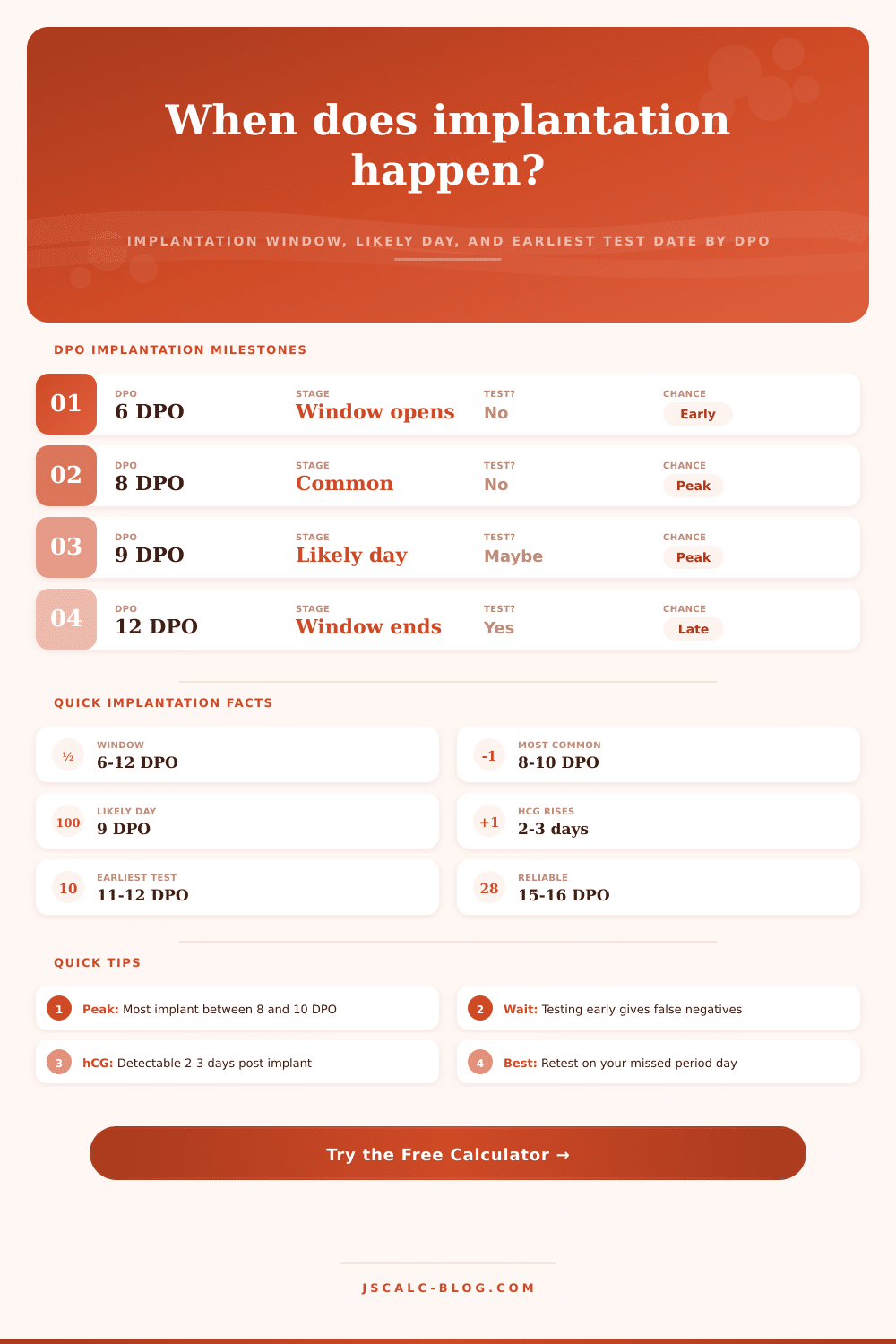
| 6–7 DPO | Early implanters | Lower | Window just opening, uncommon but possible |
| 8 DPO | Common | Rising | Many pregnancies implant on this day |
| 9 DPO | Peak | Highest | Most frequently reported single day |
| 10 DPO | Peak | High | Still very common, symptoms may begin |
| 11 DPO | Late common | Moderate | Window narrowing but well within range |
| 12 DPO | Late implanters | Lower | Latest typical day of the normal window |
🧪hCG Detection Timeline
| Stage | Days After Implant | Approx hCG | Home Test Odds |
|---|---|---|---|
| Just implanted | 0 days | Under 5 mIU/mL | Not detectable yet |
| hCG begins | 1 to 2 days | 5 to 10 mIU/mL | Rarely positive |
| Early detect | 2 to 3 days | 10 to 25 mIU/mL | Sensitive tests may show |
| Doubling phase | 3 to 5 days | 25 to 100 mIU/mL | Most tests positive |
| Missed period | 6 to 7 days | 100+ mIU/mL | Reliably positive |
✅Test Accuracy By DPO
| Test DPO | Days Post Implant | Detection Chance | Recommendation |
|---|---|---|---|
| 10 DPO | ~1 day | Low | Expect a false negative, wait longer |
| 11 DPO | ~2 days | Modest | Only early sensitive tests may catch it |
| 12 DPO | ~3 days | Fair | Earliest sensible test, retest if negative |
| 14 DPO | ~5 days | Good | Around the missed period, more accurate |
| 16 DPO | ~7 days | Very good | Reliable window for most home tests |
🗂DPO Comparison Grid
| DPO | Days To Go | Event | hCG Stage | Test Reliability |
|---|---|---|---|---|
| 6 DPO | Ov + 6 | Window opens | None yet | Do not test |
| 7 DPO | Ov + 7 | Early implant | None yet | Do not test |
| 8 DPO | Ov + 8 | Common implant | Trace forming | Do not test |
| 9 DPO | Ov + 9 | Likely implant | Rising slowly | Too early |
| 10 DPO | Ov + 10 | Symptoms may start | Low | Usually too early |
| 11 DPO | Ov + 11 | Late implant | Detectable soon | Sensitive tests only |
| 12 DPO | Ov + 12 | Window closes | Building | Earliest fair test |
| 14 DPO | Ov + 14 | Period approaches | Higher | Good accuracy |
| 15 DPO | Ov + 15 | Missed period | Strong | Reliable |
| 16 DPO | Ov + 16 | Confirm retest | Strong | Very reliable |
⚙Full DPO Breakdown
💡Implantation Tips
Waiting the two weeks are incredibly stressful, it’s like waiting for something biological to happen that you can’t see! You’ve figured out when you’re ovulating, you know you tracked your cycle…now you just have to wait for implantation. But there’s no need to wonder. There’s an implantation calculator for that.
It takes all of those unclear emotions and turns them into dates: When did I release an egg? Or when should my period start? This will help ease some of the stress, and put things in clear terms so you can plan accordingaly.
Why Use an Implantation Calculator?
The timing of implantation is based on when you ovulated (the embryo has to divide several times and travel before it implants into the uterine lining). From the day you ovulate, it typicaly takes anywhere from 6-12 days. When people assumes they should get pregnant right away, they forget that biology doesn’t work like that. It varies. The window is mapped out by your estimated ovulation date (or if you know your actual ovulation date) with a calculator. It will also take your luteal phase length into account (which help make the estimate more accurate).
Implantation happens on average nine days post-ovulation. Why? It can takes two to three days after implantation for hCG (human chorionic gonadotropin) to increase enough to be detected by home pregnancy tests. So while the hormone is present instantly upon implantation, a home pregnancy test won’t pick up the hormone until several days later.
So what if you implanted early, say, on day six post-ovulation? By day ten, your levels could still be below detectable limits and thus a test will return a negative result. Or maybe you implanted on day 12 post-ovulation, in which case by day 14, your levels might still be too low and a test would read as a false negative. Check out the chart below to see how likely you are to be detected depending on the point of attachment:
Pregnancy tests aren’t always accurate if you base it off your symptoms; many times early symptoms is mistaken for premenstrual syndrome. Your boobs might be tender, you might spot or experience some cramps, and they’re noticeable enough that you think maybe? But your body’s preparing itself for its regular cycle, those symptom align with your period. Using your gut is too emotionally biased for this test. The calculator forces you to view your body in terms of hormonal timeline and dates. It is not about how you feel, that way when you go through all of this stress, you won’t get confused.
You’ll have to decide whether you want earlier or more accurate results. There are tradeoffs between the two. An early test means you risk getting a false negative, which may end up being even worse than waiting. The calculator has options ranging from matching your estimated period to being super conservative for those who implanted later. If you use the conservative setting, you won’t get disappointed prematurely by a negative result before day twelve. That’s almost never the case, it’s just still too early to say. Be patient and you should of got a better answer.
Countdown is actualy more like an indicator, not a promise that you will be pregnant. For example, it might say there are “x” days left until you would expect hCG to be in your system at a level that a sensitive test could pick up. So while you wait, this gives you something to focus on. For example, you know what day you will hit a milestone, and then there is another date when you should start seeing positive or negative test results.
Daily testing doesn’t help if you do it early, because you aren’t producing the hormones yet so they won’t register. The longer you wait, the more accurate your results becomes. You can get rid of the guesswork by reducing uncertainty. While no tool will ever give us 100% assurance about our future, knowing the window of implantation helps us understand what is probable and what is not. It gives us the ability to wait until the right time rather than to guess. Knowing what’s going on with your body gives you an accurate idea of where you are in your cycle. And patience is still the best plan when trying to conceive in the initial weeks.