Volume to Weight Converter
Convert any volume into weight (or weight back into volume) using real material density. Pick water, milk, oil, honey, flour, sugar, sand, gravel, concrete, fuel, or enter a custom density in g/mL.
🧪Real Material Presets
📝Conversion Inputs
Used when converting volume to weight.
Used when converting weight to volume.
Active only when Material is set to Custom.
🔢The Core Formula
📊Material Density Reference
| Material | Density (g/mL) | Density (kg/m³) | Type | Weight of 1 L |
|---|---|---|---|---|
| Gasoline | 0.745 | 745 | Fuel | 0.745 kg |
| Ethanol | 0.789 | 789 | Alcohol | 0.789 kg |
| Olive oil | 0.918 | 918 | Cooking oil | 0.918 kg |
| Water | 1.000 | 1000 | Liquid | 1.000 kg |
| Milk, whole | 1.030 | 1030 | Dairy | 1.030 kg |
| Table salt | 1.220 | 1220 | Dry solid | 1.220 kg |
| Honey | 1.420 | 1420 | Syrup | 1.420 kg |
| Sand, dry | 1.600 | 1600 | Aggregate | 1.600 kg |
| Gravel | 1.680 | 1680 | Aggregate | 1.680 kg |
| Concrete | 2.400 | 2400 | Building mix | 2.400 kg |
| Mercury | 13.530 | 13530 | Metal, liquid | 13.530 kg |
🥄Cooking Ingredient Cup Weights
| Ingredient | Density (g/mL) | 1 Cup (236.6 mL) | 1 Tbsp (14.79 mL) | 1 Tsp (4.929 mL) |
|---|---|---|---|---|
| Water | 1.00 | 236.6 g | 14.8 g | 4.9 g |
| Milk, whole | 1.03 | 243.7 g | 15.2 g | 5.1 g |
| Olive oil | 0.918 | 217.2 g | 13.6 g | 4.5 g |
| Honey | 1.42 | 335.9 g | 21.0 g | 7.0 g |
| Flour, all-purpose | 0.53 | 125.4 g | 7.8 g | 2.6 g |
| Granulated sugar | 0.85 | 201.1 g | 12.6 g | 4.2 g |
| Table salt | 1.22 | 288.7 g | 18.0 g | 6.0 g |
📏Volume Unit to Milliliter Chart
| Unit | Milliliters | Liters | Water Weight | Notes |
|---|---|---|---|---|
| Teaspoon (tsp) | 4.929 mL | 0.00493 L | 4.93 g | US customary |
| Tablespoon (tbsp) | 14.787 mL | 0.01479 L | 14.79 g | 3 tsp |
| Fluid ounce (fl oz) | 29.574 mL | 0.02957 L | 29.57 g | 2 tbsp |
| Cup | 236.588 mL | 0.23659 L | 236.6 g | 8 fl oz |
| Pint, US | 473.176 mL | 0.47318 L | 473.2 g | 2 cups |
| Quart, US | 946.353 mL | 0.94635 L | 946.4 g | 2 pints |
| Gallon, US | 3785.41 mL | 3.78541 L | 3785.4 g | 4 quarts |
| Cubic meter | 1000000 mL | 1000 L | 1000 kg | SI volume |
🗂Weight Comparison Grid
| Material | Density (g/mL) | 1 L Weighs | 1 Cup Weighs | 1 Gallon Weighs | 1 Gallon (lb) |
|---|---|---|---|---|---|
| Gasoline | 0.745 | 0.745 kg | 176.3 g | 2820 g | 6.22 lb |
| Olive oil | 0.918 | 0.918 kg | 217.2 g | 3475 g | 7.66 lb |
| Water | 1.000 | 1.000 kg | 236.6 g | 3785 g | 8.35 lb |
| Milk, whole | 1.030 | 1.030 kg | 243.7 g | 3899 g | 8.60 lb |
| Honey | 1.420 | 1.420 kg | 335.9 g | 5375 g | 11.85 lb |
| Sand, dry | 1.600 | 1.600 kg | 378.5 g | 6057 g | 13.35 lb |
| Gravel | 1.680 | 1.680 kg | 397.5 g | 6359 g | 14.02 lb |
| Concrete | 2.400 | 2.400 kg | 567.8 g | 9085 g | 20.03 lb |
⚙Full Formula Breakdown
💡Accuracy Tips
You’re baking a cake, and there’s one cup of flour required by the recipe. You pour it from the bag into the bowl. Afterward, when your cake comes out dense compared to your neighbor’s, it’s not because your oven is different, or because you did something wrong. It’s because density matter. Volume does not always equal weight.
Physics says this daily, but most of us take it as an article of faith that they does. Under standard conditions, water has the handy property of weighing exactly one kilogram per liter. This means that a shipping label can simply note “10 Liters” to mean 10 kilograms; similarly, kitchen scales use this convenient fact as their basis. But change the substance and suddenly the tidy one-to-one no longer hold true.
Why Volume Is Not Weight
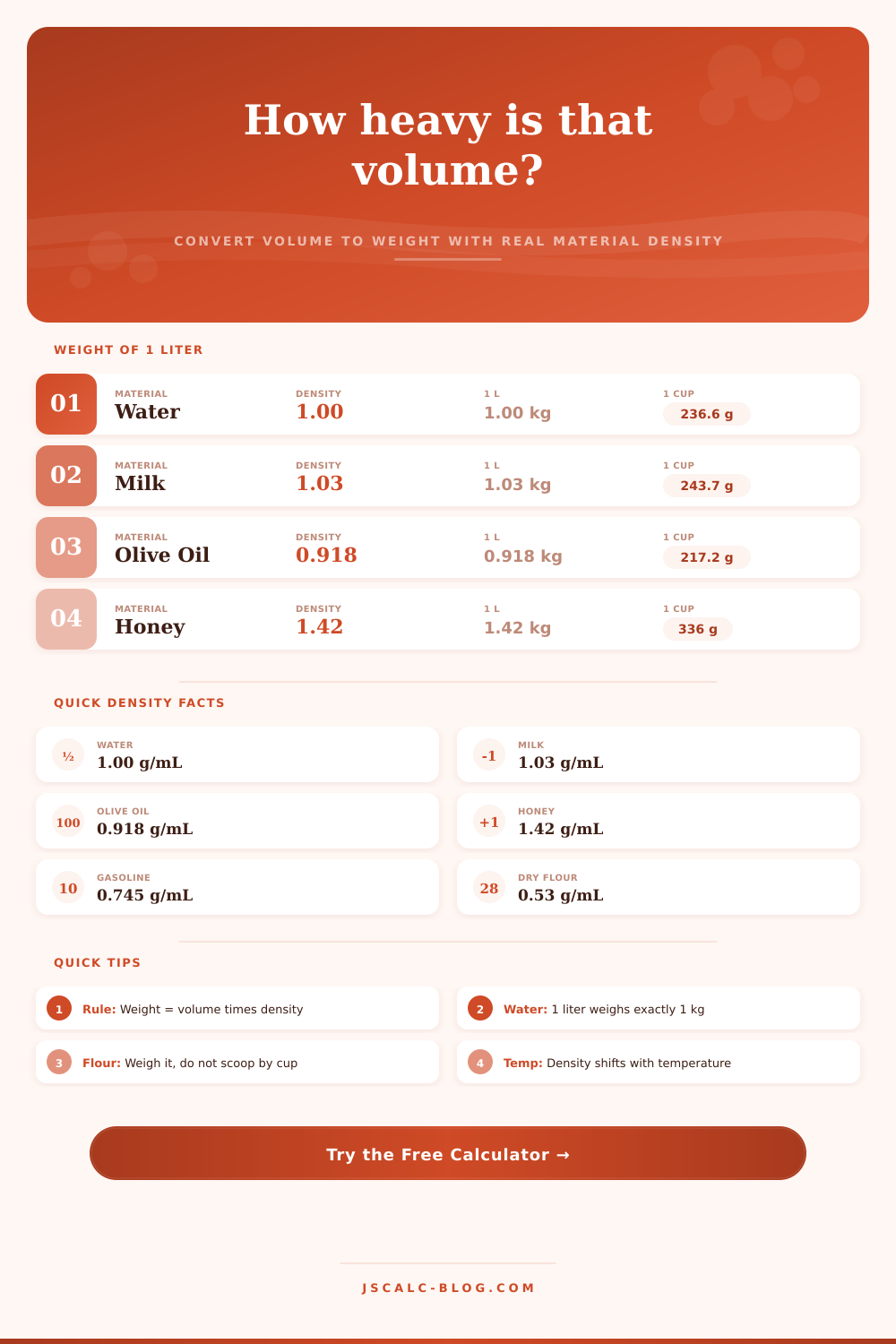
Density, on the other hand, is just a measurement of how tightly molecules in any particular amount of space are bunched up. Honey contains thick sugars, which crowd together far more densly than do the airy particles in all-purpose flour when they’re both poured into a cup. Though the containers remain the same, a heaping cup of honey weighs about 336 grams; the same amount of flour may only be 125. What’s in the container changes everything, whether you’re talking about building materials or dry goods.
The conversion tool above accounts for this variable. You can select from one of many materials (as seen in the image below), which allows it to determine your input value. If you simply type a value in as “volume”, that won’t do. You need to specify volume of what. There are some common ones for home use: olive oil, milk, etc., but it goes all the way up to heavy aggregates such as concrete and even sand. The density coefficient is applied different, so how it does the math entirely depends upon the density coefficient used.
Liquids have a fairly constant density. That slight difference determines whether your salad dressing separates or emulsifies properly. Its density is slightly less than water, at 0.918 g/mL versus 1.00 g/mL. That small variance makes the difference between emulsified dressings and separated salad dressing.
Simple formulas neglect a layer of complexity: dry ingredients! Flour especially varies widely. A cup of flour that was scooped out of a bag will be much heavier than a cup that was spooned and then leveled off, as former has been compacted in the bag. Because no one knows how much they’re compacting, the calculator use an average density to give you a baseline estimate. This is why, when baking professionally, we weight all our ingredients (and don’t use cups for anything). Human interaction changes how tightly a solid is packed each time it’s handled, making volume measures imprecise.
The same applies at a bigger scale to construction projects. If you’re having gravel delivered for your driveway, you don’t just multiply by cubic meters and expect it to tell you how many tons that will be. Concrete mixtures can range from 2.4 g/mL upwards depending upon the aggregates used, whereas dry sand ranges about 1.6 g/mL. If you get either side of this wrong, then you’ll underestimate weight of the material going onto a floor joist or overestimate how many cubic feet can fit into a truck bed for delivery. These weight differences are obvious from looking at the reference tables above. A gallon of gas is about six pounds; a gallon of water is more like eight and a half pounds. That two-and-a-half-pound difference per gallon makes a big difference if you’re trying to ship something. It also matters if you manage reserves of fuel.
There’s a little more to accuracy than that, liquids expand when they’re heated and contract when they’re cooled, which will change their density a fraction in response to temperature changes. It doesn’t realy make a difference for most casual conversions, but those fractions add up in an industrial setting. If you work with a specialty alloy or a weird chemical you can enter your own density values and it’ll spit out the same conversion. That makes this little kitchen helper double as a way of doing rough estimates for engineering work.
This is all to say that understanding the difference between weight and volume connects the visible with the carried, ultimately saving money and keeping projects from failing. From figuring out the tonnage of sand required for a sandbox to tweaking a baking recipe so it survives in high altitudes, the same principle applies: Mass is reality; space is just potential. And if you understand their relationship, via density, then guesswork becomes precision.
Maybe that cup of flour will always be challenging. But at least now you’ll have an exact idea of what’s causing its weight.