Unix Timestamp Converter
Convert Unix seconds or milliseconds to UTC, fixed-offset local time, ISO strings, readable dates, and 32-bit boundary checks.
Presets
Inputs and Options
Accepts whole or fractional seconds and milliseconds. JavaScript logs commonly use milliseconds.
Result Cards
Breakdown
Conversion Table
| Measure | Value | Formula or source | Use |
|---|
Timezone Offset Table
| Offset | Converted local time | Date shift | Note |
|---|
Boundary Table
| Boundary | Unix seconds | UTC date | Status |
|---|
Preset Reference Table
| Preset | Input | UTC result | Why it matters |
|---|
Comparison Grid
Tips
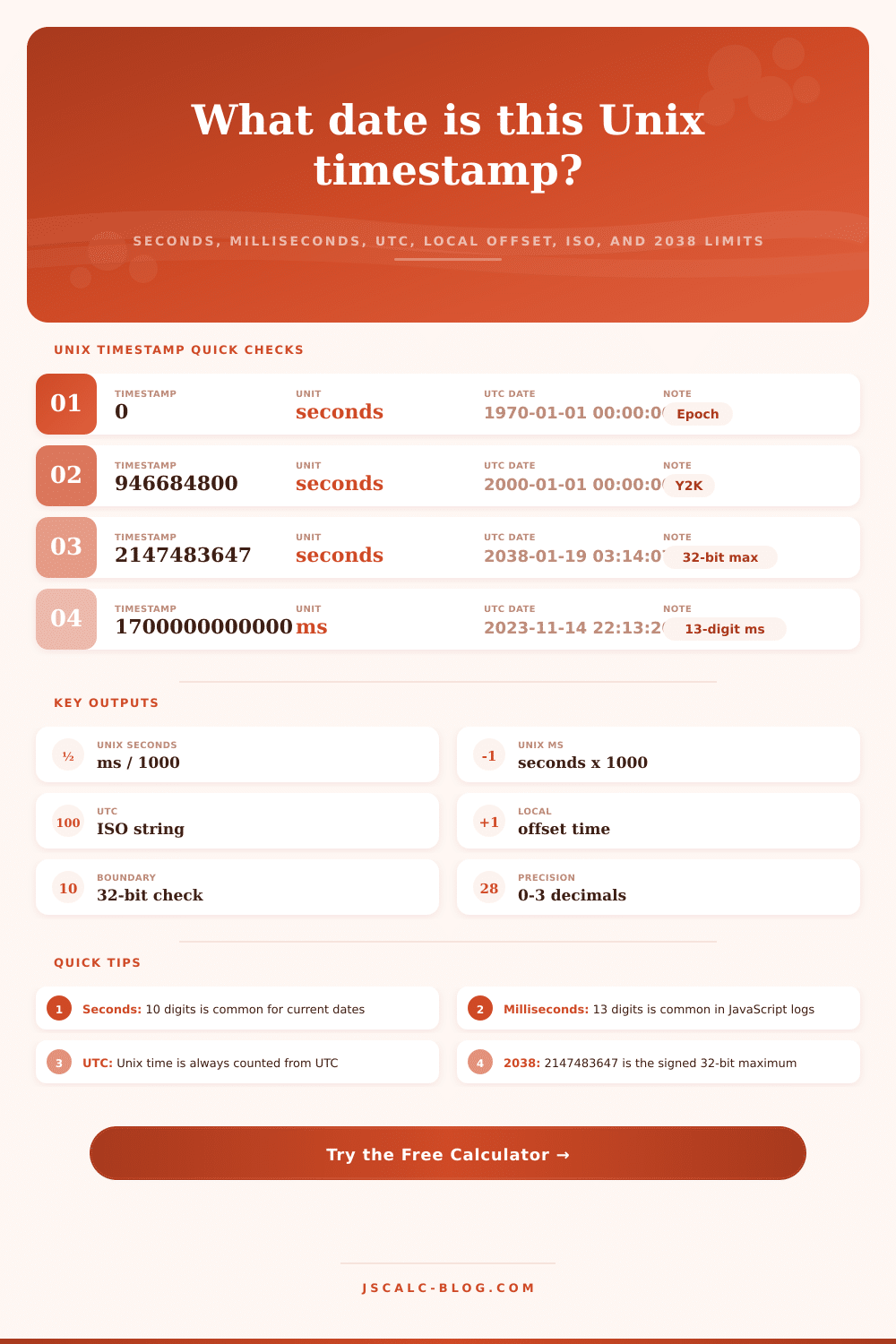
Your log file reports that a user logged in at 1700000000. To your eyes, it’s just a bunch of random numbers, yet it’s obviously some sort of timestamp. What was the date? Was it during Cold War era? Was it last week? Next year? This ambiguity is what make working with machine data so confusing. The translator (the calculator) figure out the translation, but without knowing how, you’re going to make costly mistakes.
Unix time isn’t a calendar. It’s a counter, beginning at midnight UTC on Jan. It began on Jan. 1, 1970, known as Unix epoch. And each passing second add one to this number. There are no daylight saving adjustments, no leap years and no months. It’s simply a march of time starting at some point.
Why Unix Time Is Confusing
While simple enough for machines, it’s difficult for human beings who tend to think about time in terms of dates. The largest trap: units is confused. Some systems (e.g., Android and JavaScript) measure time in milliseconds, while others (e.g., Linux commands and Python) measures it in seconds. A number in milliseconds have 13 digits; a number in seconds has 10. If you put a millisecond number into an input designed for second, it will jump ahead by a thousand. That sends your timestamp to the year 5,000. That’s a Tuesday in November becoming a year in the year five thousand.
By checking whether the number size match a known unit, the tool can infer the unit… But always check yourself. It doesn’t take much… But it prevents you from debugging a timeline that jumped too far into the future.
That’s the UTC time when you convert the number. The standard anchor is called Coordinated Universal Time. You can add an offset on the calculator and it’ll show you what local time is in New York or Tokyo or London. Wherever you might be in the world, at any given moment, the Unix timestamp doesn’t change. All that happens is display adjusts. People tend to mix up those two concepts. They believe that converting to their local time also converts the data. But it doesn’t. The number itself remain unchanged.
Systems with signed 32-bit integers has their own limit as well. They can holds up to 2147483647, or what will happen on a particular day in 2038 (January 19, 2038, 3:14:07 UTC). A second after that, it’ll overflow and turn into a negative number. That would of send your computer all the way back to January 1, 1970. 64-bit systems are common these days and they don’t have this problem. But we’re still dealing with 32-bit systems on older computers and databases. If your data approach that limit, it’s highlighted by the boundary check. And then it tell you that even infinite time has a storage limit.
A converter can be simple; skill require context. For example, when was this timestamp sent? Seconds? Or milliseconds? Was it local time, or was it UTC, which is actualy the actual time? And don’t forget: 2038 is looming. With those three things in mind, the digits stop being abstract. The date becomes obvious from the ten-digit sequence in front of you. No more asking a tool to tell you what’s going on here.
You should of checked the unit based off how big it was more different than you thought. It’s much more luxuruis than most people think for such moddern technolgy.