Triple Net Lease Calculator
Estimate monthly base rent, property tax recovery, insurance recovery, CAM, administrative load, utilities, escalation, free rent credit, total occupancy cost, and effective annual rate.
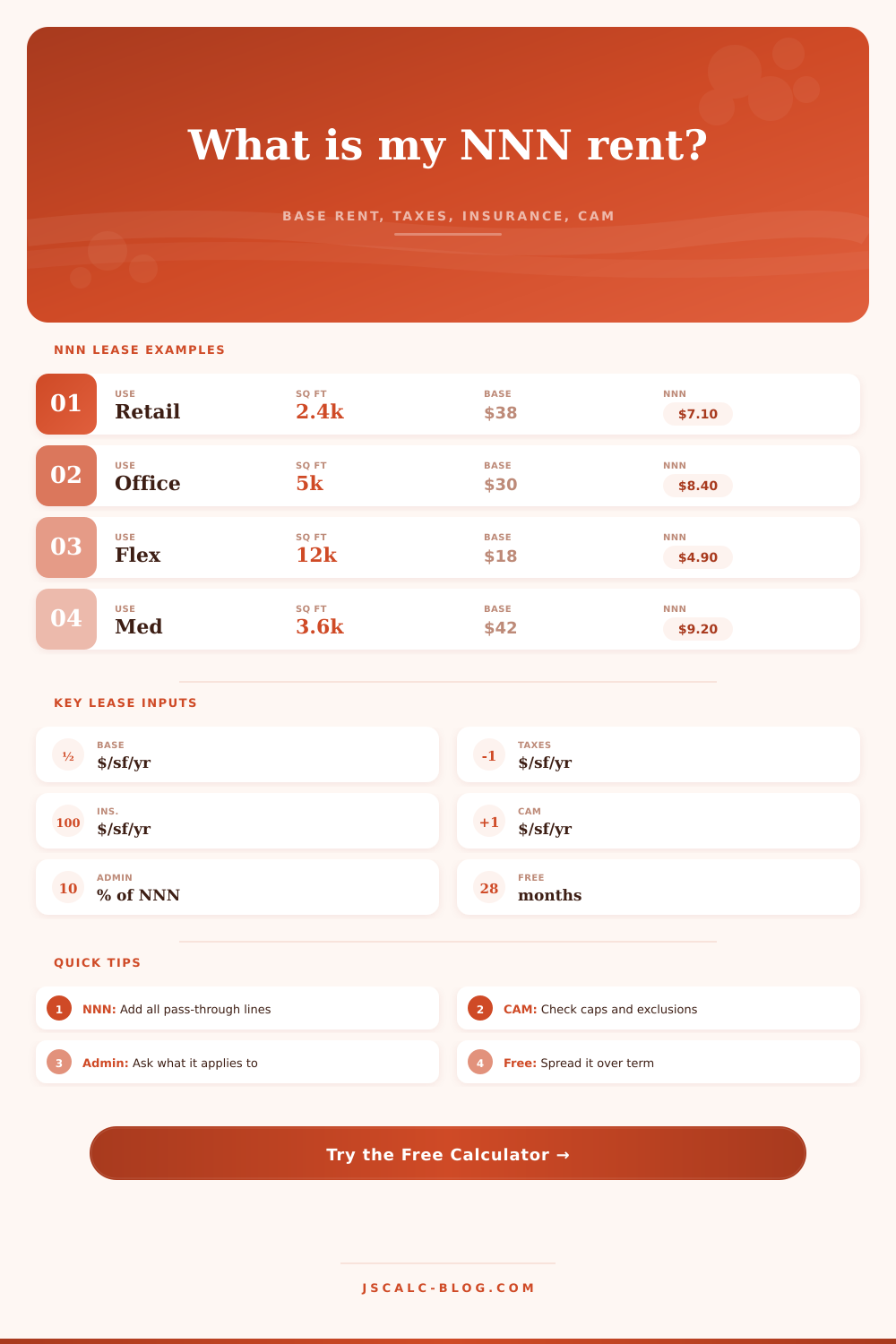
📌NNN Lease Presets
📝Triple Net Lease Inputs
Use rentable square feet from the lease proposal.
Monthly base rent = rentable sq ft x base rate / 12.
Enter the current tax recovery or estimated tax pass-through.
Use the landlord's insurance recovery estimate.
Common area maintenance often includes shared upkeep.
Some leases charge admin on controllable operating expenses.
Enter separately metered or reimbursed utility cost.
Applied once per lease year to base rent only.
Used to spread free rent across the full term.
Free rent is credited against base rent, not recoveries.
Used for the term schedule, not the first-month quote.
Detailed breakdown rows still use exact monthly math.
📊Current Scenario Metrics
🔢Formula Breakdown
📋Preset Comparison Table
| Preset | Sq ft | Base rate | Tax | Insurance | CAM | Admin | Monthly NNN | Occupancy | Eff. rate |
|---|
📅Lease Year Schedule
| Year | Base rate | NNN rate | Monthly base | Monthly NNN | Utilities | Annual occupancy | Free credit | Collected total |
|---|
🔍NNN Line Item Quick Lookup
| Line item | Common input | Monthly conversion | Tenant check | Modeling note |
|---|---|---|---|---|
| Base rent | Annual $/sq ft | Sq ft x rate / 12 | Confirm rentable area | Usually escalates by lease clause |
| Property taxes | Annual $/sq ft | Sq ft x tax / 12 | Review assessment basis | Often reconciled after tax bill |
| Insurance | Annual $/sq ft | Sq ft x insurance / 12 | Ask for recovery schedule | May be separate from tenant policy |
| CAM | Annual $/sq ft | Sq ft x CAM / 12 | Check controllable caps | Clarify exclusions and capital items |
| Admin fee | Percent of NNN | NNN subtotal x admin % | Ask which costs are included | Can be applied before or after caps |
| Utilities | Monthly dollars | Entered monthly amount | Verify metering method | Add to occupancy cost, not $/sf quote |
📈NNN Sensitivity Table
| Scenario | Tax rate | CAM rate | Monthly NNN | Occupancy cost | Effective rate |
|---|
💡Practical NNN Lease Tips
Many commercial leases look straightforward at first glance, showing a square footage amount and a base rent. Sounds good to go, right? Nope. Not necessarily.
Many commercial leases are triple net. This means the landlord will pass through all expenses for property taxes, insurance premiums and common area maintenance, and those costs can be significantly more then the base rent. That’s particularly true if the building systems needs significant maintenance, or if the tax assessment has increased significanty.
Hidden Costs in Commercial Leases
How do they add up? Will it be a budget breaker, or will it still keep your overhead under control? Once you input your unique lease term, the calculator does the math for you. That way you don’t have to guess which numbers to plug into each box or understand coefficients and other confusing conversions.
Understanding the context of how commercial landlords design their leases is helpful so that you know what to put in each box. The base rent is merely an entrance fee. The true expense is the NNN charges, which are the operating expenses of the building divided by its total leasable area. For example, if you’re comparing two spaces in separate buildings, the one with lower base rent may actualy end up costing you more, provided the building’s operating expenses (e.g., common area maintenance, insurance) is higher.
That variable is most likely property taxes. And it tends to be the biggest one. Values are constantly being reassessed at local levels. Even if your business is humming along nicely, your property tax bill can spike greatly from year to year.
The tool allows you to model such volatility by giving you the option to vary the annual growth rate for recoveries apart from the rate of escalation of the base rent. That’s important because while your base rent may escalate by a flat 3% annually, for example, property taxes tends to grow much more quickly in high-growth areas. You’ll underestimate your long-term holding costs by a wide margin if you don’t account for this divergence.
The other surprise expense is insurance. Your landlord purchases insurance to cover liability in common areas and building structure issues. That’s passed on to you via the square footage you rent. In essence, you’re paying for part of his or her plan to manage risk.
Common area maintenance includes cleaning of common areas, lighting, parking lot repairs and landscaping. Because these expenses vary depending on labor rates and fuel prices, many leases exclude them or cap them as a way to limit variability.
The example table below illustrates how each element translates from an annual amount per sq. Ft. To the required monthly cash flow. In the fine print, they bury administrative fees (often a % of their NNN charges). So while it seems like a modest mark-up at first glance, when applied to thousands of dollars in insurance & tax payments, it adds up fast. A ten percent admin fee on a significant tax recovery is a lot. That’s extra overhead that effectively raises your operating expenses while adding no additional value in terms of services provided (i.e., administrative tasks associated with billings). Always request what percentage is being charged, and whether this compounds with other fees.
Concessions like three months free rent make you think it’s a sweet deal, but if they’re spread out evenly throughout the life of the lease, they won’t add up to much. In a five-year lease, three months of free rent doesn’t dent the effective annual rate. That’s why the calculator spreads concessionary credits over total lease duration, so it can provide you with an effective annual rate, giving you a better idea of how much you’re really paying on a per-square-foot basis over time. It reveals the cost, instead of only the first-year cost when the concession kicks in.
The next thing that should of had its own line item in your budget model is your utilities. Utilities are typically metered and billed (or at least estimated) separately from other expenses, such as CAM charges. In many NNN structures, utilities are metered separately or estimated based off usage patterns rather than being included in general CAM charges. For example, if you run an energy-intensive business, think manufacturing facility or restaurant… Your utility bills may easily overwhelm the insurance bill altogether every month. Tackling this problem through negotiating base rent won’t solve it; you’ll overrun your budget if you treat it as an afterthought.
A lease isn’t just one number. It’s how much it costs to occupy the space. It’s how much you’re paying each month for variable (operating) costs vs fixed (obligations). And once you break it out, you begin to understand the pieces. What you can push back on. What you’re stuck with at market rate. If the base rent is low but the property’s tax burden is being shifted entirely in your shoulders; well, that’s not so good. There’s no historical data here, and there’s no cap. You’re not trying to get the lowest dollar per square foot on paper. You’re trying to set up a stable cost structure so that you can predict forward and know what the heck’s going on. So you don’t have to worry about some crazy spike in your operating costs.
You get to look at the whole package, the concessions + recoveries + base rent, and control your financial path, as opposed to just reacting month-to-month to whatever statement comes across your desk. The math explains who gets the risk. And if you read it right, it protects your bottom line when the market turns.