Commercial Lease Cost Calculator
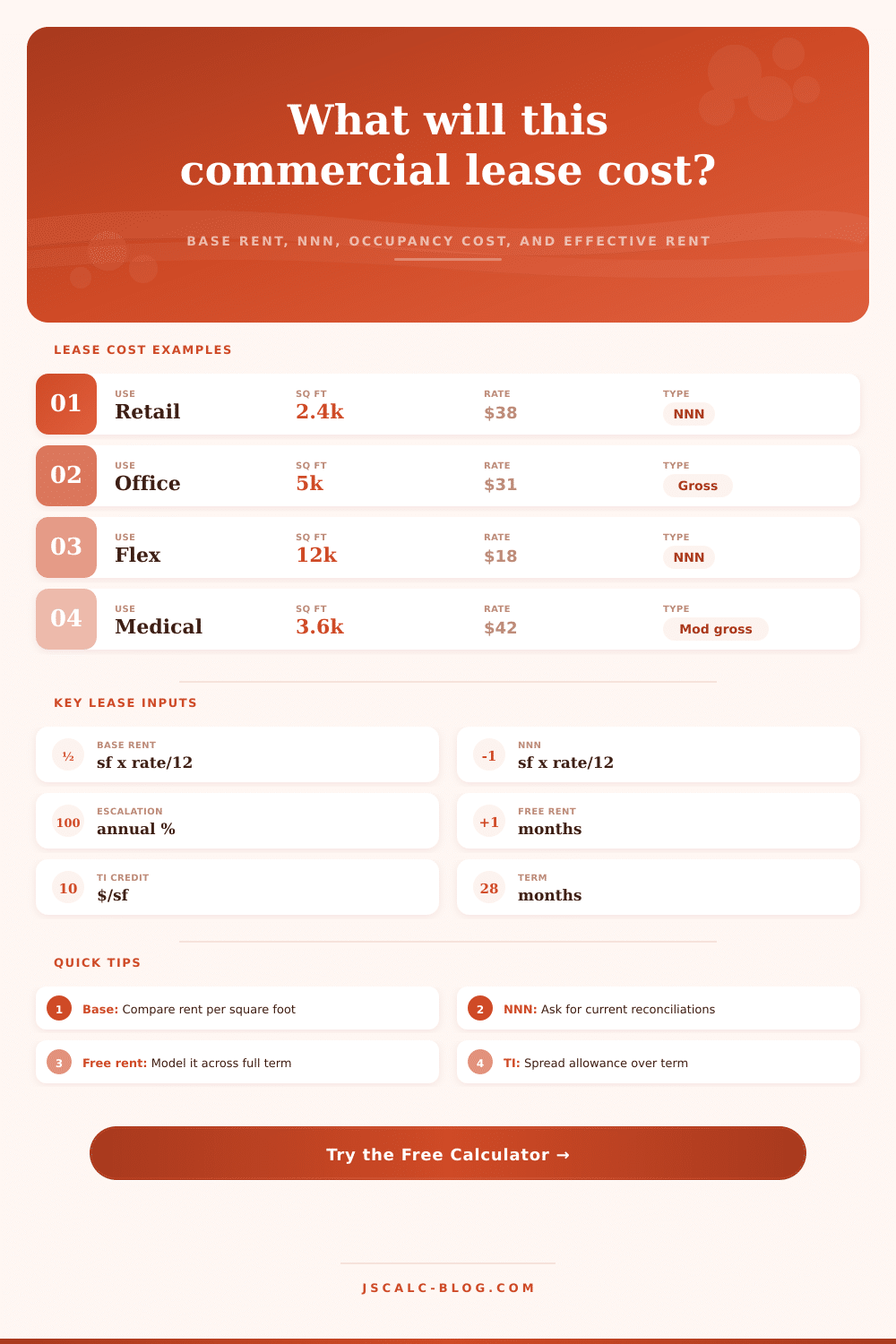
Estimate monthly base rent, NNN pass-throughs, utilities, parking, annual escalation, free rent credit, tenant improvement allowance, and effective occupancy cost.
🏢Commercial Lease Presets
📝Lease Cost Inputs
Use rentable area from the proposal, not usable area.
Base rent = rentable sq ft x annual rate / 12.
Lease type controls how much of the pass-through pool is added.
Use this for quoted combined recoveries or known additional rent.
Free rent is credited against base rent over the term.
Effective rent subtracts TI allowance spread across all term months.
For non-retail leases, leave this at 0.
📊Five-Column Lease Snapshot
🧮Formula Breakdown
🏗Lease Type Reference
| Lease type | Typical tenant adds | Calculator factor | Best fit | Watch item |
|---|---|---|---|---|
| Triple net (NNN) | NNN, CAM, taxes, insurance | 100% pass-throughs | Retail, industrial, single tenant | Annual reconciliation |
| Modified gross | Shared recoveries | 55% pass-throughs | Office and mixed spaces | Expense stop language |
| Full service gross | Often bundled | 15% pass-throughs | Multi-tenant office | Base year resets |
| Industrial gross | Some taxes or utilities | 35% pass-throughs | Warehouse and flex | Metering details |
| Retail plus percentage rent | NNN plus sales rent | 100% plus sales rent | Street retail, centers | Breakpoint definition |
| Absolute net | Nearly all property costs | 115% pass-throughs | Single tenant buildings | Capital repair exposure |
📑Preset Comparison Table
| Preset | Lease type | Sq ft | Base rate | Base rent | Pass-throughs | Occupancy cost | Effective rent | All-in $/sf |
|---|
📈Escalation Sensitivity Table
| Scenario | Escalation | Year 1 base | Final year base | Term base rent | Effective monthly |
|---|
📋Pass-Through Quick Lookup
| Annual rate item | Input basis | Monthly formula | Included in NNN lease | Review source |
|---|---|---|---|---|
| NNN charge | $/sq ft/year | Sq ft x NNN / 12 | Yes | Lease proposal or statement |
| CAM charge | $/sq ft/year | Sq ft x CAM / 12 | Yes | Operating budget |
| Property taxes | $/sq ft/year | Sq ft x taxes / 12 | Usually | Tax bill or estimate |
| Insurance | $/sq ft/year | Sq ft x insurance / 12 | Usually | Landlord recovery schedule |
| Utilities | Monthly dollars | Monthly utility estimate | Depends | Metering and usage history |
| Parking | Monthly dollars | Monthly parking charge | Often separate | Parking exhibit |
💡Two Practical Tips
Nearly every entrepreneur believe he knows his rent because lease proposal shows one figure in bold typeface. Nearly without fail, that figure is incorrect.
First of all, it’s partial: it represents your “base” rent divided by square footage, i.e., the amount of money you pay for the right to live on the premises. It doesn’t include cost of roof repair; it doesn’t include lighting; it doesn’t even include landscaping. All those expenses is buried in small print under names such as Property Tax Recoveries, NNN Fees, and CAM Charges. Add ’em up, and you’ll have some idea of your overhead.
The Real Cost of Renting Commercial Space
Once you enter your custom rates into the calculator above, it spits out math for you. And it requires you to distinguish between base rent vs. Recoveries, which confuse a lot of novice commercial tenants. For example, triple net leases (common in industrial and retail properties) requires you to pay nearly all expenses. Maintenance, insurance and taxes is passed directly through to you by the landlord. Full service gross leases (common in older office buildings) bundle these costs as part of the base.
Knowing this about your lease should change how hard you push when negotiating that headline rate. Sometimes a high base rent with no additional charges may end up being cheaper then a low base rent with aggressive pass-throughs. This tool allows you to model each scenario side-by-side to understand the true difference.
Another area where intuition sucks is escalation. Landlords think their increase is small, individually. One percent annually sounds reasonable! Compounded, it is only 3% over a period of five to ten years. Without re-negotiating, by year five your base rent have increased a lot. Model out the full cost of lease (not just month one). The calculator models escalations for length of your lease, so you’ll get an idea of what the last year will cost you.
Many tenants gets hung up on the moving in expense and overlook the moving out expense. Then there’s the whole issue of tenant improvement allowances and free rent periods. On the face of things, these incentives appear to save you money, in fact, they’re just cash flow management devices. Three months of free rent doesn’t reduce your average cost, it just alters timing of payment. To reflect this, the calculator spreads the credit across the entire duration, representing its effective monthly cost. While you’ll always see the stated base rate for reference purposes, this is much less meaningful than the effective rental rate which captures the deal’s true economic impact.
For example, a landlord may dangle a two-month free-rent carrot in front of you while increasing base rate ten bucks per square foot. You could of end up paying more… The numbers will reveal precisely how much.
Utilities and parking are often seen as extra or changing costs. That is to say, they’re not something you worry about until later, when you realize their importance. In fact, utilities in old buildings without moddern heating/cooling can fluctuate wildly depending on use (if there’s been any) and season. Parking fees can rival the base rent for a medical office or restaurant with lots of client traffic. Not including them in your model leaves a dangerous blind spot. Sure, you may find someplace that looks good on paper, only to have the heat bill kill you in January.
The tool also came with a helpful reference table explaining which risks gets allocated to each party in various types of leases. Take some time reading through that, it’ll help you understand where your responsibility starts (and where the landlord’s ends). For example, if you have an absolute net lease, you may be on the hook for significant structural repairs. That shifts the entire risk profile, instead of merely renting someone else’s space, you’re effectively a partial owner of their building. Knowing the allocations will save you from any nasty surprises come tax season … or whenever the roof spring a leak.
In the end, a commercial lease is a piece of financial engineering almost more than anything else, a financial instrument. Sure, the space may have great natural lighting or lofty ceilings. That won’t pay itself, though. So what does? Does your revenue model support all-in occupancy cost?
Before signing, run the numbers. Don’t look solely at the headline rent. Look at the effective rent. And remember: Today’s cheapest square foot could easily become tomorrow’s most-expensive by Year Three (if the escalation clause proves to steep). Avoid regret; do the math early.