Lease Payment Calculator
Estimate equipment or auto-style lease payments from cap cost, residual value, term, money factor or APR, taxes, fees, down payment, mileage charges, and payment timing.
📌Lease Presets
📝Lease Inputs
Standard mode separates depreciation and finance charges. PV mode solves a fixed annuity payment.
Used for comparison notes and reference ranges.
Vehicle price or equipment value before reductions.
Cash down, rebates, trade credit, or other cap cost reductions.
Number of scheduled monthly payments.
Percent mode multiplies the residual basis by the residual percentage.
Often MSRP for auto leases, or original equipment value for equipment leases.
Used only when residual input is percent.
Used only when residual input is dollar value.
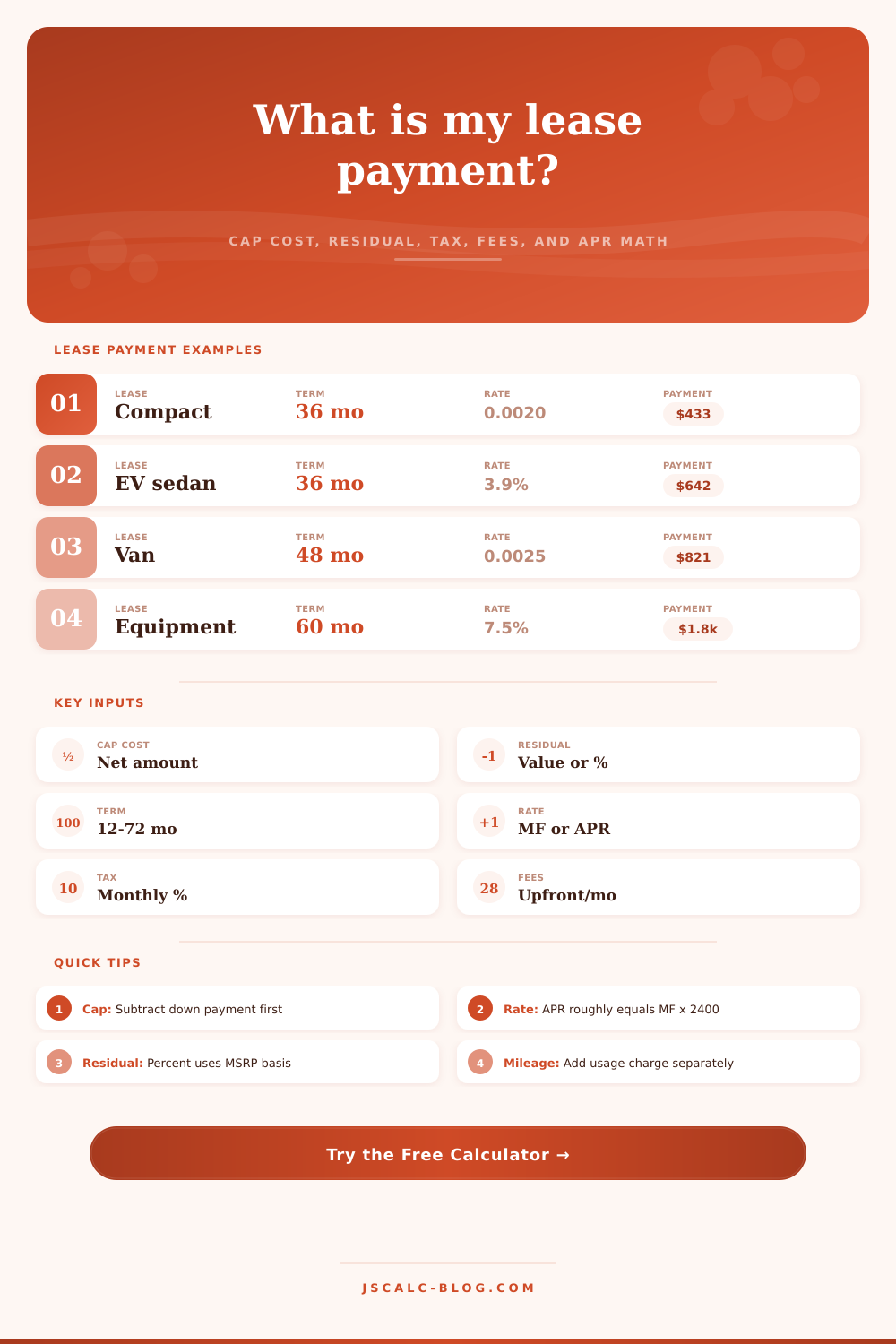
Approximate conversion: APR percent = money factor x 2400.
Standard lease finance charge uses (net cap cost + residual) x money factor.
PV annuity mode uses APR / 12 as the monthly rate.
Some leases tax each payment; others collect tax on capitalized amount.
Applied according to the tax treatment selected above.
Acquisition, documentation, title, or registration amounts capitalized into the lease.
Recurring service, property tax, administration, or account fees.
Enter annual miles, yearly hours, or other yearly included usage units.
Excess usage is spread across the monthly payment estimate.
For cars this is usually cents per mile; for equipment it can be dollars per hour.
PV annuity mode adjusts beginning-of-period payments as an annuity due.
📊Lease Snapshot Grid
📐Formula Breakdown
🗂Preset Comparison Table
| Scenario | Method | Net cap | Residual | Term | Rate | Base payment | Tax and fees | Usage add | Total payment |
|---|
📑Money Factor Reference
| Money factor | APR equivalent | Monthly rate | Finance charge on $50,000 | Common note |
|---|
📋Lease Profile Reference
| Profile | Typical term | Residual style | Rate style | Usage control |
|---|---|---|---|---|
| Auto lease | 24-48 months | Often MSRP percent | Money factor | Miles per year and cents per mile |
| Fleet vehicle | 36-60 months | Market forecast value | Money factor or APR | Annual mileage and maintenance limits |
| Office equipment | 36-60 months | Dollar buyout or fair market value | APR or lease factor | Click count, service, or page allowance |
| Construction equipment | 36-72 months | Residual value or balloon amount | APR | Annual engine-hour allowance |
| Medical equipment | 48-84 months | Fair market value estimate | APR | Service contract and utilization limits |
| Technology lease | 24-48 months | Low residual due to obsolescence | APR | Device count and refresh schedule |
💡Two Practical Tips
That’s why I decided to crack open lease math.
You think you’re getting a good deal when you sign up to drive yourself a car home from the lot for less money then expected each month, only to find out that there was a mathematical trapdoor embedded in fine print. Those trapdoors exist as hidden fees and high capital costs bury within the legal language of the contract.
How to Understand Lease Math
When you understand how your monthly lease payment is calculated, you take the mystery away and get your power back. The black box become a spreadsheet you can audit.
There’s nothing more fundamental to a lease than depreciation, the loss in value due to time spent behind the wheel. By leasing, you gets the right to drive car in the prime of its life (when it has the most value) but avoid responsibility of ownership (as that value drops). And the way the lease breaks that down into a separate figure (as shown in the calculator above) is important; why? Because these two figures behaves differently: Finance cost is influenced by interest rate.
Depreciation, however, depends solely on how much you believe the car will be worth as the lease starts versus end. Set the residual amount too low and boom! Your monthly payment increase because you’re covering more of the total cost of asset. That’s the mistake folks make: They obsess about the interest rate but not enough about the residual percentage (which is responsible for most of bill).
And then there’s the money thing, that crazy little number that remains an industry holdover from the days before APRs were required to disclose actual yearly rate of borrowing. That way it seems small: a small decimal point instead of a glaring double digit. You just multiply the money factor times two thousand four hundred, and there it is! There’s the real APR expressed in stark terms. A money factor of zero point zero zero three equals roughly seven point two percent interest.
But the tool will do the math for you and let you see how these leasing deals stack up against traditional auto loans without having to do complex math. It’ll display what those rates mean, after they’re applied to residual value plus the (net) cap cost.
The other wrinkle is taxes (and this depends on your state). If you’re in a state that allows you to pay sales tax on the monthly payment alone instead of the entire purchase price upfront, you’ll save thousands. Toggle this setting with the calculator and notice how rules of your area affect your bottom line. This little switch makes a huge difference in total cost.
Another fee to factor in here: acquisition fees and disposition fees. Think of these as administrative tolls applied by the leasing company. They gets added to the capitalized cost, which increases the amount on which interest accrues.
At the end of the lease, lessees is often surprised by usage charges. The contract most likely had a built-in mileage allowance (typically 12,000 miles per year). Any miles in excess of this will incurs extra per-mile fees that can cost hundreds of dollars extra at turn-in time.
To avoid being shocked when you hand back the keys, factor these potential overages into your monthly estimate so you’re able to budget realisticly. If you know you’ll be driving above the average amount, ask for a higher mileage package as part of your negotiation or include the additional fee in your cash flow model upfront.
In the end, there’s a tradeoff with leasing: prioritizing cash flow today at the expense of long-term equity. You will never own this vehicle (unless you choose to purchase it outright at the end) but you also don’t have to deal with selling off your used car. Unless driving newer cars every few years and avoiding the steep loss in value during the first three years is important to you, the math simply should of worked.
Understand how the residual affects depreciation and how the money factor obscures interest rates. This allows you to leave your seat-of-the-pants thinking behind and begin bargaining from a position of knowledge. You’ll enter the dealership knowing precisely what figures are relevant and what are merely cosmetics, there’s no more pretending that the monthly payment is anything other than the sum of its parts.