Transfer Credit Equivalency Calculator
Convert semester, quarter, ECTS, CATS, or contact-hour credits, then test grade rules, course match, caps, duplicates, program fit, and residency at JSCalc-Blog.com.
Use the credit units printed by the sending institution.
Use the maximum allowed transfer credits in target units.
Percent of credits likely to match an equivalent course, elective, or requirement.
Percent that fits the major, general education, electives, or concentration plan.
Percent removed for repeated, overlapping, expired, or already-awarded credit.
Required percent of the degree that must be completed at the target institution.
accepted credits = source credits × credit system conversion factor
eligible credits = accepted credits when earned grade meets the minimum grade
applicable accepted credits = min(cap, eligible credits × course match % × program applicability % × (1 - duplicate adjustment %))
remaining degree credits = degree requirement - applicable accepted credits - completed resident credits
resident credits still needed = max(0, degree requirement × residency requirement % - completed resident credits)
| Credit system | Semester equivalent | Quarter equivalent | ECTS equivalent | Typical use |
|---|---|---|---|---|
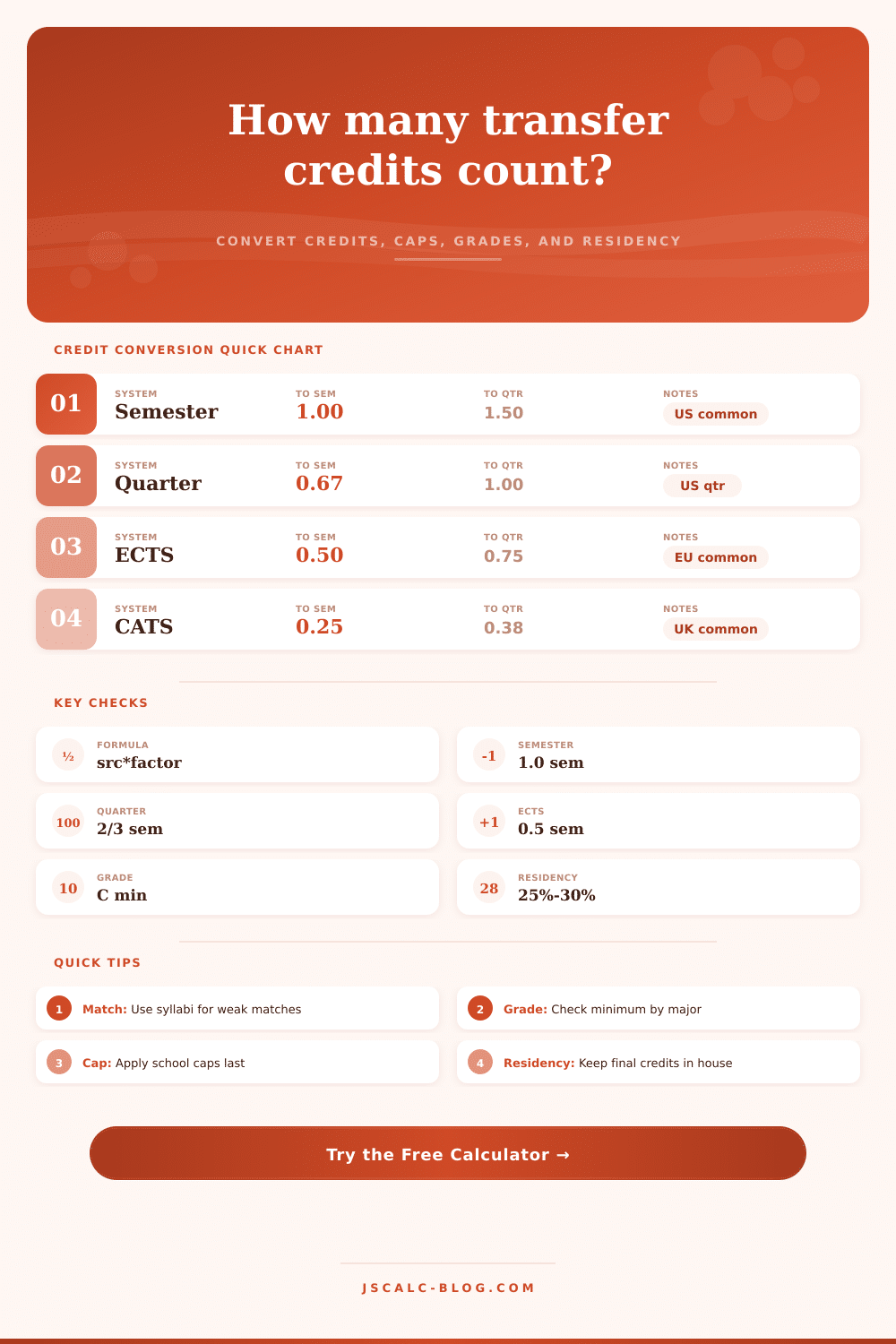
| 1 US semester credit | 1.00 semester | 1.50 quarter | 2.00 ECTS | Most US colleges and universities |
| 1 US quarter credit | 0.67 semester | 1.00 quarter | 1.33 ECTS | Quarter-calendar US institutions |
| 1 ECTS credit | 0.50 semester | 0.75 quarter | 1.00 ECTS | European higher education transcripts |
| 1 UK CATS credit | 0.25 semester | 0.38 quarter | 0.50 ECTS | UK module credit frameworks |
| 15 contact hours | 1.00 semester | 1.50 quarter | 2.00 ECTS | Lecture-hour conversion references |
| 30 lab hours | 1.00 semester | 1.50 quarter | 2.00 ECTS | Lab, studio, or practical-hour review |
Always use the target school's official equivalency rule when it differs from these common references.
| Method or type | Best use | Evidence usually needed | Typical credit handling | Main risk | Action to improve outcome |
|---|---|---|---|---|---|
| Course-by-course evaluation | Mixed transcripts | Official transcript and catalog description | Each course maps to equivalent, elective, or no credit | Partial matches reduce applicability | Attach syllabi for major courses |
| Block transfer | Completed associate degree | Degree conferral and transcript | Large lower-division block may satisfy general education | Major prerequisites may still be missing | Compare block with major map |
| Articulation agreement | Partner college pathways | Agreement term and approved course list | Pre-approved course equivalencies are favored | Old catalogs can expire | Check agreement year and catalog year |
| Exam credit | AP, IB, CLEP, DSST, A-level | Official score report | Credit depends on score threshold and subject | May award elective credit only | Confirm score table before enrollment |
| Prior learning assessment | Workplace or portfolio learning | Portfolio, certifications, or assessment | Often elective or technical credit after review | Residency and major limits can be strict | Target outcomes to required courses |
| International credential review | Non-US university study | Transcript, translation, outside evaluation | Converted by level, credit system, and content | Credit system and grading scale uncertainty | Use a recognized evaluator report |
| Graduate transfer | Master's or doctoral coursework | Graduate transcript and syllabus | Small cap with high grade minimum | Time limits and B-grade rules | Map courses to degree plan early |
| Career or technical transfer | Applied certificates or workforce courses | Competency outline and contact hours | Applied, elective, or limited program credit | General education fit may be low | Separate technical from general credits |
| Minimum grade rule | 4.0 cutoff | Typical location | Calculator effect |
|---|---|---|---|
| C or higher | 2.00 | Many undergraduate transfers | Credits below C are removed before policy filters |
| C+ or higher | 2.30 | Selective prerequisites | Borderline C courses may not apply to the major |
| B- or higher | 2.70 | Professional prerequisites | Useful for nursing, education, and health programs |
| B or higher | 3.00 | Graduate transfer review | Lower grades are treated as ineligible |
| Pass credit | School-defined | Pass-fail terms and exams | Use the equivalent grade if published |
| Repeated course | Highest or latest | Duplicate-credit policies | Use duplicate adjustment for overlap |
| Program level | Degree credits | Common transfer cap | Residency requirement | Planning note |
|---|---|---|---|---|
| Associate degree | 60 semester | 30-45 semester | 15-24 semester | Check final-term residency rules |
| Bachelor's degree | 120 semester | 60-90 semester | 25%-30% | Major courses may have separate limits |
| Bachelor completion | 120 semester | 75-90 semester | 30 semester | Cap often matters more than conversion |
| Certificate | 12-36 semester | 25%-50% | 50% common | Short programs can have tight residency |
| Graduate master's | 30-60 semester | 6-12 semester | 70%+ in program | Time limits and B grades are common |
| Doctoral coursework | 60+ semester | 12-30 semester | Program-defined | Committee approval may be required |
This matters because you fill in four years with gen ed classes only to find that half don’t apply towards your desired university. Why? Schools tracks courses differently. It doesn’t matter what you accomplished; rather, it’s about whether two universities’ course-tracking systems speaks the same language.
Enter your credits into the tool. Input the rules of the new school. Let the calculator do the math for you. Avoid mistakes. Understand state of your transcript before you submit an application.
How to Check If Your Credits Will Transfer
The initial stumbling block was unit conversion. How many semesters long was that class? Was it a quarter? You might of earned an ECTS unit if you went abroad. Those aren’t interchangeable terms, they reflect differing weights assigned by universities for academics, and for how much time those academics spent sitting in a classroom. If your quarter courses is stretching into the semester credits, congratulations! Your credits are growing with extra weight of a semester’s worth of work.
But that still doesn’t address the larger issue. Policy filters muddle things up even more. The next hurdle involve residency requirements and grade cutoffs. For most institutions, they’ll only count courses with grades of C or better. So if you recieved a C- in a challenging science course, that credit could be subtracted from the transfer equation. It is not because you’re dumb. Because it’s a bureaucratic means of gatekeeping. Before assuming a course will transfer, find out what the lowest passing grade is. With the calculator, you can tweak that bar and observe how strict policies may lowers your grand total.
There’s also the problem with courses that don’t quite match up. You see a line item on your transcript that says “Introduction to Psychology.” But what exactly did you take? How do you know if it was psychology 101 or biology 101 or whatever else? You’ll need to look at the syllabus. What if the receiving school decides it’s a generic elective instead of something that should count towards your major? That could mess up your graduation date. Why pay for time that doesn’t get you closer to graduating? With the tool, you can estimate the match percentage. In other words, it provides an estimated view of how many credits are realy going to help you graduate versus just fill the pool.
The last two walls are caps and residency requirements. For a bachelors degree, most schools cap credit transfers at between 60 and 90 units. In addition, they require that you take at least 25-30 percent of your courses at the university. The so called “residency” requirement. That residency requirement is meant as a revenue protection. After all, if they don’t make you come to school, they won’t be able to charge you for the last chunk of your education! The calculator will take these residency requirements away from your existing units to show you exactly what units you have left to fulfill at your desired school.
On the page, there’s a table of references for those conversions so you can check it yourself. That 3-credit class in the US? Expect it to convert to something like 2-credits if it’s from the UK and closer to 1-credit if it’s from Australia or Europe. This way you don’t freak out when you see fewer credits than expected. You’re not losing information. You’re just losing the way the receiving institution is willing to package up your information.
Once you know what factors are at play, it alters how you view your upcoming semesters. You no longer see class names; you read through their syllabi. You check the transfer articulation agreements before registration. You understand that sometimes getting a B in a transfer course can be better then an A- in a course which does not articulate. Getting credits isn’t everything. You want the correct credits that will make it through the filter.
The calculator shows you the figures. Your plan tells you if they’ll mean anything. Focus on the major map and the residency requirement, and the other math tends to fall into place.