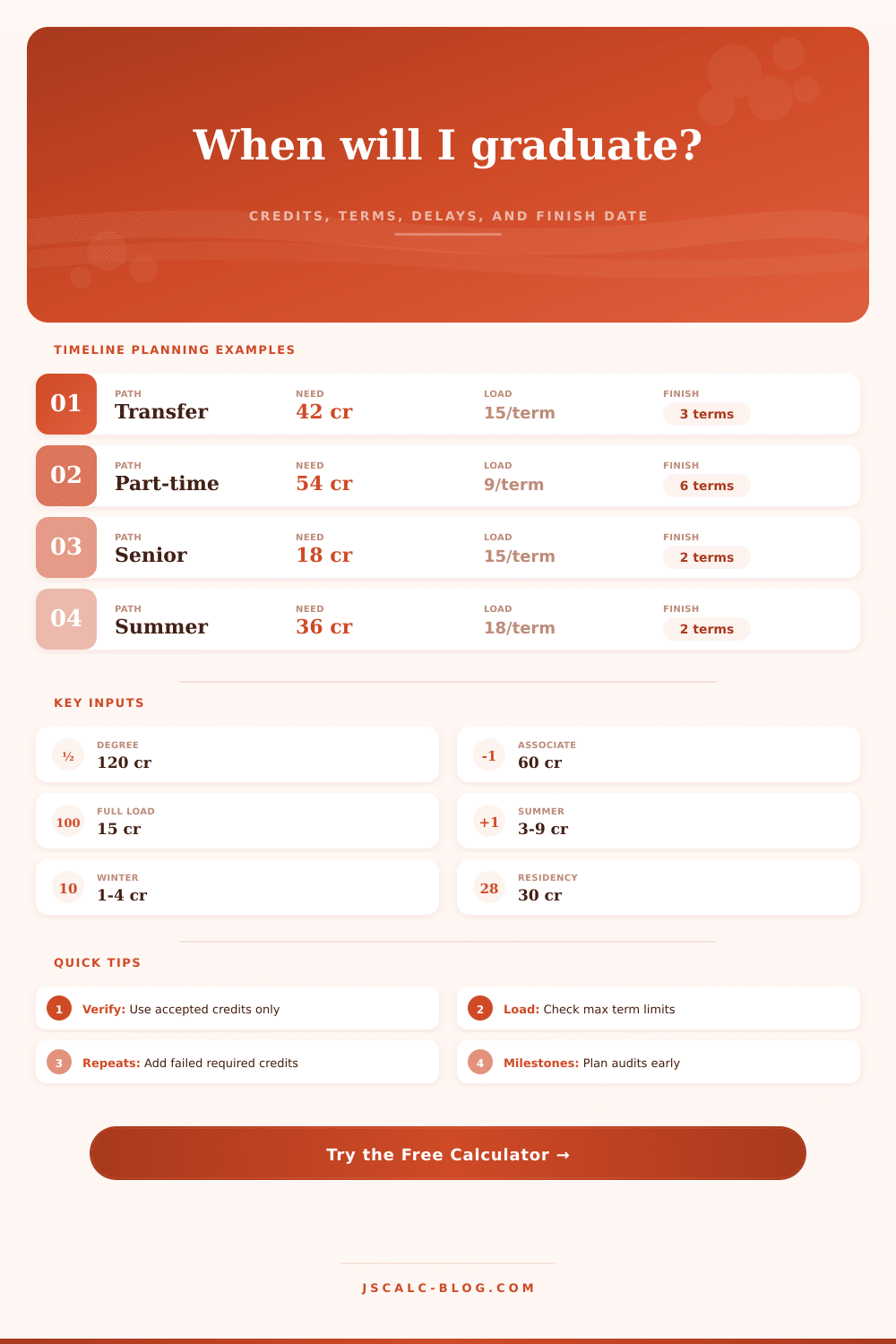
Graduation Timeline Calculator
Estimate remaining credits, required terms, graduation date, residency gaps, and milestone delays for a realistic degree completion plan from JSCalc-Blog.com.
Use credits already posted toward the degree audit.
| Load type | Semester credits | Annual pace | Planning note |
|---|---|---|---|
| Light part-time | 3 to 6 | 6 to 18 | Works around job or family commitments |
| Half-time | 6 to 8 | 12 to 24 | Often affects aid and enrollment status |
| Three-quarter time | 9 to 11 | 18 to 33 | Common for adult completion plans |
| Full-time minimum | 12 | 24 to 36 | May graduate late without summer courses |
| On-time bachelor pace | 15 | 30 to 45 | Targets 120 credits in eight semesters |
| Accelerated load | 18 | 36 to 54 | Usually needs advisor approval |
| Credential | Common total | Typical full-time terms | Residency check |
|---|---|---|---|
| Undergraduate certificate | 24 to 36 credits | 2 to 3 terms | Often program-specific |
| Associate degree | 60 credits | 4 semesters | 15 to 30 credits common |
| Bachelor degree | 120 credits | 8 semesters | 30 credits common |
| Engineering bachelor | 126 to 132 credits | 8 to 9 semesters | Lab sequence may control timing |
| Licensure bachelor | 120 to 150 credits | 8 to 10 semesters | Clinical or teaching term may be fixed |
| Master degree | 30 to 48 credits | 3 to 6 terms | Institutional credits usually required |
| Term | Typical completion month | Credit pattern | Timeline effect |
|---|---|---|---|
| Winter | January | 1 to 4 credits | Good for one elective or repeat |
| Spring | May | 12 to 18 credits | Main graduation term at many schools |
| Summer | August | 3 to 9 credits | Can remove one fall or spring term |
| Fall | December | 12 to 18 credits | Main term for sequence courses |
| Path | Best for | Typical load | Summer use | Main risk | Advisor check |
|---|---|---|---|---|---|
| Traditional full-time | First-time bachelor students | 15 credits | Optional | Missed prerequisites | Annual degree audit |
| Part-time completion | Working adults | 6 to 9 credits | Helpful | Long calendar span | Aid and pace rules |
| Transfer finish | Community college transfers | 12 to 15 credits | Optional | Unaccepted credits | Residency minimum |
| Accelerated summer | Students near the finish | 15 to 18 credits | Frequent | Overload burnout | Max credit approval |
| Winter intensive | One-course shortfalls | 3 to 4 credits | Optional | Limited offerings | Course availability |
| Co-op or internship | STEM and business majors | 12 to 15 credits | Helpful | Paused sequences | Catalog plan map |
| Clinical or teaching | Licensure programs | 12 credits | Limited | Cohort-only terms | Placement clearance |
| Online competency | Self-paced learners | Variable | Continuous | Assessment delays | Minimum enrollment |
| Delay source | Common added time | Calculator input | Actionable check |
|---|---|---|---|
| Graduation audit hold | 1 term | Milestone delay | Submit audit before registration opens |
| Prerequisite sequence miss | 1 to 2 terms | Milestone delay | Map courses by semester offered |
| Failed required course | 3 to 5 credits | Repeat credits | Add the exact catalog credit value |
| Transfer credit denial | 3 to 15 credits | Transfer credits | Use only officially accepted credits |
| Residency shortfall | Variable | Residency minimum | Compare institutional credits earned |
| Credit overload denial | 1 term | Max credits per term | Cap every term at the approved load |
| Step | Formula | What it protects against | Result used by calculator |
|---|---|---|---|
| Accepted completed credits | Institutional completed + accepted transfer | Counting credits not in the audit | Posted progress toward degree |
| Expected current credits | In-progress credits x pass rate | Assuming every current class will pass | Probable credits after current term |
| Degree credit gap | Degree credits - accepted completed - expected current + repeats | Missing required repeats or failures | Academic credits still needed |
| Residency gap | Minimum residency - institution earned - expected institutional current | Graduating without enough home-school credits | Additional institutional credits required |
| Final remaining credits | Greater of degree gap and residency gap, plus buffer | Understating the binding requirement | Credits scheduled into future terms |
| Terms remaining | Iterate selected term sequence using capped term credits | Ignoring summer, winter, and overload caps | Enrollment terms until credits finish |
Graduation for most student is treated as a destination achieved through showing up to class. But it’s better understood as a logistical problem. Credits are the cargo, and semesters is the window during which they ship. Knowing both the size of your load and the number of remaining trips will speed up your progress. With a timeline calculator, you’re replacing the optimism of semester start with the mathematics of getting that degree.
The fallacy is that all earned credit are created equal. It isn’t. Schools have residency rules, meaning they requires a certain number of credits to be taken on campus. Most calculators will runs the numbers for you. But it’s nice to know what goes into them.
How to Plan Your Graduation Date
Did you transfer forty credits? That is great! But if your college has a residency rule requiring that you take thirty credit on campus, you’re going to get through courses but not accelerate your overall timeline. You’ll remain stuck based off the residency floor. This one gets caught because when calculator breaks down your credits, it separates out those you’ve already finished and those that was transferred. Otherwise, your estimate appears rosy, but crashes and burns at registration time.
There’s another wrinkle: the time of year. Students on a two-year cycle often don’t consider winter and summer sessions which are their advantage. Winter intersession could knocks off an entire spring semester with single three-credit class. That’s nothing, but if you want to get out while the getting’s good (or avoid getting kicked out for not paying your rent), it counts.
You’ll see the effect of adding winter/summer terms in credit-load-per-active-period table. Toggling them toggles whether to stretch your degree over more calendar years or compress it into higher-intensity bursts. There’s no one best choice; just a tradeoff between length and burnout.
And then there’s uncertainty. While most students wants to pass every class they register for, reality doesn’t always work out that way, whether because of syllabus or because of life. There are fields for courses you need to repeat and an input for the in-progress credits‘ expected pass rates. You’re forced to consider the odds of stumbling. Let’s say you have a hard class, and you think there’s only a 90% chance you’ll pass each quarter. The model will increases the timeline just enough to compensate for being overly confident. It’s hedging against overconfidence.
Too many students don’t anticipate losing credits when they fail a prerequisite. That stalls your progress, and sometimes delays it (the alternative course isn’t available during next term).
Look at maximum term cap. To protect your academics, universities imposes a limit on the number of credits students may carry. That typically falls between eighteen and nineteen. To surpass that mark puts you in dangerous territory and requires approval. The tool acknowledges that boundary. If your leftover credits split cleanly across terms within that cap, congratulations… You’re good to go. Otherwise, if there’s a remainder that exceeds the cap, you must tack on another term. It’s simple math with important implications. One additional term equals higher housing/tuition costs.
And that’s the point, it’s not only about finding a date, but also creating a buffer. Add a couple of credits or even a light term just in case. If the math works out, then you let go of the stress. You no longer wonder when you’ll graduate; you begin to plan for afterward. And that peace is worth more than any calculations.
Actualy, it would of been better to start early.