Full-Time Status Credit Calculator
Check whether enrolled, pass-fail, audit, added, and dropped credits meet common undergraduate, graduate, and financial aid enrollment thresholds for JSCalc-Blog.com planning.
Choose a realistic enrollment situation, then adjust the fields for your school policy.
Enter your credits and policies to see a full status review.
| Scenario | Counted Credits | Enrollment Status | Full-Time Gap | Aid Gap | Decision Signal |
|---|---|---|---|---|---|
| Current entry | 12.0 | Full-time | 0.0 | 0.0 | Meets selected target |
The scenario grid separates currently enrolled credits from planned add/drop changes and waitlisted credits.
| Student Profile | Full-Time | Three-Quarter | Half-Time | Typical Pace | Planning Note |
|---|---|---|---|---|---|
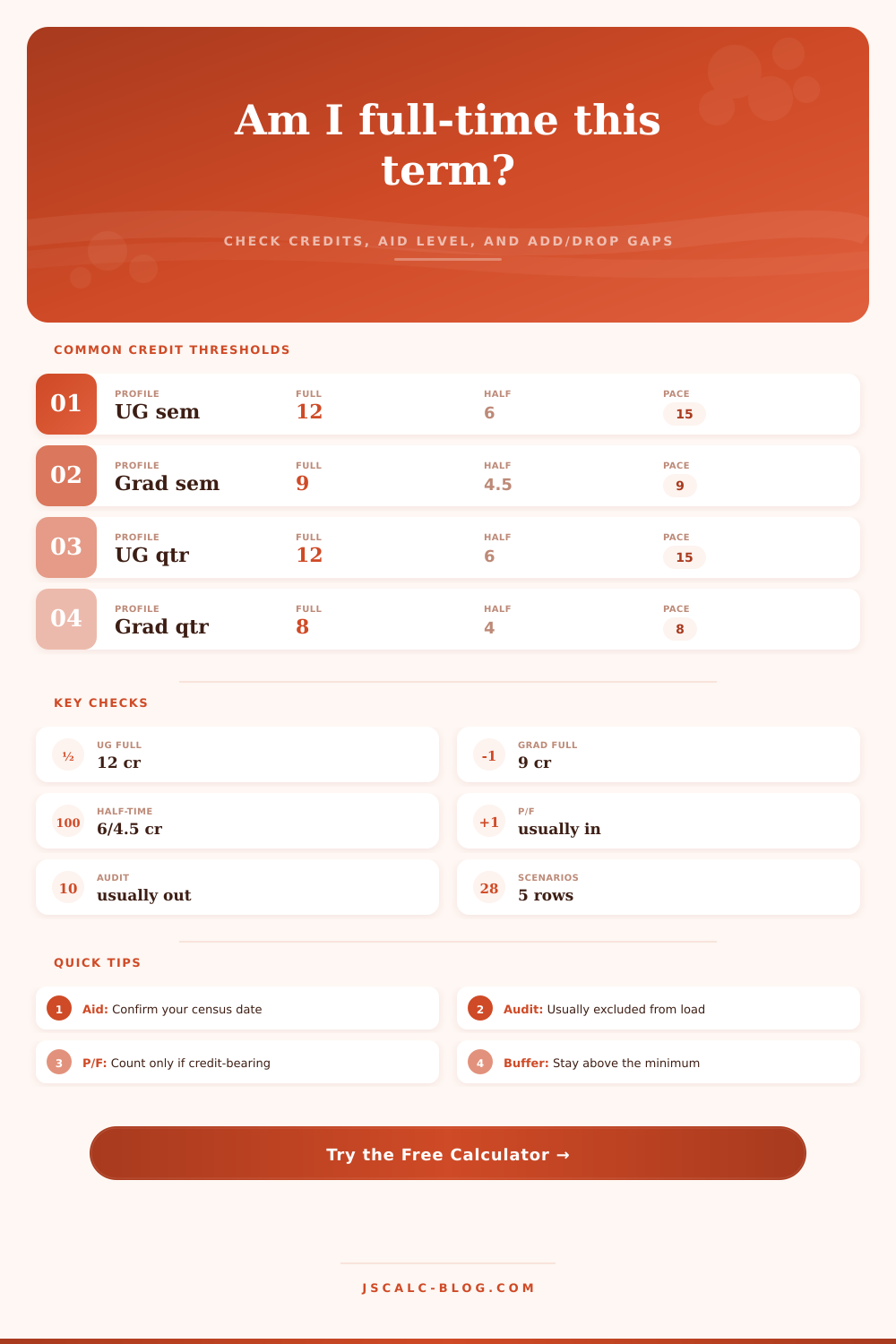
| Undergraduate semester | 12 credits | 9 credits | 6 credits | 15 credits | Common federal aid and registrar baseline. |
| Graduate semester | 9 credits | 7 credits | 4.5 credits | 9 credits | Often school-defined for graduate aid. |
| Undergraduate quarter | 12 credits | 9 credits | 6 credits | 15 credits | Quarter calendars may still use 12 as full-time. |
| Graduate quarter | 8 credits | 6 credits | 4 credits | 8 credits | Common graduate-quarter approximation. |
| Professional program | School-defined | School-defined | School-defined | Catalog plan | Use the custom threshold fields. |
| Clock-hour or module program | Institutional rule | Institutional rule | Institutional rule | Program map | Confirm conversion before relying on credit logic. |
| Credit Type | Status Count | Aid Count | GPA Effect | What To Verify |
|---|---|---|---|---|
| Letter-graded course | Usually counts | Usually counts | Counts in GPA | Course is enrolled before census. |
| Pass-fail or credit/no-credit | Usually counts if credit-bearing | Usually counts if degree-applicable | Usually excluded from GPA | Whether the course satisfies program or aid rules. |
| Audit course | Usually excluded | Usually excluded | No GPA effect | Whether your registrar grants enrollment credit. |
| Waitlisted course | Excluded until enrolled | Excluded until enrolled | No effect yet | Whether the course becomes registered by census. |
| Dropped course before census | Usually removed | Usually removed | Usually no GPA effect | Drop deadline and aid recalculation date. |
| Withdrawn course after census | May still affect aid pace | May affect satisfactory progress | Often W grade | Return-of-aid and SAP policy. |
| Aid Level | Undergrad Semester | Grad Semester | Calculator Rule | Use Case |
|---|---|---|---|---|
| Full-time | 12+ credits | 9+ credits common | Counted credits at or above full-time threshold | Maximum enrollment intensity comparison. |
| Three-quarter-time | 9 to 11.5 credits | 7 to 8.5 credits common | At least three-quarter threshold but below full-time | Grant proration or status reporting checks. |
| Half-time | 6 to 8.5 credits | 4.5 to 6.5 credits common | At least half-time threshold but below three-quarter | Common loan eligibility and deferment floor. |
| Less than half-time | 1 to 5.5 credits | Below half-time rule | Positive credits below half-time threshold | Often limited aid eligibility. |
| Not enrolled | 0 counted credits | 0 counted credits | No countable enrollment credits | Loan grace and enrollment reporting review. |
| Step | Formula | Included Inputs | Output | Why It Matters |
|---|---|---|---|---|
| Count current credits | Graded + included P/F + included audit | Enrolled credit categories | Current countable load | Separates credit-bearing and non-credit courses. |
| Apply add/drop plan | Current + added - dropped | Add/drop switch and credit values | Projected counted credits | Shows remaining credits before census or deadline. |
| Classify status | Compare counted credits to thresholds | Full, three-quarter, half-time rules | Enrollment status label | Determines full-time and part-time category. |
| Check aid target | Selected aid minimum - counted credits | Aid target or custom aid minimum | Aid threshold gap | Flags whether more credits may be needed. |
| Measure buffers | Counted - threshold | Full-time, aid, pace, and max load | Drop buffer or credit gap | Helps avoid slipping below a required level. |
Many schools lock enrollment intensity for aid on a census or freeze date. If you add or drop after that date, the aid, transcript, and advising effects can differ.
If you must remain full-time or half-time, staying exactly at the minimum gives no room for a canceled section, failed registration, late prerequisite issue, or audit exclusion.
With good intentions, you sit down at your computer to sign up for classes. You’ve got a plan in mind, a list of courses, and you’re sure as hell going to get them all into your schedule. Click. Submit. Then: you’re told you’re officialy part-time. Your financial aid package becomes smaller. Your student loan deferment run out. And this happens more frequent than you’d imagine… And it’s hardly ever fair.
The issue isn’t necessarily the courses. It’s the unseen math behind how they’re tallied. The thing people get wrong is if a class is credited, it goes on their record. That’s not true. Where they go awry is the difference between courses that fill up your schedule (the former) and course that fill up your enrollment record (the latter).
How to Keep Full-Time Status and Your Aid
If the course isn’t applicable to your degree program, it may be pass/fail, and thus can absorbs for graduation purposes but not for federal aid purposes. Or perhaps it is a audit course, meaning it might add nothing to your credit total, even though you’re sitting in lecture hall for three hours per week.
Plugging in these rules of thumb allow you to bypass the guesswork over whether your schedule conforms with federal versus institutional standards, the calculator does the math for you. Which brings us back to the census date. Maybe your plan is to go full-time the first day of classes and drop one class past the census date. In that case, you might still get counted as full time by the Registrar’s Office during the term. Or maybe you won’t. It all depends on how school defines it.
This is exactly where the add-drop scenario grid helps: it lets you try out various scenarios, such as if a class gets canceled. Do I want to lighten my load?) so you can see what would happen.
Sit down with this spreadsheet if you’re balanced on the edge of twelve credits, because technically you’re full time. But you don’t have any wiggle room. You miss one class, and now you’re part time. Want to build a buffer? Good idea. Life-saver.
There are other traps awaiting graduate students. Their full-time threshold may be only nine credits (on a quarter system, sometimes even eight). Sounds doable. This means it is the difference between half-time aid and maximum aid if you take two classes plus a half-credit workshop. Thousands of dollars in a year. The tool lets you compare your credit load against various aid levels at once, so you can actualy visualize how many credits will bring you to the half-time level for loans vs. It also shows the three-quarter level for grants to help you see where that line is.
The other one that’s missed by undergraduate students are the pace metric. To keep your benefits, you should of take at least a full-time course load. The pace to graduate in four years is typically fifteen credits. And here is where it gets tricky. On the one hand, you’re advised to take only what you can handle; on the other, if you don’t take enough credits, you’re going to drop below the pace needed to stay eligible for things. So the calculator will display how far off you are from reaching your pace target based off your current load.
Imagine you are always taking twelve credits just to meet the full-time requirement. Congratulations! You’re stretching out your timeline to degree. You’re paying more than tuition. You’re also losing out on salary and delaying when you enter the workforce.
Inputs matter. Not outputs. Fill out the columns honestly in the audit. If you’re auditing a class that’s not required but interesting, don’t count it towards your aid status. The system won’t allow you to. Don’t count it if you’re on the waitlist. The system views you as not enrolled. These are clearly separated by the system. It forces you to differentiate between what you hope to take versus what you are officialy registered for. That keeps things clear so that you can avoid the panic of finding yourself with a changed status mid-semester.
Read what overrides apply at your school. Full time is defined differently in some programs. Hours (rather than credits) may be required for certain professional degrees. You can list those special rules in the custom fields. If your handbook differs from default, don’t trust the default! The handbook is the rulebook; the tool is just a model of your circumstances.
Run it as an alert system to identify the gaps. Run it to see how your proposed add or drop would push you over or under a line. Then check with an adviser. The math holds up. The policies do not. The only way to remain both funded and enrolled without getting blindsided is to understand the distinction.