Credits Per Semester Calculator
Plan remaining credits, short terms, full-time thresholds, maximum loads, and graduation targets with JSCalc-Blog.com.
📌 Common academic plans
Calculation breakdown
🎓 Degree credits and timeline
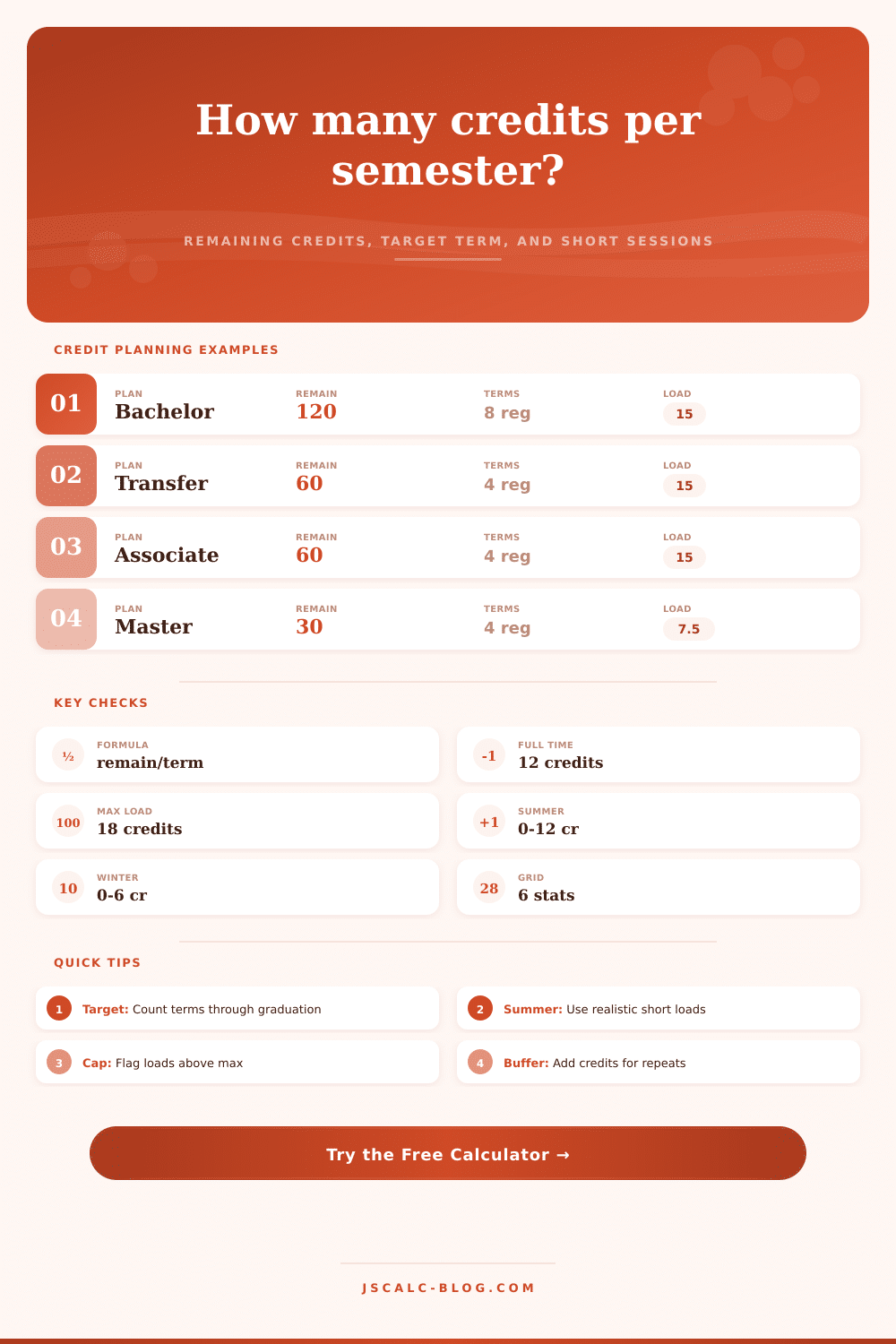
The primary result uses: regular semester credits = (remaining credits minus planned summer/winter credits) divided by remaining Fall/Spring terms.
Use 1 to 6 credits for pending substitutions, repeats, or catalog uncertainty.
📊 Planning grid
📋 Term breakdown tables
| Term type | Count before target | Planned credits each | Total planned credits | How it affects the result |
|---|---|---|---|---|
| Fall/Spring | 0 | 0 | 0 | Primary semester average |
| Summer | 0 | 0 | 0 | Reduces regular load |
| Winter | 0 | 0 | 0 | Reduces regular load |
| Program pattern | Typical credits | Regular terms | Common semester load | Planning note |
|---|---|---|---|---|
| Certificate | 12 to 24 | 1 to 3 | 6 to 12 | Often stacked around work or prerequisite needs |
| Associate degree | 60 | 4 | 15 | Four regular terms at 15 credits reaches 60 |
| Bachelor degree | 120 | 8 | 15 | Eight regular terms at 15 credits reaches 120 |
| High-credit bachelor | 124 to 132 | 8 | 15.5 to 16.5 | Labs and accreditation can raise the average |
| Master degree | 30 to 36 | 4 to 6 | 6 to 9 | Graduate full-time rules can differ by school |
| Completion program | 30 to 60 | 3 to 6 | 9 to 15 | Transfer evaluation controls the remaining total |
| Prerequisite track | 15 to 45 | 2 to 4 | 6 to 15 | Sequence rules can matter more than credit count |
| Accelerated plan | 90 to 120 | 6 to 7 | 15 to 18 | Usually depends on summer or winter terms |
| Regular load | Common status | 12-credit threshold | 18-credit cap | Use case |
|---|---|---|---|---|
| 3 to 5 credits | Light part-time | Below | Within cap | One course, internship, or final requirement |
| 6 to 8 credits | Part-time | Below | Within cap | Two-course workload for working students |
| 9 to 11 credits | Heavy part-time | Below | Within cap | Near full-time but may not qualify for benefits |
| 12 to 15 credits | Full-time | Meets | Within cap | Common undergraduate pacing |
| 16 to 18 credits | Heavy full-time | Meets | At cap | Often needs careful course mix |
| Above 18 credits | Overload | Meets | Above cap | Usually needs approval or another term |
| Formula step | Input used | Math | Result meaning |
|---|---|---|---|
| Credited work | Earned, transfer, in-progress | Earned + transfer + in-progress | Credits already expected to count |
| Adjusted remaining | Requirement, buffer, repeats | Requirement - credited + repeats + buffer | Credits still needing a plan |
| Short-term credits | Summer and winter loads | Summer count x load + winter count x load | Credits removed from regular terms |
| Credits per semester | Adjusted remaining and regular terms | (Remaining - short terms) / Fall-Spring terms | Average regular semester load |
✅ Planning tips
It starts out well. There’s a spreadsheet few student look at too hard and plenty of energy to get going. There are classes left to take and a deadline for graduation, but there is not much of a straight line connecting them. The assumption most students have is that they can graduate in four years by taking a full load (fifteen credits) every single semester. It’s an easy-to-understand mental model.
What happens in real life? Labs take longer then lectures. Courses has prerequisites that pin them down to certain semesters. Sitting through summer courses feel like torture.
How to Plan Your College Credits
By running the numbers beforehand, you avoid the panic of realizing in your third year that you’re not on track to graduate. Calculating it (it’s easier than you think). Here’s how:
How many credits does your major need? Subtract how many credits you’ve already completed. That means classes you’re taking right now, any exams you’ve passed, and any transfer credit.
Now how many semesters remain before your desired graduation date? Divide the former by the latter. And voila! That’s your average load per semester. That’s your remaining credit balance. Input those numbers into the calculator and let it crunch the numbers for you… No guesses needed. It will even factor in any buffer credits you want to add (more on that later) and courses that gets repeated.
Creating a slight cushion for when you might need to retake or substitute a class makes your schedule more resilient, rather than brittle.
Being “full time” matters more than you might realize. For undergraduate programs, the magic number is usually 12 credits, which determines whether you are full-time or part-time. It impacts financial aid availability, visa policies for international students, and occasionally even housing contract. When the average rounds down to less than 12, it’s time to change your timeline. That means taking classes during summers or perhaps delaying graduation by one semester. The tool includes a reference table that links different credit levels to this full-time/part-time status. That will help you visualize where you are relative to the edge of part-time status (and whether you’re comfortable).
On the other hand, summer and winter sessions is completely different setups. These sessions are compressed periods for learning at twice the rate. Maybe you decide you want to reduce your usual semester’s course load by taking some classes during the summer. Sounds good. But it’s intense.
Those shorter sessions has an effect, and the only way to gauge this effect is to know how many summer session you will be taking and how many credits per session you’ll take. The tool calculates this by taking the number of regular semesters and subtracting both the number of summer sessions you will take and the number of summer credits you will take, then dividing that result by the remainder. This tells you how much you should work over the fall and spring. So if you do a lot of summer school, your semester load decreases, but the load of summer increase. It is a trade-off between time and intensity.
The other caveat is maximum load caps. Regular semester loads usually cap out at eighteen credits without petitioning for an exception. Overloads frequently require both a petition and a compelling reason. If your calculation pushes you into the overload zone, the system will flag it and give you a choice. Do you want to space the credits across additional semesters? Can you handle a delayed graduation date? Or do you want to roll the dice and jam in extra classes?
On paper, the gap between fifteen and eighteen credits doesn’t seem like much. In reality, it’s three extra hours of class time, three extra hours of studying or lab time, and several extra hours of lost sleep.
There are variables in sequencing that spreadsheets will not account for. For instance, having an outstanding credit average won’t matter if the class you require next term doesn’t come up every single year. You should also look at the course catalog to see what pattern courses is being offered. There are some majors that are very strict on their sequencing, for example, nursing, engineering, etc. These tight sequences might require you to take a heavier or lighter workload in a certain semester depending on when you can take which classes. Don’t wait until your senior year to realize there’s a bottleneck! Plan it out early.
In the end, it’s all about planning for the degrees your school offers while also planning for your own limitations as a student. You want to get out on-time. The school wants you to succeed. The space between them is filled by credit hours. You plan out those hours by figuring out where to add extra time and which terms carry more weight. This process turns anxiety into a schedule. It isn’t about the ideal load each semester. It’s about creating a plan that will last through the unforeseen. That’s the difference between real life and a rigid schedule.
You should of checked this earlier.