Total Credits Needed Calculator
Estimate the remaining credits required for a degree audit, including accepted transfer credit, in-progress courses, major and general education gaps, residency, term pace, and projected graduation from JSCalc-Blog.com.
Use posted credits that apply to this exact program.
| Credential path | Total credits | Major or core | General education | Electives | Residency check |
|---|---|---|---|---|---|
| Associate transfer degree | 60 semester | 18 to 30 | 30 to 42 | 0 to 12 | Often 15 to 24 resident credits |
| Bachelor liberal arts | 120 semester | 30 to 48 | 36 to 45 | 27 to 54 | Often 30 resident credits |
| Bachelor STEM or engineering | 128 to 136 | 60 to 90 | 30 to 45 | 0 to 24 | Upper-division residency may apply |
| Teacher or health licensure | 120 to 150 | 54 to 90 | 30 to 45 | 0 to 24 | Cohort and clinical terms can bind |
| Certificate program | 12 to 36 | 12 to 36 | 0 to 9 | 0 to 6 | Often half completed in program |
| Master's degree | 30 to 60 | 24 to 48 | 0 to 12 | 0 to 12 | Transfer caps are usually small |
| Category | Requirement field | Completed field | In-progress field | Formula | What to verify |
|---|---|---|---|---|---|
| Total degree | Total credits required | Institutional plus transfer | Current total credits | Required - completed - transfer - current | Only credits that apply to the program |
| Major or concentration | Major credits required | Major completed | Major in progress | Major required - major done - expected current | Upper-division and prerequisite rules |
| General education | Gen ed credits required | Gen ed completed | Gen ed in progress | Gen ed required - gen ed done - expected current | Distribution areas and minimum grades |
| Electives | Implied by degree total | All excess completed credits | Remaining after categories | Total gap - major gap - gen ed gap | Whether free electives are allowed |
| Residency | Minimum resident credits | Institutional completed | Resident current credits | Residency required - resident done - current | Final credits taken at home school |
| Repeats and shortfalls | Repeat credit field | Not deducted | Not deducted | Add repeats to total gap | Failed, expired, or insufficient-grade courses |
| Remaining credits | 9 credits/term | 12 credits/term | 15 credits/term | 18 credits/term | Planning note |
|---|---|---|---|---|---|
| 12 credits | 2 terms | 1 term | 1 term | 1 term | Check whether all courses are offered together |
| 24 credits | 3 terms | 2 terms | 2 terms | 2 terms | Summer can remove one main term |
| 36 credits | 4 terms | 3 terms | 3 terms | 2 terms | Major sequences often control the finish |
| 48 credits | 6 terms | 4 terms | 4 terms | 3 terms | Residency may matter for transfer students |
| 60 credits | 7 terms | 5 terms | 4 terms | 4 terms | Full-time pace usually means two academic years |
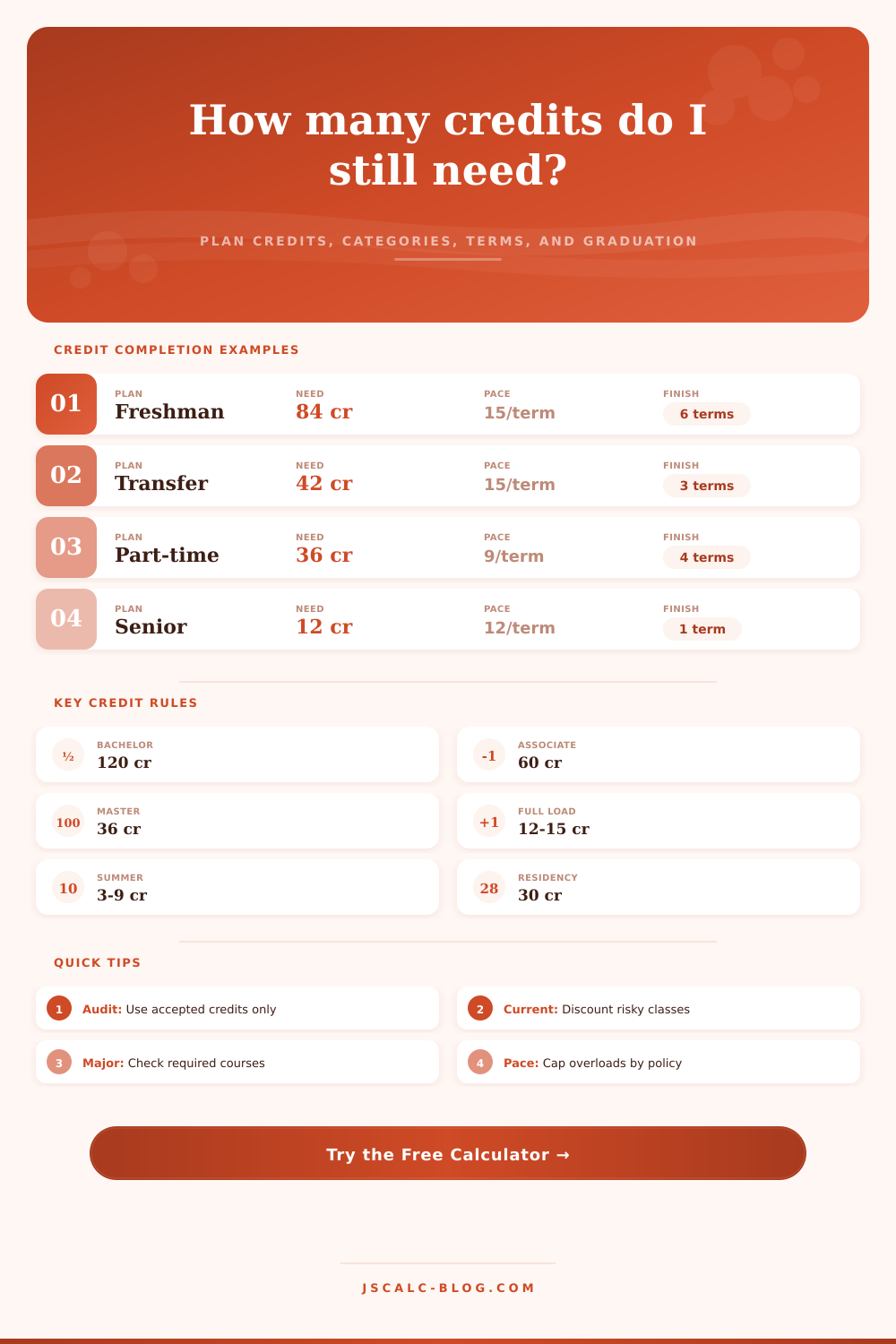
| 84 credits | 10 terms | 7 terms | 6 terms | 5 terms | Use annual plans for multi-year projections |
| Step | Formula | Result type | Why it matters |
|---|---|---|---|
| Accepted progress | completed institutional + accepted transfer | Completed credits | Separates posted home-school work from transfer credit |
| Expected current credit | in progress × pass rate | Probable credit | A 75% confidence rate discounts uncertain courses |
| Remaining total | requirement - completed - transfer - current + repeats | Total gap | Main remaining credits equation |
| Category gaps | category requirement - completed - current | Major and gen ed | Prevents a high credit count from hiding missing requirements |
| Binding credits | max(total gap, category gaps, residency gap) | Scheduled credit need | Uses the largest requirement that still blocks graduation |
| Graduation date | iterate selected terms until credits reach zero | Projected term | Converts credits needed into a term-by-term plan |
When you log onto your student portal, there’s a part of you that gets anxious because it feels more like a puzzle than a map. You look at this degree audit, and while you see course requirements you’ve already met, you don’t know how to get from here to there. Most of our academic stress comes from the disconnect between what we believe we’ve accomplished versus what counts to the registrar. We imagine that credits work everywhere, but each credit is realy a thing whose worth depends on context. While you may need a seminar for history, it won’t necessarily fulfill your engineering residency requirement, which mean you rack up a ton of credits without moving forward.
All you need to do is input your transfer credits/earned credits, and the calculator does the rest, no more subtracting it all out yourself. By breaking down what you’re lacking in each category, it can separate signal from noise. The signal is your overall progress; the noise is where you fall short in particular categories. (Why this matters: passing your general education classes doesn’t matter when you still lack final class required for your major.)
How to Plan Your Degree Better
Most of us look at the bottom line, we’ve got 40 credits left! I’m just one more semester away! We do not realize that some residency check or distribution requirement are our actual binding constraint, the thing that holds us back. While transfer credits are a great way to save money, there’s usually a catch: most schools limit how many credits from previous colleges/schools will count towards your major. This means you’ll need to repeat similar courses once you get to your new school. By entering those accepted credits into the tool yourself, you ensure your projection takes them into account.
In addition, it enables you to enter any currently-in-progress class, since this matters for determining whether you’ll be able to handle your remaining workload or if you’ll be stuck with a killer last term. If you ignore your pass rate, you end up on the optimistic side; if you ignore work-in-progress, you’re looking at the pessimistic side. Get both right and you’ve got yourself a clear picture of where you stand.
Where it starts getting tactical is pacing. The calculator lets you toggle summer and winter terms to see how much faster you can finish based off your course load. But life doesn’t follow a neat timeline. To make up for this, you might consider taking heavier loads in short-term, more intense bursts via summer terms. The problem? These terms are typically less flexible: There’s less professor availability and fewer section options. With our calculator, you can turn on/off summer/winter terms to view your acceleration potential without burning yourself out.
By adding summer/winter terms, you lower the number of credits you need to take each semester, lowering stress, but you also lengthen your degree timeline and increase your total tuition bill. Weigh the financial penalty of remaining in school longer than You face the academic risk of overloading one specific semester.
There’s also a little-known pitfall in residency requirements: schools require a minimum number of credits to be completed on their campus to award a degree. They do this for good reasons, protecting the value of the credential. But it may surprise students who have transferred many credit. You may find yourself hitting a wall where every remaining course must be taken at your current institution. That doesn’t leave much wiggle room.
The page breaks down this rule using a handy reference table that shows how different kind of degrees treat this requirement. It’s a reminder that a bachelor’s isn’t some mix of classes, but a carefully crafted collection of ingredients. Managing constraints is what credit planning is all about. The number of credits necessary to complete your degree is not something you can modify. How you spread those out over time is completely up to you, though.
If there’s a major prerequisite or a residency minimum that’s realy gumming things up, identify it and create a plan that addresses the real bottleneck. Stop guessing at your graduation date. Use actual rules of your program to calculate when you’ll finish. A few clear numbers make all the difference between confusion and confidence.
You should of used this sooner.