Quarter Hours to Semester Hours Converter
Convert quarter credits to semester credits, reverse semester totals, compare course-by-course rounding, account for lab contact hours, and check minimum program or residency thresholds.
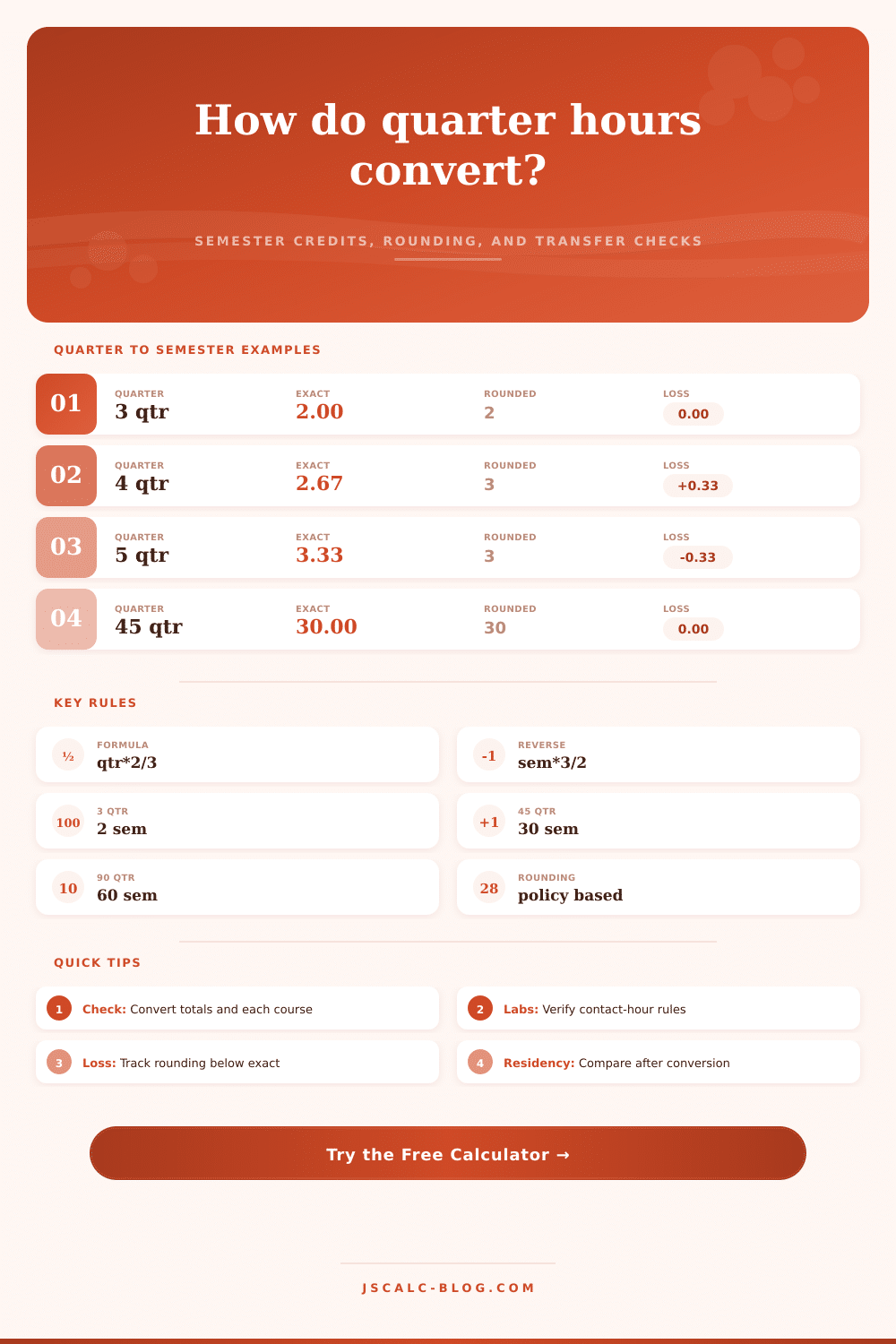
Standard formula: semester hours = quarter hours x 2 / 3.
Reverse formula: quarter hours = semester hours x 3 / 2.
| Course or requirement | Quarter hours | Course type | Exact semester | Rounded semester | Rounding difference |
|---|---|---|---|---|---|
| Quarter hours | Exact semester hours | Nearest 0.5 | Nearest whole | Common interpretation |
|---|---|---|---|---|
| 1 | 0.67 | 0.5 | 1 | Small workshop or activity credit |
| 2 | 1.33 | 1.5 | 1 | Short elective or lab support |
| 3 | 2.00 | 2.0 | 2 | Clean two-credit semester match |
| 4 | 2.67 | 2.5 | 3 | Often reviewed against a 3-credit requirement |
| 5 | 3.33 | 3.5 | 3 | Common quarter course transfer value |
| 6 | 4.00 | 4.0 | 4 | Lecture plus lab or intensive course |
| 9 | 6.00 | 6.0 | 6 | Two-course sequence block |
| 12 | 8.00 | 8.0 | 8 | Multi-course requirement cluster |
| Semester hours | Quarter equivalent | Typical use | Minimum quarter block |
|---|---|---|---|
| 1 | 1.50 | Activity or orientation credit | 1.5 quarter hours |
| 2 | 3.00 | Small requirement | 3 quarter hours |
| 3 | 4.50 | Standard semester course | 4.5 quarter hours |
| 4 | 6.00 | Course with extra contact time | 6 quarter hours |
| 15 | 22.50 | Full semester load comparison | 22.5 quarter hours |
| 30 | 45.00 | Residency or annual block | 45 quarter hours |
| 60 | 90.00 | Associate degree total | 90 quarter hours |
| 120 | 180.00 | Bachelor degree total | 180 quarter hours |
| Method or type | Formula basis | Rounding timing | Best used for | Main risk | Example result |
|---|---|---|---|---|---|
| Program total conversion | Total quarter x 2 / 3 | After total | Degree audits and totals | May hide course gaps | 90 qtr = 60 sem |
| Course exact conversion | Each course x 2 / 3 | None | Transcript mapping | Fractions may not post | 5 qtr = 3.33 sem |
| Nearest half credit | Exact semester value | Per course | Schools using half credits | Small gains or losses | 5 qtr = 3.5 sem |
| Nearest whole credit | Exact semester value | Per course | Catalogs using whole credits | 4 and 5 qtr shift | 4 qtr = 3 sem |
| Round down whole | Floor exact semester | Per course | Conservative audits | Credit loss accumulates | 5 qtr = 3 sem |
| Round up whole | Ceiling exact semester | Per course | Internal planning only | May overstate transfer | 5 qtr = 4 sem |
| Lab contact check | Contact hours / divisor | After contact review | Labs and clinics | Credit title may differ | 30 hrs = 1 lab sem |
| Residency check | Resident qtr x 2 / 3 | After resident total | Graduation minimums | Only local policy decides | 45 qtr = 30 sem |
| Instruction type | Common semester divisor | 30 contact hours | 45 contact hours | Credit note |
|---|---|---|---|---|
| Lecture | 15 hours per credit | 2.00 credits | 3.00 credits | Often seat-time based |
| Lab | 30 hours per credit | 1.00 credit | 1.50 credits | Lab credits may post lower |
| Clinical | 45 hours per credit | 0.67 credits | 1.00 credit | Programs may set stricter rules |
| Fieldwork | 60 hours per credit | 0.50 credits | 0.75 credits | Verify supervised-hour policy |
| Studio | 30 to 45 hours per credit | 0.67 to 1.00 | 1.00 to 1.50 | Art and design rules vary |
| Independent study | Varies by contract | Policy based | Policy based | Use transcript evaluator guidance |
| Calculation | Formula | When to use it | Interpretation |
|---|---|---|---|
| Quarter to semester | Quarter hours x 2 / 3 | Incoming quarter-credit transcript | Converts to semester-credit scale |
| Semester to quarter | Semester hours x 3 / 2 | Planning quarter equivalent | Converts to quarter-credit scale |
| Program total | Sum quarter x 2 / 3 | Degree totals and transfer blocks | Best for total-credit eligibility |
| Course exact | Course quarter x 2 / 3 | Individual requirement match | Shows the fractional semester value |
| Rounded difference | Rounded semester - exact semester | Policy impact review | Negative values are credit loss |
| Contact-hour check | Contact hours / divisor | Labs, clinics, studios | Compares seat time to posted credits |
Imagine yourself as someone with a pile of transcripts in front of you, and imagine that you’re the registrar in an admissions office. You flip through the pages. What does the registrar see? She doesn’t understand what’s going on: the numbers don’t adds up.
The registrar isn’t questioning your intelligence or your performance. In fact, you may have done quite well. No: you went to one kind of school, which records its hours in quarter hours, but now you’d like to go to another school, which records its hours in semester hours. There is a conversion problem here.
The Math Is Easy, But The Strategy Is Important
That means there is a difference between how much time was spent studying for each class in each system. Semesters space out learning; quarters compress them. When you translate from one to another, you are translating effort. To convert quarter credits to semester credits, you should of multiply by two-thirds.
It looks easy enough, but the real world gets messy. Let the calculator above do the easy math for you, and then think about what messes up the process. Generally the big issue is rounding. In a five-quarter-hour class, it converts exactly to 3.33 semester credits. But most schools don’t give out fraction credits; they round them off. Some round to nearest half credit. Others round to the nearest whole number. A tiny number round down to be safe. That will cost you credits.
Let’s say you take ten classes, each one of which rounds down a third of a credit. You’ve lost three full credits worth of progress! At the beginning, this isn’t significant, but it accumulates over time. You might not notice it until you’re flat. Remember: It’s the sum of your parts.
The tool lets you enter each class individually, which is important because it lets you view the rounding effect on a class-by-class basis. For example, what appears to round off perfectly in theory (i.e., a biology lab) may end up being devalued in reality. Why? Because receiving university doesn’t treat lab time the same way yours does. Labs aren’t lectures. While a lecture may be worth fifteen hours per credit hour, a lab could be thirty or even forty-five. Without accounting for this, you’ll think the lab will count toward a lecture, but in fact it won’t.
Another frequent problem arises from residency requirements. In many universities, they expects you to take a minimum number of credits on campus in order to graduate. Let’s say you transferred forty-five quarter hours, which converts exactly to thirty semester hours. That sounds like it should be fine. But suppose the university has a residency rule that says you must take thirty-one semester hours in house. Now you’re one credit shy. Mathematically speaking, your credits convert correctly. Administratively speaking, it don’t. Know the distinction between these two.
These flaws are evident in the reference tables packaged with the tool. They illustrate how a four-quarter-hour course becomes a three-semester-hour course. And they illustrate how an elective that’s two quarter-hours long could get rounded down and dissapears. That’s not a problem, that’s simply how semester catalogs function. But it does highlight the importance of knowing what you’re measuring. Are you measuring finished learning outcomes? Or are you measuring something like seat time?
Because if it’s a fraction of a credit, don’t let it destroy your plans. Examine your particular courses, examine labs as separate entities, check the residence requirements, and use the converter to find out where you actualy are. Then you’ll know whether you have to take an extra elective. It is better to do this sooner then later.
Strategy: The math is easy. The strategy is what matters.