Credit Hour Cost Calculator
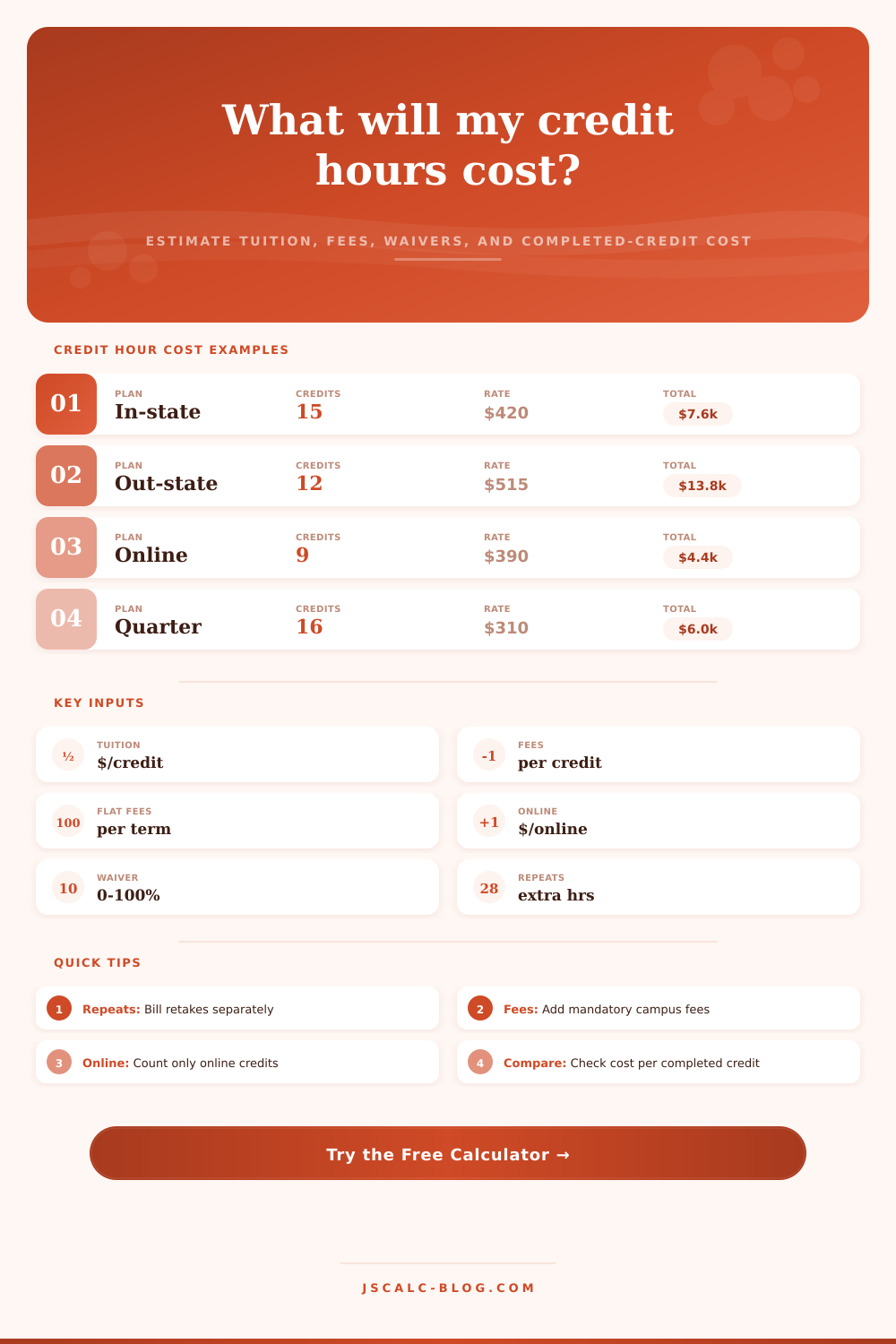
Estimate billed credits, tuition, mandatory fees, online and lab charges, residency multipliers, waivers, repeat credits, and effective cost per completed credit.
🎯Credit Hour Cost Scenarios
📝Tuition and Fee Inputs
Uses your entered per-credit amount; the category only documents the pricing basis.
Quarter credits convert to semester-equivalent credits by multiplying by 2/3.
Use likely passed credits after withdrawals, incomplete courses, and repeats.
📊Live Cost Signals
📘Credit System Reference
| Credit System | Common Full-Time Load | Conversion Basis | Cost Use |
|---|---|---|---|
| Semester credits | 12 to 15 credits | 1 semester credit = 1 semester credit | Multiply the billed semester credits by the school rate. |
| Quarter credits | 12 to 16 credits | 1 quarter credit = 0.667 semester credits | Multiply billed quarter credits by the quarter-credit rate. |
| Trimester credits | 9 to 12 credits | Institution specific | Use the published credit rate for that calendar. |
| Clock-hour conversion | Varies by program | Often mapped by contact hours | Use the converted credit value listed by the school. |
| Repeated course billing | Course credit value | Repeated credits are charged again | Add repeated credits to the billed-credit total. |
| Completed-credit view | Passed credits only | Withdrawals may count as billed, not completed | Divide final payable cost by completed credits. |
🧮Enrollment Cost Comparison Grid
| Scenario | Credit System | Billed Credits | Base Rate Example | Common Extra Fees | Planning Note |
|---|---|---|---|---|---|
| Light part-time semester | Semester | 3 to 6 | $150 to $650 | Flat registration fee can dominate | Effective cost per completed credit may be high. |
| Half-time aid threshold | Semester | 6 | $250 to $800 | Technology and student service fees | Check aid rules before dropping below 6 credits. |
| Standard full-time term | Semester | 12 to 15 | $300 to $1,100 | Course and campus fees | Flat fees spread across more completed credits. |
| Heavy undergraduate load | Semester | 16 to 18 | $300 to $1,100 | Overload or lab charges | Watch overload policies and completion risk. |
| Graduate professional load | Semester | 6 to 12 | $600 to $1,800 | Program and clinical fees | Per-credit rates often exceed undergraduate rates. |
| Quarter full-time load | Quarter | 12 to 16 | $180 to $900 | Term and online fees | Convert to semester-equivalent credits for comparisons. |
| Online accelerated block | Semester | 6 to 9 | $250 to $950 | Online fee per credit | Online credits can carry separate technology charges. |
| Retake-heavy schedule | Either | Course credits plus repeats | Same published rate | Repeated lab or course fees | Completed-credit cost rises when credits are billed twice. |
📋Fee Component Checklist
| Charge Type | How It Is Usually Applied | Calculator Field | Why It Matters |
|---|---|---|---|
| Published tuition | Per billed credit | Published tuition per credit hour | Main variable charge before residency adjustments. |
| Residency differential | Multiplier on tuition | Residency or tuition multiplier | Public colleges often price non-residents higher. |
| Mandatory credit fee | Per billed credit | Mandatory fee per billed credit | Adds to every attempted and repeated credit. |
| Flat term fee | Once per term | Flat registration and campus fees | Raises part-time cost per completed credit. |
| Course or lab fee | By course section | Course, clinical, lab, or studio fees | Common in science, nursing, studio, and shop courses. |
| Online technology fee | Per online credit | Online technology fee per online credit | Applies only to credits delivered online. |
| Tuition waiver | Percent of eligible charges | Tuition discount or waiver percent | Reduces gross charges before flat aid is applied here. |
| External aid | Dollar amount | Applied grant, scholarship, or employer aid | Subtracts from the payable amount after percentage waivers. |
🔢Formula Breakdown
| Metric | Formula | Inputs Used | Interpretation |
|---|---|---|---|
| Billed credits | credit hours + repeated credits | Schedule credits and repeated credits | Total credits that produce per-credit charges. |
| Residency-adjusted tuition | billed credits x tuition rate x multiplier | Credit rate and residency status | Tuition before separate fees and discounts. |
| Mandatory credit fees | billed credits x fee per credit | Per-credit fee field | Recurring fees tied to every billed credit. |
| Online fees | online credits x online fee | Online credits and online fee | Distance-learning charge on online credits only. |
| Total payable | gross charges - waiver - aid | All charges, waiver percent, aid | Estimated amount due for the term. |
| Completed-credit cost | total payable / completed credits | Total payable and passed credits | Best view when withdrawals or repeats affect value. |
✅Actionable Cost Checks
The brochure told you that fifteen credits are a full load. You signed up for that. Then you get the bill. It is more. It is more then tuition. The number is much higher. And it doesn’t feel right.
Why does it include all these other things? Where did all of this additional money come from? Fees? Residency multipliers? Did you have to retake credits?
Why College Costs More Than You Think
The headline rate is what most student budget for. It is not the administrative overhead. But the overhead exists. And it gets added up each term. It’s a predictable trap.
Once you input your personal rates into the calculator, it crunches numbers for you. No guessing required. It reveals how those sneaky layers add up.
The starting price is the base tuition rate. Public schools charge extra fees for out-of-district residents. If you’re an out-of-district resident, that multiplier can easily double or triple the base rate. Where do your tax dollar flow?
Next come mandatory per-credit fees. At first glance, they seem insignificant. Maybe they’re only forty bucks per credit. They increases according to each credit attempted. If you fail a class and have to repeat it, those fees kick in once more.
The system charge you for attempting a course. You did not succeed. That difference cost you money. Classroom time is paid for. Whether you get a passing grade doesn’t matter. That’s why flat fees can be treacherous.
It looks like a small registration fee. Maybe it’s six hundred dollars. That sounds reasonable. But how many credits do you enroll in? Depending on the number of credits, it works different than before.
Fifteen credits? That cost gets spread pretty thin. Nine credits? That exact same fee now make up a higher portion of your expense. The more you spread fixed expenses across fewer variables, the less efficiently you spends. This is where most folks stumble. They look at their reduced overall bill, they assume they’re saving money. In fact, they’ve paid a higher price for each credit completed.
Add in online classes. Distance education has a tech fee at most schools. This is a convenience surcharge. If you take half your coursework online, that adds up. Do your classes involve both online and on campus? That will affect pricing. In any given degree, the school may price things differently.
That’s where the reference table comes in. That table shows how various scenarios changes the bottom line. How does having a semester or a quarter system affects things? How do graduate tuition rates compares to undergrad rates? Does your calendar structure mean you are paying flat fees more or fewer times per year?
Aid is an offset, so is a waiver. Which one comes first? That’s the timing. Tuition is typically charged based off how many credits you take and whether you are an in-state or out-of-state resident. A waiver is applied before the fee. Grant: applied after fee. What do you keep? Who knows? Follow the order of operations.
It is a small thing. It is a big deal at the margins when you’re on a budget. What’s the net price you should of pay? It is not what the financial aid office shows you (gross). The brochure tries to soften the blow. The numbers do not lie.
It is not just about spending less. It is about spending wisely. A cheaper total bill can be more expensive choice. Why? You might not be getting your money’s worth.
You are buying both education and access to the institution’s infrastructure, but the brochure tries to soften the blow regarding the true costs. That is true, but you’re also paying for something else. Withdrawals matter. Repeats matter. Fees that don’t care about your GPA matter.
The truth is in the cost per completed credit. That’s your effective cost. Look at that efficiency number. Are you carrying a heavy or a lighter load? You get to decide.
A actualy luxurius education can be expensive.