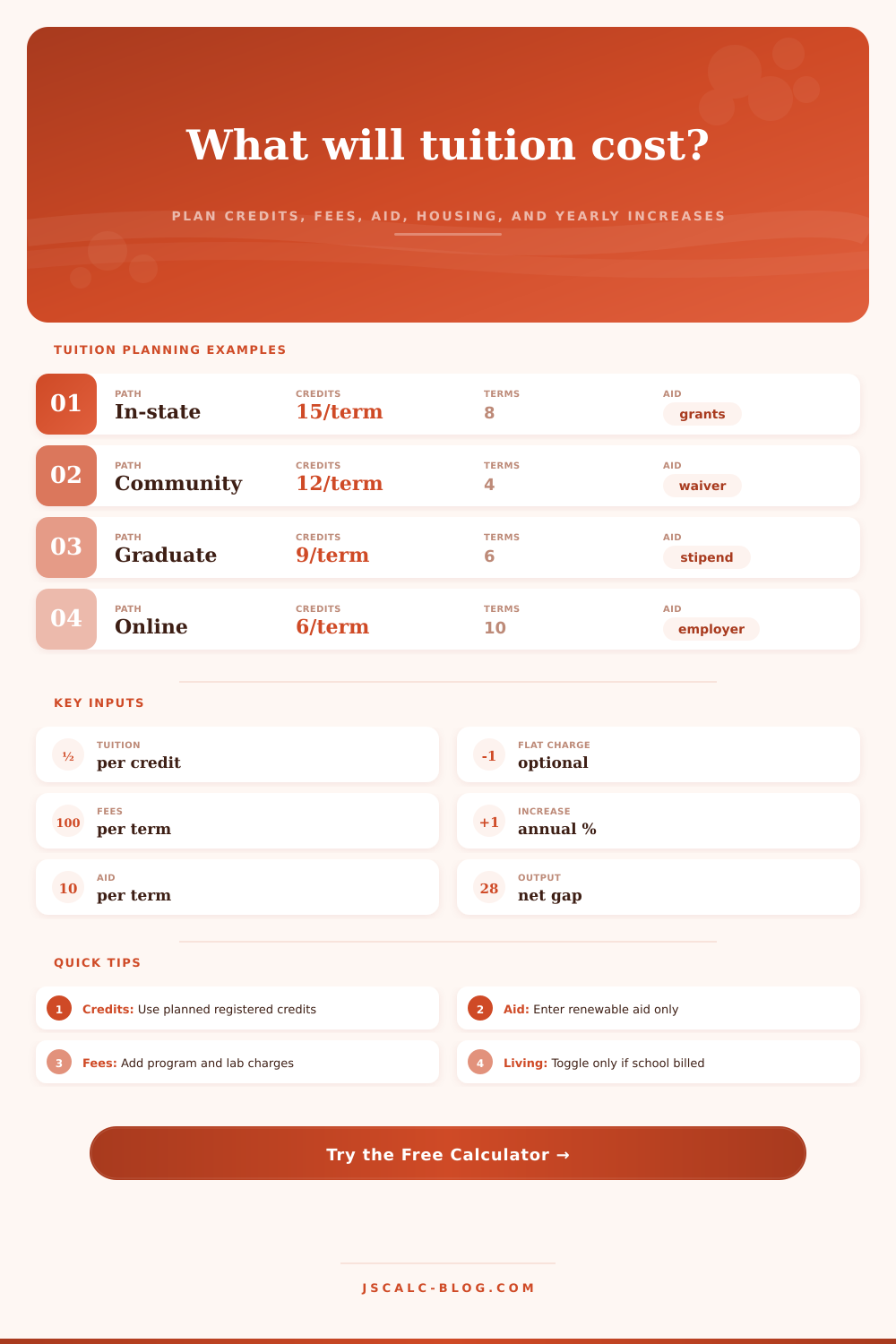
Tuition Cost Calculator
Plan JSCalc-Blog.com tuition scenarios by credit load, flat tuition, required fees, living expenses, grants, scholarships, waivers, and annual increases.
Count semesters, quarters, trimesters, or sessions you still need.
Use this for block tuition, program tuition, or cohort charges in addition to per-credit tuition.
| Enrollment model | Tuition formula | Common fee pattern | Aid timing | Planning note |
|---|---|---|---|---|
| Community college transfer | Credits x district rate | Registration and campus fees | Usually term based | Model lower first two years separately if credits or rates change. |
| Public in-state bachelor | Credits x in-state rate plus fees | Activity, facility, technology, health fees | Grants split across terms | Annual tuition increases often compound by academic year. |
| Public out-of-state bachelor | Credits x nonresident rate plus fees | Nonresident tuition differential | Merit aid may renew yearly | Scholarships can cover part of the nonresident premium. |
| Private college flat tuition | Flat term charge plus special fees | Comprehensive fee and course fees | Institutional aid annualized | Enter block tuition as flat tuition and leave per-credit rate at zero if billed that way. |
| Online adult degree | Credits x online rate | Technology and course platform fees | Employer support per term | Part-time terms stretch increases over more billing periods. |
| Graduate coursework | Credits x graduate rate | Program, library, and graduate fees | Assistantships or waivers | Fewer credits per term can still have high per-credit tuition. |
| Clinical professional track | Credits x rate plus clinical fees | Lab, simulation, placement, insurance | Scholarships and waivers vary | Use the course fee per credit field for repeating clinical costs. |
| International student plan | Credits x international rate plus living | International, health, and insurance fees | Sponsor funds may be term based | Keep billed insurance and housing in the living or fee fields. |
| Aid type | Enter as | Applied against | Renewal caution |
|---|---|---|---|
| Federal, state, or institutional grant | Grants per term | Tuition, fees, and eligible charges | Confirm enrollment level rules before assuming full renewal. |
| Merit scholarship listed by year | Scholarship per academic year | Split evenly across terms in this calculator | Check GPA and full-time credit requirements. |
| Tuition waiver | Waiver per term | Usually tuition before living costs | If waiver is percent based, convert it to dollars first. |
| Employer reimbursement | Waiver or other aid per term | Usually after grades are posted | Model cash-flow timing separately if reimbursement is delayed. |
| Assistantship stipend | Other aid per term | Depends on school billing rules | Do not double count a waiver plus stipend in the same field. |
| 529 or family contribution | Savings per year | Used after aid to reduce annual gap | Enter only funds intended for the school year. |
| Step | Formula | What it includes | Output used |
|---|---|---|---|
| Term tuition | credits x tuition rate + flat tuition | Per-credit tuition plus optional block tuition | Tuition subtotal |
| Annual increase | base tuition x (1 + rate) ^ year | Compounds tuition by academic year | Adjusted term tuition |
| School fees | mandatory fees + credits x course fee | Required campus, lab, clinical, and technology charges | Fee subtotal |
| Living costs | housing + meals + books + transport | Included only when the living toggle is set to yes | Living subtotal |
| Total aid | grant + scholarship / terms per year + waiver + other aid | Confirmed aid assigned to each term | Aid subtotal |
| Net gap | gross cost - total aid | Amount remaining after aid, floored at zero for payment planning | Term, year, and program result |
| Planning item | Common range | Calculator field | How to use it |
|---|---|---|---|
| Full-time semester load | 12 to 18 credits | Registered credits per term | Use the credits you expect to bill, not only credits needed for the major. |
| Quarter load | 12 to 16 credits | Terms per academic year | Select 4 terms when tuition is charged across quarters or sessions. |
| Program length | 4 to 10 terms | Total terms remaining | Adjust for transfer credits, summer terms, and part-time plans. |
| Annual tuition increase | 2% to 5% | Annual tuition increase | Use the published board-approved increase if your school provides one. |
| Course or lab fee | $25 to $250 per credit | Course fee per credit | Average repeating fees across the term when only some classes have labs. |
| Books and supplies | $300 to $900 per term | Books and supplies | Include required software, kits, exam tools, or professional materials. |
| Housing and meals | School-specific | Housing and meal plan | Use billed room and board when comparing financial aid packages. |
You probably recognize the sticker price. It’s the big dollar amount found on websites or in brochures. Or it’s the price that news outlets reference when they describe how much college costs has risen over time. It’s the scary number, but it doesn’t do anything useful for your financial plan. It provides no clue as to what you’ll pay out of pocket with all those scholarship, grants, and loans. It also fails to account for the hidden fees tacked onto every term. And it assumes an unmoving sticker price, one that won’t change over time.
Higher education work in terms of cash flows. It works one term at a time. It isn’t based off some headline number. For that reason, it’s important to understand the difference between the gross sticker price and net cost, most people don’t.
Why You Should Not Look at the Sticker Price
After plugging in your specific aid structure and amount of credits, the calculator do the math for you. No need to guess at fee stacking and compounding increases.
Many student underestimate the impact of annual tuition hikes. It’s easy to think “A three percent raise? No problem!” But that’s on top of your starting tuition, which compounds each year for four (or more) years. By senior year, compounding vs. A flat rate make a huge difference. You’re not only paying for this semester; you’re paying for inflation built into all future semesters.
Then there are the fees. The tuition-per-credit amount is visible to all. Mandatory campus fees, lab charges, and clinical costs (for nursing and engineering paths) isn’t viewed by many. They are not optional add-ons. They are as mandatory as tuition itself. Meal plans and housing can add a second tuitions worth of cost. Without considering such factors, your budget will fall over like a domino.
Before you decide how to pay for anything, you need to know what’s being billed. Except for financial aid. Financial aid adds complexity. Few financial aid package are simple. Annual scholarships exist. Grants tied to full-time enrollment happen. One-time aid dissapears after the first term. Don’t double-count a one-time award over more than one year! Four-year scholarships is nice. One-year scholarships drive up your net cost by a bunch in subsequent years. The tool shows the difference between temporary versus renewable aid and reveals actual gap. And that’s what you’ll fill via loans, family contributions, or savings.
Think of your degree as a chain of billing events instead of a single transaction. Aid is distributed and costs are incurred each term. Viewing it this way allow you to break it down, term-by-term, so that you’re not shocked by the last-year bill. It’s clear how much money you’ll need and exactly when you’ll run out of aid (and when your bills will be highest). That detail let you make better-informed decisions about credit load.
In some cases, taking fewer credits may save you money during a specific term but it will also prolong your time at school. This means more terms, which means more fees. So you should of balance short-term savings with the long-term cost of extending your education.
For various situations, there is decent defaults on the calculator. If you’re a graduate student who pays out-of-state tuition, a freshman from in state, or a community college transfer, it’s still the same math. The variables shift, sure, but the logic doesn’t. Plug in your costs: fees, rates, aid. Let the calculator do its thing.
What’s left? It is not exactly magic, but it is illuminating. Instead of worrying over an unknowable figure, you feel confident that you know what to do next. Education isn’t so much about choosing the least-expensive school as it is about figuring out the cash flow of your chosen schooling path. If you have the time to take it slow and you have the means to cover it, then go for the cheapest. If you’ve got the help to cover the most expensive, then pick that one too. The trick is knowing what each will realy cost.
When you get past staring at the sticker price and begin to stare at the net gap, the fear goes away. You’re no longer guessing… You’re calculating. And that’s how you pay your way through with no regrets.