Total Monthly Housing Payment Calculator
Add up your complete PITI payment - principal, interest, property taxes, homeowners insurance, PMI, and HOA dues - into one monthly number, then check your front-end debt-to-income ratio against the 28 percent guideline lenders use to qualify you.
🎯Real Full-Payment Presets
📝Home & Loan Inputs
Purchase price or appraised value of the home.
Choose how you want to enter the down payment.
Enter 20 for 20% or a dollar figure like 80000.
Annual mortgage rate on the loan balance.
Length used to amortize principal and interest.
Yearly county property tax bill, divided by 12.
Yearly hazard insurance premium, divided by 12.
Homeowners or condo association fee, entered per month.
Only applied when the down payment is under 20%.
Used for the front-end DTI ratio; leave 0 to skip.
🔢Payment Formula Snapshot
📋Home Price to Estimated PITI
| Home Price | Down Payment | Est. P&I | Taxes + Ins | Total PITI |
|---|---|---|---|---|
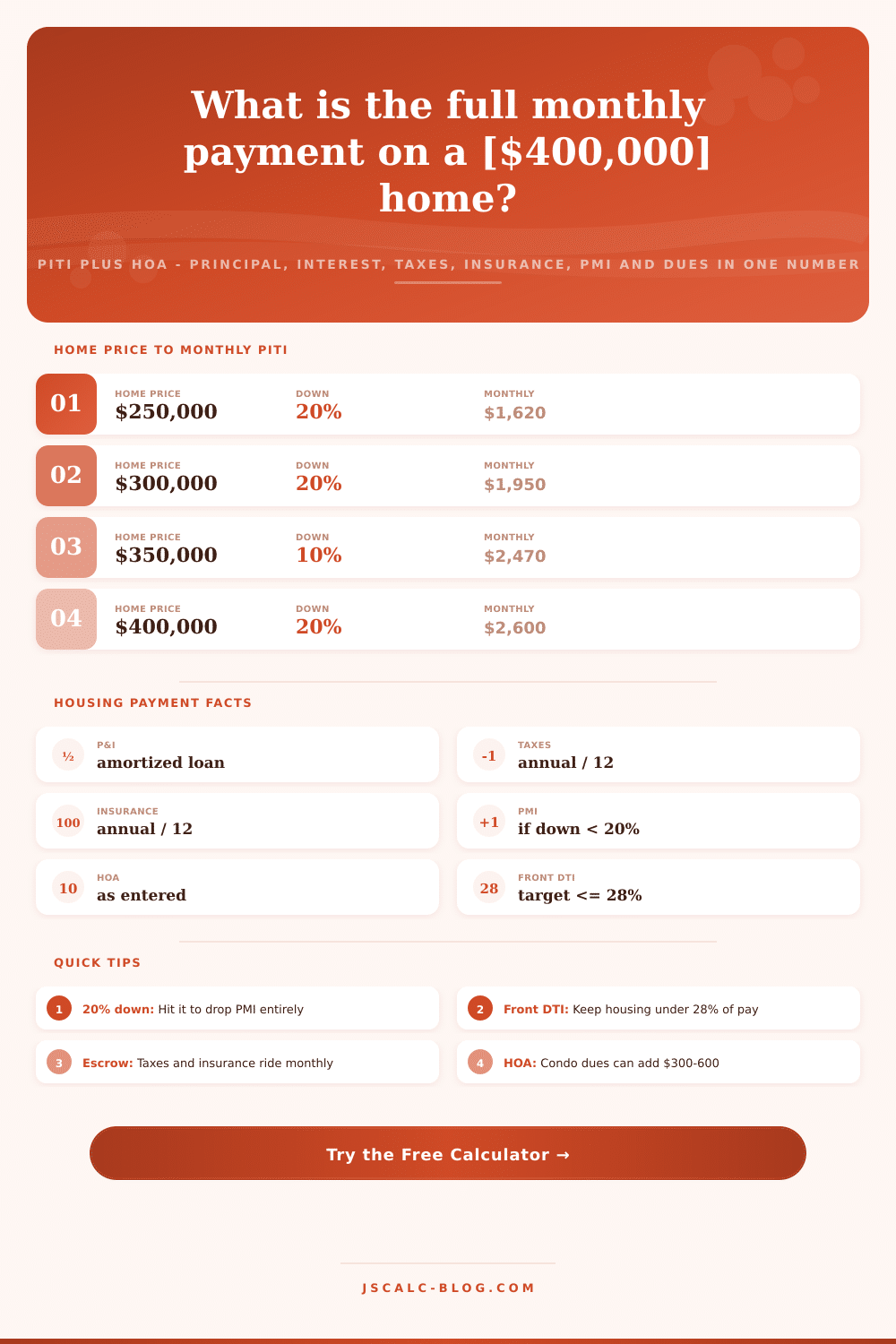
| $250,000 | 20% ($50k) | $1,264 | ~$356 | ~$1,620 |
| $300,000 | 20% ($60k) | $1,517 | ~$433 | ~$1,950 |
| $350,000 | 10% ($35k) | $1,991 | ~$479 | ~$2,470 |
| $400,000 | 20% ($80k) | $2,023 | ~$577 | ~$2,600 |
| $450,000 | 10% ($45k) | $2,560 | ~$610 | ~$3,170 |
| $500,000 | 20% ($100k) | $2,528 | ~$722 | ~$3,250 |
| $600,000 | 20% ($120k) | $3,034 | ~$866 | ~$3,900 |
| $700,000 | 20% ($140k) | $3,540 | ~$1,010 | ~$4,550 |
📊Front-End DTI Guideline Chart
| Gross Monthly Income | 28% Front-End Cap | 31% FHA Cap | 36% Stretch |
|---|---|---|---|
| $4,000 | $1,120 | $1,240 | $1,440 |
| $5,000 | $1,400 | $1,550 | $1,800 |
| $6,000 | $1,680 | $1,860 | $2,160 |
| $8,000 | $2,240 | $2,480 | $2,880 |
| $10,000 | $2,800 | $3,100 | $3,600 |
| $12,000 | $3,360 | $3,720 | $4,320 |
| $15,000 | $4,200 | $4,650 | $5,400 |
💰PMI Cost by Down Payment
| Down Payment | PMI Applies? | Typical Rate | On $360k Loan | Monthly PMI |
|---|---|---|---|---|
| 3.5% down | Yes (FHA MIP) | 0.55% | $386,000 base | ~$177 |
| 5% down | Yes | 0.80% | $380,000 loan | ~$253 |
| 10% down | Yes | 0.50% | $360,000 loan | ~$150 |
| 15% down | Yes | 0.35% | $340,000 loan | ~$99 |
| 20% down | No | 0.00% | $320,000 loan | $0 |
| 25% down | No | 0.00% | $300,000 loan | $0 |
🗃Component Breakdown Comparison Grid
| Scenario | P&I | Taxes | Insurance | PMI | HOA | Total |
|---|---|---|---|---|---|---|
| $250k, 20% down, 30yr | $1,264 | $250 | $106 | $0 | $0 | $1,620 |
| $300k, 5% down, PMI | $1,802 | $300 | $117 | $190 | $0 | $2,409 |
| $400k, 20% down, 30yr | $2,023 | $400 | $133 | $0 | $0 | $2,556 |
| $550k condo, 10% down | $3,131 | $458 | $150 | $206 | $450 | $4,395 |
| $500k high-tax, 20% | $2,528 | $833 | $167 | $0 | $0 | $3,528 |
| $350k FHA, 3.5% down | $2,135 | $292 | $117 | $155 | $0 | $2,699 |
| $750k jumbo, 20% down | $3,792 | $625 | $250 | $0 | $0 | $4,667 |
| $350k, 15yr, 20% down | $2,378 | $292 | $100 | $0 | $0 | $2,770 |
| $200k rural, 10% down | $1,138 | $150 | $83 | $75 | $0 | $1,446 |
⚙Formula Breakdown
💡Payment Planning Tips
Say you find a house in your favorite neighborhood. You run through the numbers. You add up the principal and interest, review property tax rate, and figure out how much your mortgage payment will be. Then you decide if you can comfortabley afford it.
So you get the loan estimate back … and it’s $200 more than you budgeted for. It wasn’t that you misjudged the cost of the house. You simply missed half of the bill. The total housing payment each month isn’t just what goes to the bank; it includes all the cash leaving your checking account that enable you to have a roof over your head. Lenders package all of that into one single automatic draft: Principal, Interest, Taxes, Insurance. That’s the P-I-T-I acronym. This include the portion going toward repaying the loan itself, as well as the portion being sent in the escrow account to cover hazard insurance and other local government fees.
What to Include in Your Monthly Housing Cost
But there are times when Piti doesn’t tell the entire tale. Private mortgage insurance apply if you’re putting down less than 20 percent. Homeowners association dues join the chorus if you reside in a planned community or condominium. The calculator above allow you to plug in your unique set of fees and rates, so that you don’t underestimate what your true monthly burden is. It forces you to stare at the sum of everything that’s flowing out of your pocket, instead of merely the repayment schedule.
Then there’s the principal and interest portion. This part of the payment follows old loan formula. It is the size of the loan (the price less your down payment) divided by the number of months (or years) at the interest rate, which is shown as an annual percentage rate. The bigger your loan, the longer the term, and/or the higher the interest rate, the more goes toward the principal and interest portion. For example, that’s why your monthly payment on a fifteen-year mortgage will feel like a brick in your pocket. While shaving thousands off your total interest costs over the course of the loan. You’re sacrificing short-term cash flow for long-term wealth-building; you get to choose whichever is most important given your circumstances right now.
You also forget about insurance and taxes, which lenders bundle into one automatic draft along with your principal and interest. Taxes will wildly differ between counties and will jump upward if your property gets reassessed (as it may be worth more now than before). Insurance premiums depend on the limits of your coverage, location’s risks and construction of your house. This isn’t a fixed cost that never changes. Like your grocery bill, it sneaks upward over time. You must budget for these costs to increase, create a cushion for them. Assuming this year’s amount will be frozen for three decades are risky.
The punishment for taking out more than your equity is private mortgage insurance. This is something everyone hates, because it’s a penalty that insures your loan if you should fail to pay back, protecting the bank, NOT YOU. Generally, putting down twenty percent usually eliminates the private mortgage insurance entirely. So don’t freak out about it in the long run; just recognize that you’re paying a short-term price (less down = fewer dollars up front) for some time. When you appreciate or pay off your house, you will become eligible to get rid of the privit mortgage insurance.
Homeowners association dues are the wild card of urban and suburban life. These may be a mere hundred bucks, paying for landscaping, exterior maintenance, and other amenities. Or they might be more than your mortgage interest, as in luxurius condos. Know exactly what those dues are buying. Is it just basic snow removal? A gym and pool? The value of those services should justify the monthly hit to your wallet. What happens if the HOA is underfunded? Expect big surprise special assessments, delivered with no notice.
The front-end debt-to-income ratio is what lenders use to assess affordability. This is calculated as your total housing payment divided by your gross (pre-tax) monthly income. Conventional loans require it to be less than twenty-eight percent. FHA loans will go up to thirty-one percent. Your figure comes out at forty percent? You’re flirting with disaster; sinking into a hole before you’ve moved in.
On the page, there’s a tool to calculate this immediately. It tests you against bankers’ harsh rules-of-thumb: an arbitrary check on reality. Home buying isn’t just a matter of falling in love with a location; it’s a matter of making sure owning that location doesn’t crush your financial soul. Falling in love with the house means nothing if the cash outflow each month is suffocating.
The presets show what varying combinations of interest rate and down payment do to the grand total. Adjust insurance and taxes to match what you actualy pay (not the national average). Then read through the full breakdown… One card at a time (until you are sure the number is right). That’s how you transform a beautiful listing into a smart purchase, without losing sleep when you get the first mortgage statement.