Principal and Interest Split Calculator
Break any single loan payment into its interest and principal portions, see the balance that remains right after it, and find the crossover payment where the principal part first grows larger than the interest part on a fixed-rate amortizing loan.
🎯Real Payment Inspect Presets
📝Loan and Payment Inputs
The starting principal borrowed, in dollars.
Nominal yearly rate; monthly rate is APR / 12.
Full length of the loan; months n = years x 12.
Which single payment to split, from 1 to n.
Used to date payment k on the results panel.
Sets which stretch the mini schedule below shows.
🔢Amortization Snapshot
📋This Loan Mini Schedule
| Payment # | Interest | Principal | Balance After |
|---|---|---|---|
| - | - | - | - |
📊How the Split Shifts Over 30 Years
| Payment # | Interest Part | Principal Part | Share to Principal | Stage |
|---|---|---|---|---|
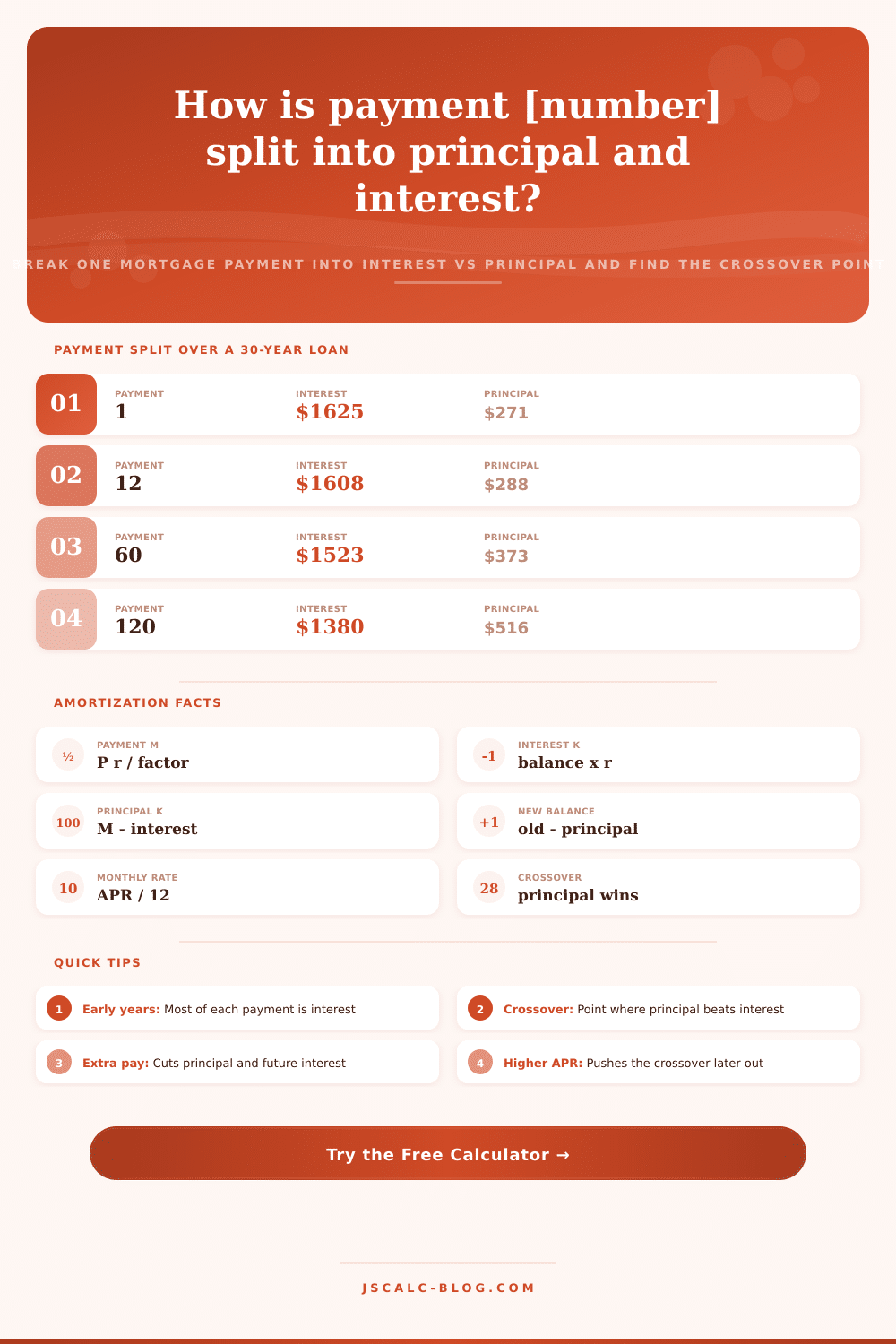
| 1 | $1,625 | $271 | 14% | Almost all interest |
| 60 | $1,523 | $373 | 20% | Year 5, slow gain |
| 120 | $1,380 | $516 | 27% | Year 10 |
| 180 | $1,183 | $713 | 38% | Halfway in time |
| 233 | $947 | $950 | 50% | Crossover point |
| 300 | $532 | $1,364 | 72% | Year 25 |
| 359 | $20 | $1,876 | 99% | Nearly all principal |
| 360 | $10 | $1,886 | 100% | Final payment |
Reference loan: $300,000 at 6.5% APR over 30 years, monthly payment $1,896.20.
🗃Crossover Payment Comparison Grid
| Loan Amount | APR | Term | Monthly Payment | Crossover # | Crossover Year | Interest at Pay 1 |
|---|---|---|---|---|---|---|
| $200,000 | 4.5% | 30 yr | $1,013.37 | 176 | Year 15 | $750 |
| $300,000 | 6.5% | 30 yr | $1,896.20 | 233 | Year 20 | $1,625 |
| $350,000 | 7.5% | 30 yr | $2,447.25 | 250 | Year 21 | $2,188 |
| $400,000 | 7.0% | 30 yr | $2,661.21 | 242 | Year 21 | $2,333 |
| $500,000 | 6.0% | 30 yr | $2,997.75 | 223 | Year 19 | $2,500 |
| $250,000 | 5.5% | 15 yr | $2,042.71 | 30 | Year 3 | $1,146 |
| $35,000 | 6.0% | 6 yr | $580.09 | 3 | Year 1 | $175 |
Higher APR and longer terms push the crossover payment later; shorter terms move it much earlier.
💵Monthly Rate From APR
| APR | Monthly Rate r | r as Decimal | Interest on $100k Balance |
|---|---|---|---|
| 3.0% | 0.2500% | 0.002500 | $250.00 |
| 4.5% | 0.3750% | 0.003750 | $375.00 |
| 5.5% | 0.4583% | 0.004583 | $458.33 |
| 6.0% | 0.5000% | 0.005000 | $500.00 |
| 6.5% | 0.5417% | 0.005417 | $541.67 |
| 7.0% | 0.5833% | 0.005833 | $583.33 |
| 7.5% | 0.6250% | 0.006250 | $625.00 |
⚙Formula Breakdown
💡Payment Split Tips
Your mortgage is paid from same exact check each month. But when bank records it, they break out the details differently. Most months; especially at the start of your loan, a large portion of your mortgage payment are interest with just a little going toward principal reduction. As you near the end of the loan, nearly all your dollars goes toward reducing the loan principal. On a fixed rate loan, this change is both automatic and unstoppable, but it’s happening behind the scenes of your monthly mortgage statement.
During those initial couple years, you may wonder why your balance isn’t dropping faster. Why doesn’t it seem like you’re making progress?
How Your Mortgage Payment Changes Over Time
The calculator above does that math for you. It tells you precisely which part of each mortgage payment go toward principal and which part is interest. It identifies the moment immediately following that payment, showing you how much money remains unpaid. And it highlights the month when the math turn in your favor.
It’s easy enough once you wrap your head around it (though admittedly that might take a few minutes). You’re charged interest on your outstanding balance, not your initial loan balance. As each payment reduce the balance just slightly, so does the corresponding interest charge. So a greater portion of your fixed payment can go toward paying down principal instead, and next month, even more of it will be able to. Your overall payment remains the same, but its makeup gradually change from interest-heavy to principal-heavy.
It’s that breakdown that’s the difference between feeling like you’re spinning your wheels vs. You will have a clear idea of when you will start building equity for real.
But it doesn’t stop there. The process is driven mercilessly by formulas. Your monthly payment is easy: Just divide your annual percentage rate in half (that’s 0.06) and then divide again. (That’s why it’s 0.005.) Next, use a basic amortization formula that makes your loan reach zero at the end of term. That means that your level payment is … well, I won’t bore you with the details. Believe me.
Now all we have left are the numbers, so let’s calculate the split for every single month. First you’ll need balance immediately preceding that month’s payment. Second, multiply that balance by your monthly rate. That gives you the amount of interest due. Third, take away the interest from your fixed payment. Whatever’s left over is the amount you’ve paid toward principal. Rinse and repeat.
Paying down principal lowers your interest costs going forward, freeing up part of following payment to reduce principal even more. It is a self-reinforcing cycle.
Imagine taking out a three hundred thousand dollar loan at six point five percent for thirty years. The first payment sends one thousand six hundred twenty five dollars to interest. You’re left with just $271 toward principal, hardly money that feels like an investment. Halfway through the calendar (but not halfway through the loan), by payment #180, you notice a big change in this ratio: Interest drops to about $1,183, while principal rise to $713. Your check hasn’t changed, yet its effect on your net worth doubles.
The best use of this calculator might be to find its output called the “crossover payment number.” This is the payment number, for instance, number 233 in our six point five percent, three hundred thousand dollar example above, when you cross over from a period where most of each payment go toward interest to a period where more money goes toward paying down the principal. (Here’s what the page’s reference table looks like; it illustrates this clearly.)
The takeaway: Anything you can do to bring that crossover date sooner will accelerate equity accumulation, because after that date, your payments is spending less and less on interest and more and more on principal. As you’d expect, reducing the term pulls crossover way up early. A higher rate pushes crossover way later. When this crossover occurs however, surprisingly, it doesn’t affect the loan’s size. If you have a six hundred thousand dollar loan and a two hundred thousand dollar loan with the same rate and terms, they’re going to crossover at exactly the same payment number. It depends based off the length, the rate, but absolutely not upon the total size of dollars involved.
The thing that makes a difference is the interest rate. The lower your interest rate, the less interest is accrued per month and more of your payment go toward principal right away. That’s why switching to a fifteen year term, or even better, refinancing into a lower rate, builds your equity much faster then a long term at a high rate.
If you intend to pay off debt with extra payments, this is critically important. Extra payments made early in the loan term will save you much, much more future interest than the exact same amount applied years later. An extra two hundred bucks applied as principal on payment number twelve reduces the balance against which all future interest builds up. Essentially, it jumps you forward a few months on the timeline.
For example, on a $300,000 loan at 6.5%, it’ll take two hundred thirty three payments before you hit the tipping point. Every extra payment you apply towards principal advances that date just a little bit further. You could of transformed a vague feeling of progress into a concrete plan for how you’re going to repay.
A “split” shows you this clearly, whether it’s on a mortgage, an auto loan, or student debt. Simply enter your loan information, pick a payment number, and take a look. What happens each month? How does that impact the balance? When do you start paying down principal? Having that insight turns a boring monthly expense into a road map for your finances, one that lets you drive toward ownership with accuracy instead of hope.