Remaining Mortgage Balance Calculator
Find out exactly how much you still owe after any number of payments. Enter your original loan, rate, term, and how far along you are to see your outstanding balance, principal and interest paid to date, the percent of your loan paid off, and your current loan-to-value.
🎯Real Payoff Checkpoints
📝Loan Details
The starting balance when the mortgage began.
Fixed nominal yearly rate on the note.
Full length of the loan, usually 15 or 30.
Choose how you want to enter your progress.
How far along you are, per the mode above.
Used to compute current loan-to-value. 0 to skip.
Lump sum overpayments made on top of schedule.
Controls how dollar results are displayed.
🔢Formula Snapshot
⚙Formula Breakdown
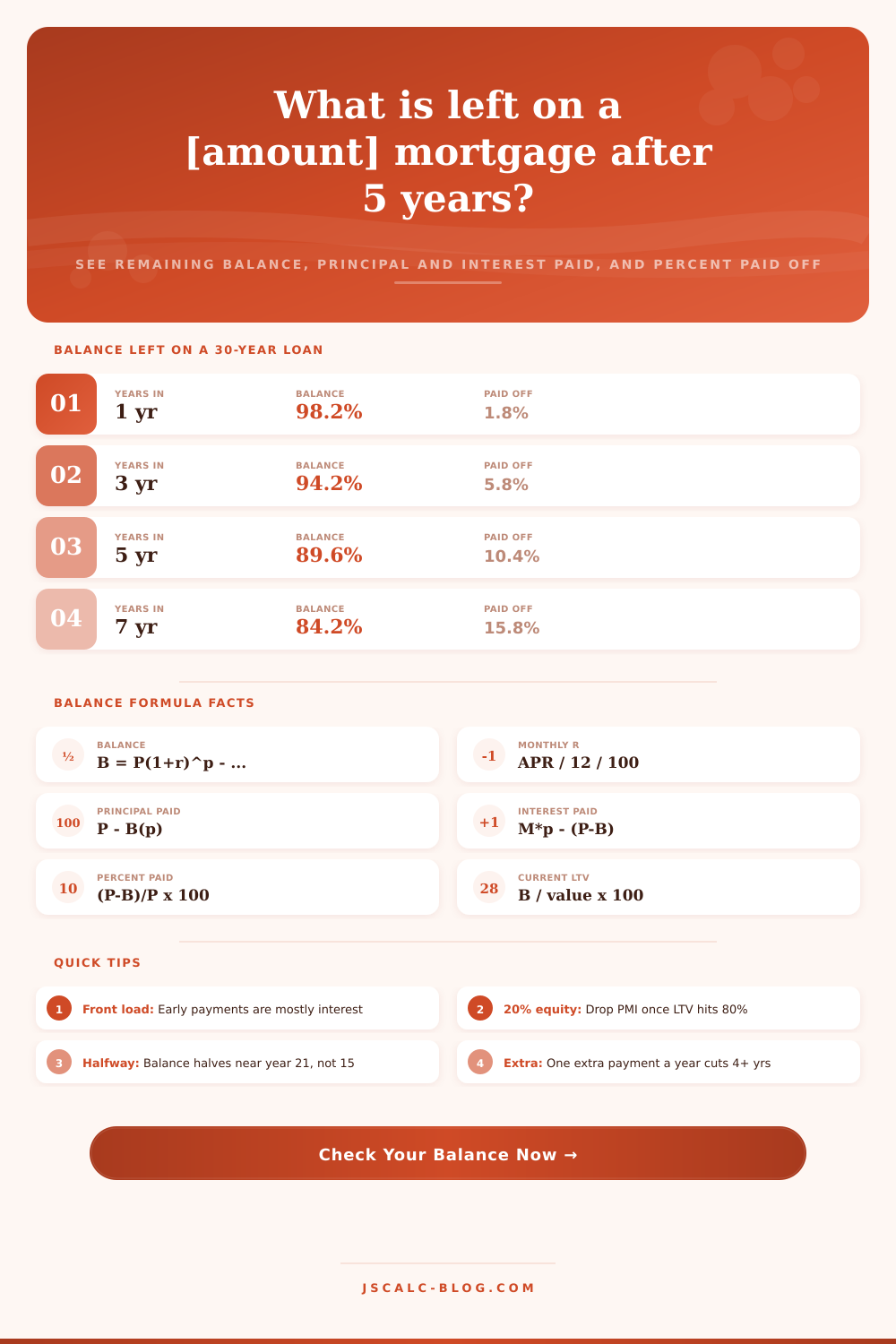
📊Balance Remaining on a 30-Year Loan
| Years Elapsed | Payments Made | Balance Remaining | Percent Paid Off |
|---|---|---|---|
| 1 year | 12 | 98.2% of loan | 1.8% |
| 3 years | 36 | 94.2% of loan | 5.8% |
| 5 years | 60 | 89.6% of loan | 10.4% |
| 7 years | 84 | 84.2% of loan | 15.8% |
| 10 years | 120 | 74.6% of loan | 25.4% |
| 15 years | 180 | 55.5% of loan | 44.5% |
| 20 years | 240 | 32.0% of loan | 68.0% |
| 25 years | 300 | 10.5% of loan | 89.5% |
| 30 years | 360 | 0.0% of loan | 100% |
💵Balance After 5 Years by Loan Size (30-yr, 6.5%)
| Original Loan | Monthly Payment | Balance at Year 5 | Principal Paid |
|---|---|---|---|
| $200,000 | $1,264 | $186,109 | $13,891 |
| $250,000 | $1,580 | $232,636 | $17,364 |
| $300,000 | $1,896 | $279,163 | $20,837 |
| $350,000 | $2,212 | $325,690 | $24,310 |
| $400,000 | $2,528 | $372,217 | $27,783 |
| $500,000 | $3,160 | $465,272 | $34,728 |
📏Rate Impact on Year-10 Balance ($300k, 30-yr)
| APR | Monthly Payment | Balance at Year 10 | Percent Paid Off |
|---|---|---|---|
| 4.0% | $1,432 | $236,234 | 21.3% |
| 5.0% | $1,610 | $243,761 | 18.7% |
| 6.0% | $1,799 | $251,057 | 16.3% |
| 6.5% | $1,896 | $223,749 | 25.4% |
| 7.0% | $1,996 | $257,896 | 14.0% |
| 8.0% | $2,201 | $263,229 | 12.3% |
🗃Payoff Progress Comparison Grid ($300k, 30-yr, 6.5%)
| Years Elapsed | Payments Made | Remaining Balance | Principal Paid | Interest Paid | Percent Paid Off |
|---|---|---|---|---|---|
| 1 year | 12 | $296,472 | $3,528 | $19,224 | 1.2% |
| 3 years | 36 | $288,309 | $11,691 | $56,565 | 3.9% |
| 5 years | 60 | $279,163 | $20,837 | $92,893 | 6.9% |
| 7 years | 84 | $268,760 | $31,240 | $128,024 | 10.4% |
| 10 years | 120 | $250,896 | $49,104 | $178,428 | 16.4% |
| 15 years | 180 | $212,545 | $87,455 | $253,865 | 29.2% |
| 20 years | 240 | $156,449 | $143,551 | $311,529 | 47.9% |
| 25 years | 300 | $78,565 | $221,435 | $347,245 | 73.8% |
| 28 years | 336 | $21,417 | $278,583 | $358,377 | 92.9% |
| 30 years | 360 | $0 | $300,000 | $362,558 | 100% |
💡Payoff Progress Tips
Every month, you look at your mortgage statement and it has hardly budged. Five (or 10) years of payments later, and it’s as though you’re stuck on a treadmill. The pace adjust according to your output. That’s what happens with an amortizing loan. And that’s the design.
The reason why your balance never seem to budge: A mortgage balance calculator explain the math behind that seemingly-stationary figure. This mortgage payoff calculator reveal exactly how much of your mortgage payment goes toward principle; and how much go towards interest. It calculates how much equity you’ve accrued so far, and how much remain to be repaid.
How a Mortgage Balance Calculator Helps You Save Money
Why does this matter? Knowing the distinction between “paying off” a mortgage and “reducing its balance” alter your long-term planning. It’s deceptively simple, yet powerful. Each payment divide into two parts: one goes toward paying down the principal, the other go toward paying off the interest on whatever you borrowed so far.
At first, most of your money go toward interest. You’re sending in $1,900 per month, but only $300 of it go to reducing the debt. The remaining amount goes toward borrowing. This is why your balance doesn’t drop quicky initially. Later, it speeds up, because as your principal decreases, your interest charge decline too. More of your money goes to the debt.
The calculator on this page will run that amortization schedule for you. It won’t guess. It’ll crunch the numbers using your own term and rate. The second thing: It will take longer then you think to get to half-way. At the end of year fifteen, on a typical 30-year mortgage, you’re nowhere near paying half. In fact, you’ll typically only get to that mark during year 21 or 22. That’s because you pay most of interest at the start.
Refinancing early won’t save you much (in terms of total interest). By the time you do, you’ve paid the bulk of lender’s profits over the course of first decade. If you know about this curve, you won’t make emotional calls because you feel like you’ve made “half” of your payment.
The calculator has some reference tables that help illustrate how little principal decreases during the first five years versus the final five. But there are three things: home values, time, and Private Mortgage Insurance (PMI). You can generally remove PMI once you reach 80% of the home’s current value. You’ll save yourself hundreds each month. Enter an estimate of today’s home value in the calculator to determine whether or not you’ve reached that milestone. This matters most if you purchased a home with less than 20% down. While you’re technically still “paying” PMI, it may no longer apply based off current equity levels. Running this check once per year can net you thousands over the life of the loan. What was once a required payment becomes a way to save money.
Even small additional payments drastically alter the course. One additional payment per year will knock four or five years off the term. Enter the amount of a lump sum overpayment and immediatly see what it’ll do for you. And this is the personal math. You can plug in different scenarios without calling a loan officer. There is nothing slowing down your financial planning.
Paying an additional $100 monthly does more than just reduce your final balance. In those first few years, the interest component gets reduced by more than the principal component. Time + Compounding = Your Friend, Not Your Enemy.
The bottom line: You make actual decisions when you know what’s what, when you know your balance. Do you want to pay off this loan? Should I sell the house? Should I refinance into cash? Is it smarter to pay it down faster or just hold onto it? Numbers don’t lie. But without context, you can easily misinterpret them.
A simple calculator removes the noise in the monthly statement. It puts your equity in perspective. You’re no longer left guessing if you’re making headway. Instead, you KNOW how many steps you’ve taken on this journey and how far you still need to go. And that knowledge is worth more than just the calculator.
You should of seen this earlier.