Combined Loan-to-Value (CLTV) Calculator
Enter your home value and each lien to see your first-lien LTV, your combined CLTV across all mortgages, and your HCLTV counting the full HELOC credit line. Then set a target CLTV cap and the tool shows exactly how much more you could borrow before you hit it.
🎯Real Lien-Stack Presets
💳Home Value & Lien Balances
Current appraised or market value of the property.
Outstanding principal on the primary first-lien loan.
Balance actually owed on a second loan or HELOC.
Full approved credit line, used for HCLTV. Set to the drawn amount if not a HELOC.
Any additional recorded liens against the home.
Lender ceiling used to size your borrowing headroom.
🔢Formula Snapshot
📋Liens to CLTV Reference
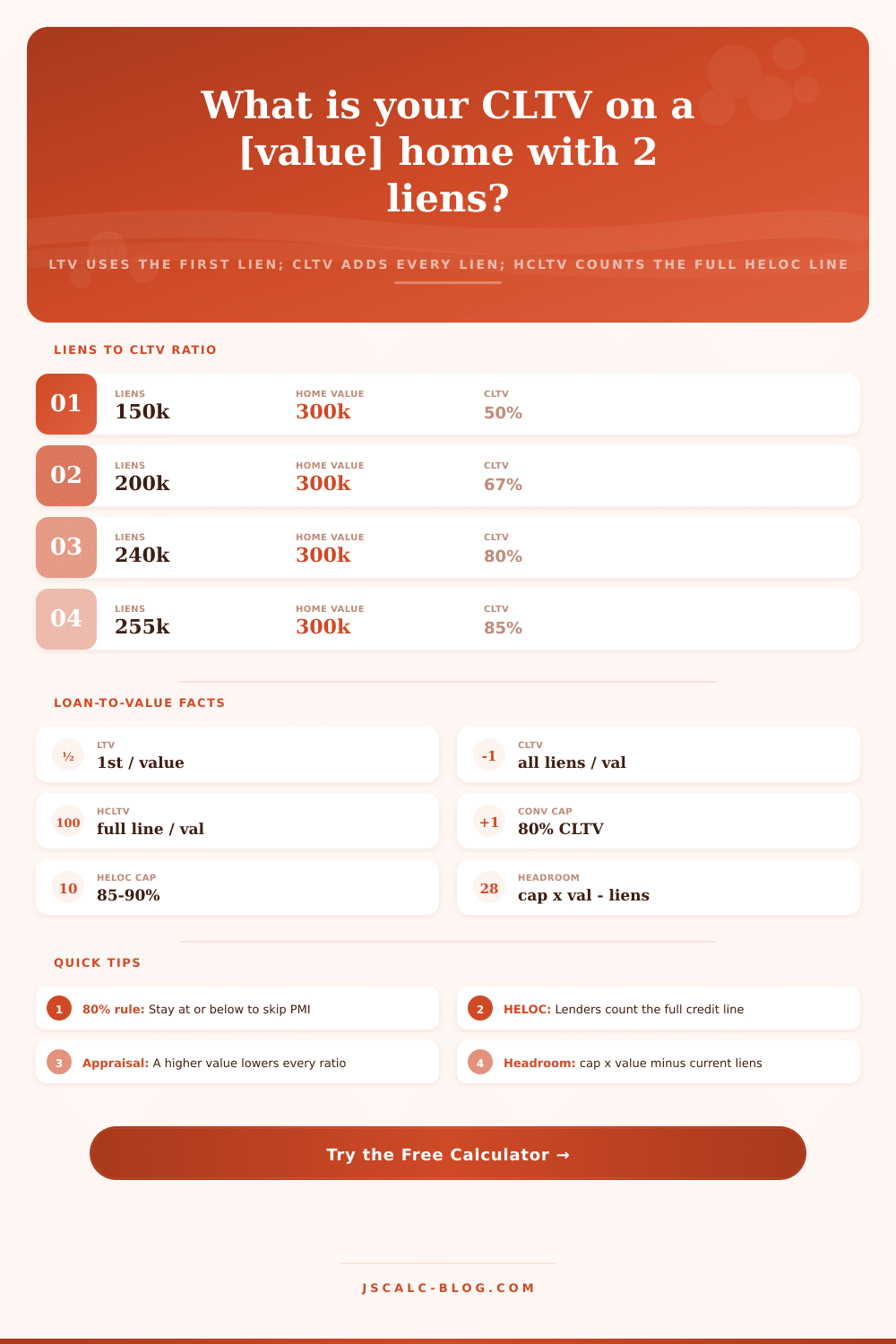
| Total Liens | Home Value | CLTV = liens / value | Reads As |
|---|---|---|---|
| $150,000 | $300,000 | 50% | Deep equity |
| $200,000 | $300,000 | 66.7% | Healthy |
| $240,000 | $300,000 | 80% | Conventional cap |
| $255,000 | $300,000 | 85% | HELOC territory |
| $270,000 | $300,000 | 90% | Aggressive |
| $320,000 | $400,000 | 80% | Conventional cap |
| $340,000 | $400,000 | 85% | HELOC territory |
| $225,000 | $250,000 | 90% | Thin equity |
📊Common Lender CLTV Caps
| Loan Type | Typical CLTV Cap | PMI Needed? | Notes |
|---|---|---|---|
| Conventional, no PMI | 80% | No | Classic 20% equity rule |
| Conventional with PMI | 95% - 97% | Yes | Low down payment loans |
| Standard HELOC | 80% - 85% | No | Second lien behind first |
| Aggressive HELOC | 89.9% - 90% | No | Higher rate, tighter credit |
| Home equity loan | 80% - 85% | No | Fixed lump-sum second |
| FHA cash-out | 80% | MIP | Government-backed limit |
| VA cash-out | 90% - 100% | No | Eligible veterans only |
📏LTV vs CLTV vs HCLTV
| Ratio | What It Counts | Formula | Used For |
|---|---|---|---|
| LTV | First lien only | 1st / value | Primary mortgage & PMI |
| CLTV | Every drawn lien | (1st + 2nd + other) / value | Second loans & HELOCs |
| HCLTV / HELTV | Full HELOC credit line | (1st + full line + other) / value | Worst-case exposure |
🗃Lien Combo Comparison Grid
| Scenario | Home Value | 1st Lien | 2nd / HELOC | LTV | CLTV | Room to 80% |
|---|---|---|---|---|---|---|
| 1st only, low | $400,000 | $300,000 | $0 | 75% | 75% | $20,000 |
| Piggyback 80/10/10 | $400,000 | $320,000 | $40,000 | 80% | 90% | -$40,000 |
| 1st + small HELOC | $400,000 | $240,000 | $40,000 | 60% | 70% | $40,000 |
| HELOC to 85% | $400,000 | $240,000 | $100,000 | 60% | 85% | -$20,000 |
| Maxed HELOC 90% | $400,000 | $240,000 | $120,000 | 60% | 90% | -$40,000 |
| Paid-down equity | $400,000 | $150,000 | $0 | 37.5% | 37.5% | $170,000 |
| New purchase 95% | $300,000 | $285,000 | $0 | 95% | 95% | -$45,000 |
| Over-levered | $250,000 | $200,000 | $37,500 | 80% | 95% | -$37,500 |
⚙Formula Breakdown
💡Borrowing & Equity Tips
How much of the home is currently pledged as collateral for debt? That’s a central question that any lender will ask when considering your mortgage application, whether it’s a cash-out refinance, or a second mortgage. JSCalc-Blog.com‘s combined loan-to-value calc gives you the answer with a single click, and displays three ratios simultaneously. You get the Home Equity CLTV (HCLTV), the Combined Loan-to-Value (CLTV) and the First-Lien Loan-to-Value (LTV). And you’ll see what number in dollars you have remaining before reaching a desired limit. These percentages are all about home-equity borrowing, so being able to view all three turns a sea of confusion into checkable fact.
What’s your home worth vs. How much do you owe? This ratio is called loan-to-value. Your first-lien LTV is calculated like this: Divide the amount owed on your mortgage by its appraised value, and multiply that number by 100. So if your house is worth $400,000 but you’ve got $240,000 left on your mortgage, the LTV = 60%.
What Are LTV, CLTV, and HCLTV?
The combined loan-to-value (or CLTV) takes into account all the liens attached to the house. In addition to the mortgage, say you have a $40,000 second mortgage, so now you’re carrying $280,000 in total debt. Now divide $280,000 by $400,000 to get a 70% CLTV.
Finally, the HELOC’s total credit limit is used to calculate yet another metric: the HCLTV. Rather than assuming that you’ve drawn down only part of the available line, the lender assumes that you may max out the line whenever you want. That’s why lenders use HCLTV for their calculation. The difference between HCLTV and CLTV brings down many an application. For example, imagine that you have a $60,000 HELOC but have only withdrawn $10,000. That’s all that your CLTV covers. But when it comes to underwriting, they’ll use the HCLTV, and if you had a $60,000 HELOC line, they’d count in that full amount because there’s no reason why you couldn’t go out and spend the remaining amount. So if you’re sitting on a $400,000 house with a first mortgage of $240,000, your CLTV may appear reasonable at 62.5 percent, but your HCLTV? 75 percent! And if a program has a cap on HCLTV, well, the undrawn portion of the line can send you past that limit. This calculator never leaves you surprised about this gap.
The tool takes six inputs: the home’s appraised value; the first mortgage balance; the second mortgage or HELOC amount actualy drawn; the full HELOC credit limit; any other liens such as tax or judgment liens; and the target maximum CLTV you want to test against. The tool then calculates the LTV, CLTV and HCLTV percentage by dividing total lien balances against the home value. It also calculates your borrowing headroom, which is value minus the total balances of all outstanding loans. Multiplied by the target percent in the formula. When your entered line limit exceeds your drawn balance, it increases the line limit to equal the drawn amount. This ensures our HCLTV gives an accurate view of your risk.
The result is summed up in four cards. The first one indicates what I call the “first-lien LTV”; the ratio of debt on that loan versus the value of the house. If this figure exceeds 80 percent (the usual trigger point for private mortgage insurance), then yes, PMI is required; otherwise, no.
The second card displays the cumulative “combined CLTV.” This represents the ratio between total debt and home value. Most lenders use this metric to underwrite a loan.
The third card displays “HCLTV,” which represent the ratio including any outstanding balance against a fully tapped-out HELOC. That’s a conservative view of the worst case.
The fourth card tells you how much money you’d get back if your objective was to bring the mortgage to whatever level you desire, plus the extra dollar amount you would be able to borrow. (Alternatively, if you’re already past the line, this will tell you how many more dollars over the line you are.) Below the cards, a breakdown panel explains each substituted number and allows you to follow the math.
Here’s a concrete example: Imagine you’re in a $400K house with a $240K first and a $40K HELOC draw. And you wish to experiment with a cap of 80 percent. The current total of all your drawn liens equals $280K, which results in a combined loan-to-value of 70 percent. At an 80 percent cap, max liens would be $320K. Minus what you have now ($280K) and you get the magic number: $40K. That’s the additional money that a lender might be willing to give you, before hitting the limit.
On a $400,000 home, an 85 percent cap raises the ceiling to $340K. This bumps your headroom up by $60K. As you adjust the target on the calculator, it automatically works out the numbers for you, showing how much more juice you’ll unlock with a higher cap.
Where does each product draw the line? A conventional loan not requiring private mortgage insurance typically targets an LTV of 80 percent or less on the first lien. A standard HELOC and most cash-out refinances combine for 80 to 85 percent CLTV. For solid credit, some more-aggressive HELOC lenders will extend to 89.9 or 90 percent (but with a higher rate). Mortgage insurance is required on low-down-payment purchase programs, which go up to 95 or even 97 percent CLTV. Eligible veterans can secure a cash-out loan through the VA program up to 90 to 100 percent. The reference table on this page shows these guidelines so you can find a realistic target for your scenario before applying.
The tool also serves as a debt-consolidation-or-piggyback purchase-planning tool because it reports borrowing headroom in dollar terms. Select the cap rate (the one used by your lender) and enter your numbers, then let the room-to-target card spit out the maximum size of second lien you can take without violating the cap. A negative number means it is time to run to the bank to pay something off, wait for the house to appreciate, or get a new appraisal before taking on any more debt.
There are ten presets that reflect actual lien stacks from a 75 percent LTV clean first mortgage to a maxed-out HELOC at 90 percent. Start with the one nearest your situation and tweak from there.
And this: The lower your combined loan-to-value ratio, the better your pricing will be, and the more deals you will get. Everything that pulls those ratios down supports a good appraisal, avoids draws on the HELOC, and helps pay down principal. Depending solely on what you owe, the same $400,000 house can swing between a 70 percent CLTV and a 90 percent CLTV. Tracking your numbers over time will show just how each payment increases your equity.
Run your numbers. Compare your CLTV, LTV, and HCLTV cards. Use the result of your headroom to make a smart decision about when’s the right time to tap into your home.