Escrow Payment Calculator
Estimate the monthly escrow (impound) portion of your mortgage that collects property taxes and homeowners insurance, plus optional flood and PMI. See the RESPA two-month cushion, your aggregate initial escrow deposit at closing, and the projected escrow after next year's escrow analysis.
🎯Real Escrow Scenarios
📝Escrow Inputs
Total yearly county and municipal property tax bill.
Yearly hazard or homeowners policy premium.
Optional. Required in FEMA flood zones.
Optional. Applies when down payment is under 20%.
RESPA caps the reserve cushion at two months.
Months of escrow gathered upfront, varies by closing date.
Projected rise in taxes and insurance for next year.
Controls how every result is displayed.
🔢Formula Snapshot
📋Tax and Insurance to Monthly Escrow
| Annual Tax | Annual Insurance | Annual Total | Monthly Escrow |
|---|---|---|---|
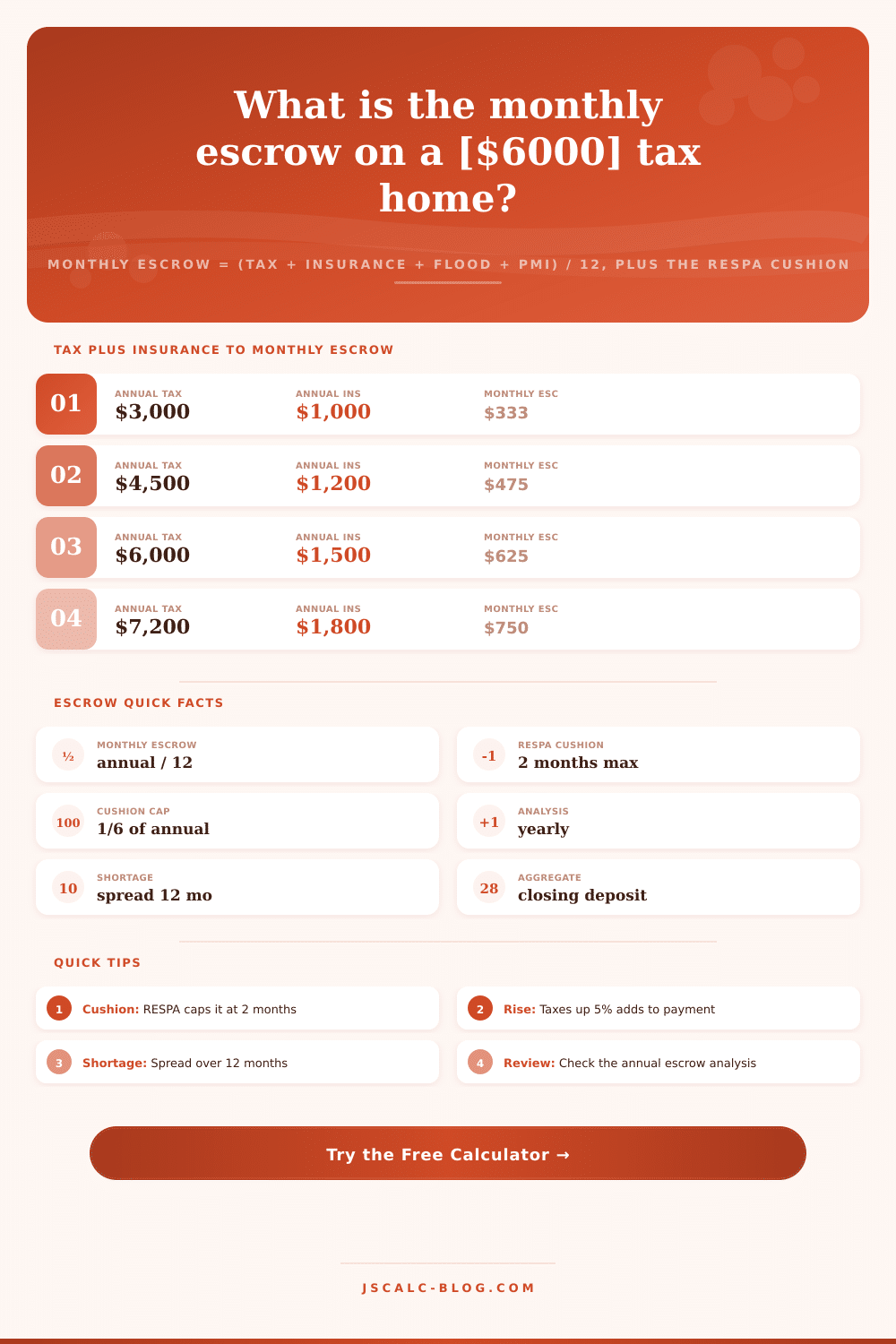
| $3,000 | $1,000 | $4,000 | $333.33 |
| $4,500 | $1,200 | $5,700 | $475.00 |
| $6,000 | $1,500 | $7,500 | $625.00 |
| $7,200 | $1,800 | $9,000 | $750.00 |
| $9,000 | $2,000 | $11,000 | $916.67 |
| $12,000 | $2,400 | $14,400 | $1,200.00 |
| $5,000 | $3,500 | $8,500 | $708.33 |
| $15,000 | $3,000 | $18,000 | $1,500.00 |
📊RESPA Cushion by Monthly Escrow
| Monthly Escrow | 1-Month Cushion | 2-Month Cushion (Max) | Annual Escrow |
|---|---|---|---|
| $300 | $300 | $600 | $3,600 |
| $450 | $450 | $900 | $5,400 |
| $625 | $625 | $1,250 | $7,500 |
| $750 | $750 | $1,500 | $9,000 |
| $900 | $900 | $1,800 | $10,800 |
| $1,200 | $1,200 | $2,400 | $14,400 |
| $1,500 | $1,500 | $3,000 | $18,000 |
📏Annual Increase Impact on Escrow
| Annual Increase | This Year Monthly | Next Year Monthly | Monthly Change |
|---|---|---|---|
| 0% | $625.00 | $625.00 | $0.00 |
| 3% | $625.00 | $643.75 | +$18.75 |
| 5% | $625.00 | $656.25 | +$31.25 |
| 8% | $625.00 | $675.00 | +$50.00 |
| 10% | $625.00 | $687.50 | +$62.50 |
| 15% | $625.00 | $718.75 | +$93.75 |
🗃Escrow Scenario Comparison Grid
| Scenario | Annual Tax | Annual Ins | Flood + PMI | Annual Total | Monthly Escrow | 2-Mo Cushion |
|---|---|---|---|---|---|---|
| Starter Home | $2,400 | $900 | $0 | $3,300 | $275.00 | $550.00 |
| Low-Tax Rural | $1,800 | $1,100 | $0 | $2,900 | $241.67 | $483.34 |
| Base Home | $6,000 | $1,500 | $0 | $7,500 | $625.00 | $1,250.00 |
| Texas No-Income-Tax | $8,400 | $1,600 | $0 | $10,000 | $833.33 | $1,666.66 |
| Coastal + Flood | $5,500 | $2,800 | $1,200 | $9,500 | $791.67 | $1,583.34 |
| Condo w/ HOA | $4,200 | $1,300 | $0 | $5,500 | $458.33 | $916.66 |
| Low Down + PMI | $5,000 | $1,400 | $1,320 | $7,720 | $643.33 | $1,286.66 |
| High-Tax NJ | $13,500 | $2,100 | $0 | $15,600 | $1,300.00 | $2,600.00 |
| Luxury Estate | $22,000 | $4,500 | $1,800 | $28,300 | $2,358.33 | $4,716.66 |
⚙Formula Breakdown
💡Escrow Planning Tips
If you’ve ever looked at your mortgage statement, there’s a line for “principal & interest“, then another line with a higher number which always strike you as too high. That’s your “escrow payment,” an amount that covers the lender’s bill for your homeowners insurance (and perhaps property taxes). Escrow payments look like a hidden fee, but they’re not; instead think of them as a prepaid savings account that works in reverse.
The lender collect all these payments into one big bucket each month then pays out the bills on your behalf. On this page, we isolate the escrow payment from your combined mortgage payment. See exactly how much of your payment goes toward someone else’s bills, how much is reserved in a buffer and how rising tax rates could affect your payment.
How Escrow Payments Work
Most homeowners lump their mortgage payment into one block. Truth is: only some of it lower your loan balance. Other parts cover things you don’t directly control (e.g., insurer premium changes, local government tax schedules). Why does it matter? These other expenses adjusts independently of interest rate changes. Knowing how this works will help you budget for surprises instead of reacting to them once they happen.
It’s pretty basic math. Add up all the money you have in escrow each year, including your property tax, hazard insurance, any flood coverage you might need, and/or private mortgage insurance if your down payment was low. Divide that total by 12, and you’ll get a sense of how much your mortgage will require in monthly impounds. To save you time, the calculator does that math for you right away while you input your numbers.
More important than the math itself is knowing what goes into escrow and what doesn’t: Not everything gets funneled into that pot. For example, your HOA fees won’t go in there, unless your lender choose to bundle them (which is uncommon).
RESPA also gives banks some leeway: They can keep a cushion in your account. But here’s what you need to know about this reserve cushion (which is part of your escrow). First, it’s no money-maker for the bank; it’s an insurance fund in case your bills spike unexpectedly or there are payment delays. For example, if your escrow payment is $625 per month, then that two-month max leaves up to $1,250 in your account unspent.
Often, people think this is “wasted” money, they don’t realize it’s all theirs, just parked there as a reserve. You’ll be able to model various sizes of cushion, too. This helps you understand how a larger escrow will affect your closing costs. You won’t commit to one lender’s policy until later.
The aggregate deposit is the sum off the prepaid months and the initial cushion. This means you’ll need a lump sum of money at closing: part is the prepaid months and part is the initial cushion. You may have to prepay as many as three or four months’ worth of escrow just to get the account current by closing, which is especially likely if you close near end of tax year. If you haven’t anticipated this up-front cash demand, it can be a budget-buster during closing. Having the precise number lets you set aside funds appropriately.
Your taxes/insurance: Those seldom remain the same, as both are prone to creeping upward. Every year, your servicer completes an escrow analysis; comparing what they paid vs. They compare this to what you paid into escrow. Did bills go up more than anticipated? You’ll be short (not immediately, though). Instead, this gets spread over the following dozen payments. Even if your cost-of-living goes up just 5% annually, this show up as a noticeable jump in your payment. Avoid sticker shock by planning for this hike today.
In reality, there are so many variables, just look at presets in this tool. You can select a low-tax rural county or a high-tax market like New Jersey and see how differently it comes out. If your home’s on the coast, it has flood insurance; an inland house does not. Each change affects your overall number. Adjust the variables and you’ll get a sense for how sensitive your escrow is to other factors. It is less a single right answer then a spectrum.
Escrow, at its core, is a way to manage your cash flows. Rather than having to come up with one giant lump sum at some point in time, you’ll pay a little bit each month instead. The tool shows you both what that little bit will be today and tomorrow. It makes the number predictable.
It takes a hidden line item and turns it into an expense you can plan for instead of something you fear.