Total Cost Calculator
Combine item quantity, unit amount, discounts, tax, shipping, handling fees, processing charges, and contingency buffer into one final total with a per-unit landed cost and repeat-order projection.
🎯Total Cost Presets
🧮Cost Inputs
Scenario loads a typical tax, fee, shipping, and buffer profile.
The symbol changes display only; calculations use the entered amounts.
Use seats, units, cases, rentals, or line items as the quantity.
Base amount for one unit before discounts, shipping, tax, and fees.
Discount is capped so the net merchandise amount cannot go below zero.
Enter 10 for 10% when percent mode is selected.
Choose the base your invoice uses before applying the tax rate.
Enter 8.25 for an 8.25% rate.
Weight mode uses item weight multiplied by quantity.
Amount, per-item rate, per-weight rate, or percent by selected mode.
Used only for weight-based shipping; leave any value for other modes.
Use both for card processing plus a handling line.
Handling, booking, setup, or minimum order fee.
Enter 2.9 for 2.9% processing, or an amount in per-item mode.
Applies after discount, shipping, fees, and tax are added.
Use 0 for one-time decisions or 12 for monthly recurring orders.
📊Current Cost Snapshot
📐Total Cost Formula Breakdown
📋Preset Comparison Table
| Scenario | Quantity | Unit Amount | Discount | Tax Base | Shipping | Fee Method | Buffer | Repeat Use |
|---|---|---|---|---|---|---|---|---|
| Online cart checkout | 12 units | $49.95 | 10% off | Net only | Flat $18.50 | Fixed $4.95 | 5% | 4 orders/year |
| Office supply order | 38 units | $16.40 | $35 fixed | Net + ship | $0.80/item | Fixed + 2.5% | 3% | 6 orders/year |
| Inventory restock | 240 units | $7.85 | 8% off | Net only | 4% of net | 1.2% processing | 7% | 12 orders/year |
| Contractor materials | 52 units | $28.75 | No discount | Net + ship | $2.10/item | Fixed $25 | 12% | 2 orders/year |
| Event equipment rental | 18 units | $42.00 | $5/item | All additions | Flat $95 | Fixed + 3% | 8% | 1 order/year |
| Software seats | 24 seats | $19.00 | 15% off | Net + fees | No shipping | 2.9% processing | 0% | 12 orders/year |
| Wholesale case buy | 96 cases | $11.25 | $80 fixed | Net only | $0.45/item | $0.35/item | 6% | 8 orders/year |
| Imported sample batch | 35 units | $31.20 | 4% off | All additions | $3.80/lb | Fixed $42 | 15% | 3 orders/year |
| Repair parts bundle | 9 units | $64.90 | No discount | Net + ship | Flat $23 | Fixed $6.50 | 10% | 1 order/year |
🧭Shipping and Fee Method Reference
| Method | Formula Used | Best Fit | Input To Enter | Watch Point |
|---|---|---|---|---|
| Flat shipping | Shipping value once | Online cart or single shipment | Invoice shipping line | Does not scale with quantity |
| Per-item shipping | Quantity × shipping value | Small parcel orders | Charge per unit | Can overstate pallet shipments |
| Weight shipping | Quantity × item weight × rate | Freight, import, bulky goods | Rate per weight unit | Needs accurate weight per item |
| Percent shipping | Net amount × shipping percent | Quote estimates | Percent of net amount | Use only when quote is percent-based |
| Fixed fee | Fixed fee amount once | Handling, booking, setup | Fee line amount | Large effect on small orders |
| Percent fee | Net amount × fee percent | Payment processing | Processing percentage | Rises with order size |
| Fixed plus percent | Fixed fee + net percent | Card processing plus handling | Both fee fields | Most complete fee mode |
| Per-item fee | Quantity × fee rate | Ticketing, pick-pack, rental items | Fee per unit | Scales linearly with quantity |
🔍Taxable Base Reference
| Tax Setting | Taxable Base | Formula | When It Matches | Result Impact |
|---|---|---|---|---|
| Net merchandise only | Net after discount | Net × tax rate | Common product checkout | Lowest taxable base with tax |
| Net plus shipping | Net + shipping | (Net + ship) × tax rate | Invoices that tax delivery | Tax rises with freight |
| Net plus fees | Net + fees | (Net + fees) × tax rate | Taxable handling or service fee | Tax rises with fee lines |
| All additions | Net + ship + fees | (Net + ship + fees) × tax rate | Fully taxable invoice total | Highest taxable base |
| No tax applied | Zero | 0 | Non-taxable, exempt, or internal estimate | Tax result stays zero |
| Manual estimate | Closest available setting | Selected base × rate | Planning before invoice arrives | Use buffer for uncertainty |
💡Total Cost Tips
A lot of times we think we know how much something costs. We look at the price tag. We figure out the quantity. And we’re comfortabley with our budget. Until that invoice comes in.
That sticker price was just the headline. All those regional tax rates, payment processing surcharges, and shipping fees is hidden. All these factors adds up to make a simple unit price turn into a financial puzzle.
Why the Final Cost Is Often Higher Than the Price Tag
It’s this difference between what you thought would be the price and what actualy ended up being the price that causes most budget overrun. It’s the little things that makes a big difference on your bottom line.
Different types of costs exhibit different behavior. Fixed costs (e.g., a flat handling fee) will apply regardless of order size, it’s either a single item or a hundred items; no difference. Variable costs (e.g., a per-item shipping fee, or a fee based off the total processing cost) increases or decreases based on quantity ordered. Mixing fixed and variable costs results in an average cost per unit that change based on the order size.
Flat fees overwhelm the grand total for a small order, so it seems expensive. Percentage fees add up, compounding on a larger and larger subtotal for a big order, and so it seems cheap, unless you consider the bigger picture. Only then can you decide if buying is right for you.
What about that discount? That looks good, it’s less money. Yes, it saves you money! But it also changes the basis against which everything else are measured. So when you subtract 10 percent off at checkout, your grand merchandise total go down.
But do you then pay taxes based on that lower price? Do you include shipping costs in the subtotal (and therefore apply taxes to that)? Those scenarios complicates the math.
What’s commonly forgotten as the variable most prone to miscalculation is the taxable base. Depending where you live, shipping gets included in the tax line item. Or it doesn’t. Some fees get included; some don’t. Miscalculate this one thing and you don’t simply make a tiny mistake. You skew the whole estimate from the start.
There’s also shipping: Small orders ship with flat rates which are great. Bulk purchases? Not so much. Per-item shipping rates makes sense as items get bigger and heavier; however, they skyrocket fast if you’re ordering bulky industrial parts or light weight digital products. Weight based shipping works perfectly for freight but assumes you have precise knowledge about each product weight. In the heat of battle, it’s easy to forget that.
You’d think your choice would of affect the amount by less than you’d think. But then there’s the fees. There’s the percentage charged by payment processors. There’s the flat rate charged by handling departments. And some invoices has a little bit of both. All those add-ons add up fast.
And all those add-ons stay hidden, until you see them in the bill. That two-percent processing fee doesn’t seem like much when it’s being applied to a hundred dollar order. Eight dollars. That’s nearly as expensive as an entire unit of product.
When it’s being applied to a thousand dollar order? Two hundred dollars. That makes a big difference as the scale shift.
This is where a buffer comes into play. It is not out of pessimism. It is out of necessity. Stuff happens. Fees get changed. Weights prove inaccurate. Prices rises and fall.
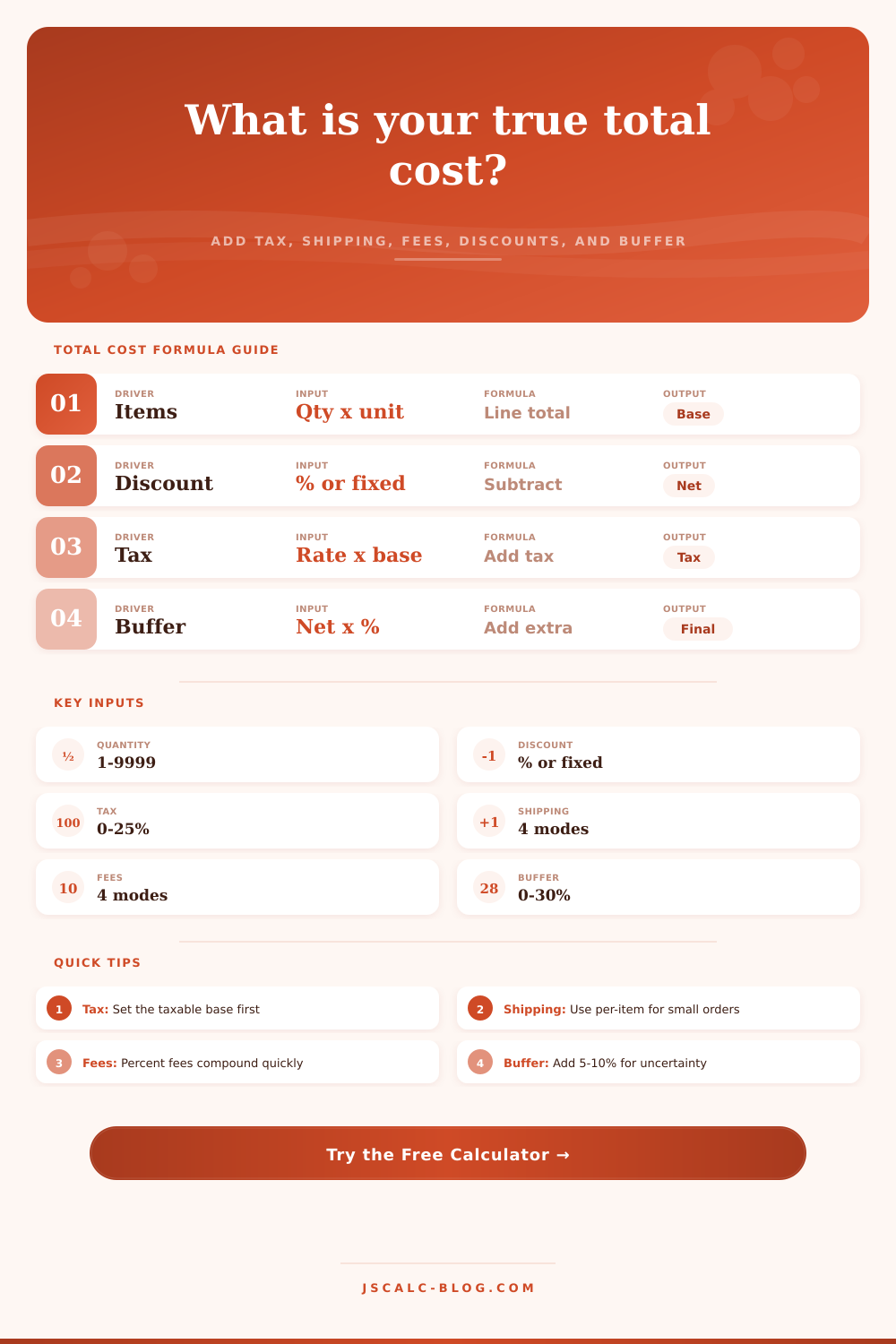
After you’ve run the numbers and made your best guess, add a five to ten percent cushion. It’s a pro move. It’s your plan B for the unexpected. It is the unknown that spreadsheets can’t always account for. It’s what separates the surprised from the prepared.
Click this link to use the calculator. You’ll input all the variables (quantity, fees, shipping methods, discounts, tax basis), and it will spit out the final number. Or it will split it up by unit so that you can see the landed cost of each unit.
That’s what you want to know as a contractor if you’re bidding a job, because that’s how you make sure you keep your margin. And that’s what you want to know as someone who reorders supplies every month. Because then you know what it really costs per item and if you should bother switching suppliers.
No. Total cost isn’t a reflection of me trying to be cheap. It’s a reflection of being clear. Understanding what goes into the total means you are making good choices. You’re not guessing. You’re planning. And the price tag? That’s only part of the story.