Variable Cost Per Unit Calculator
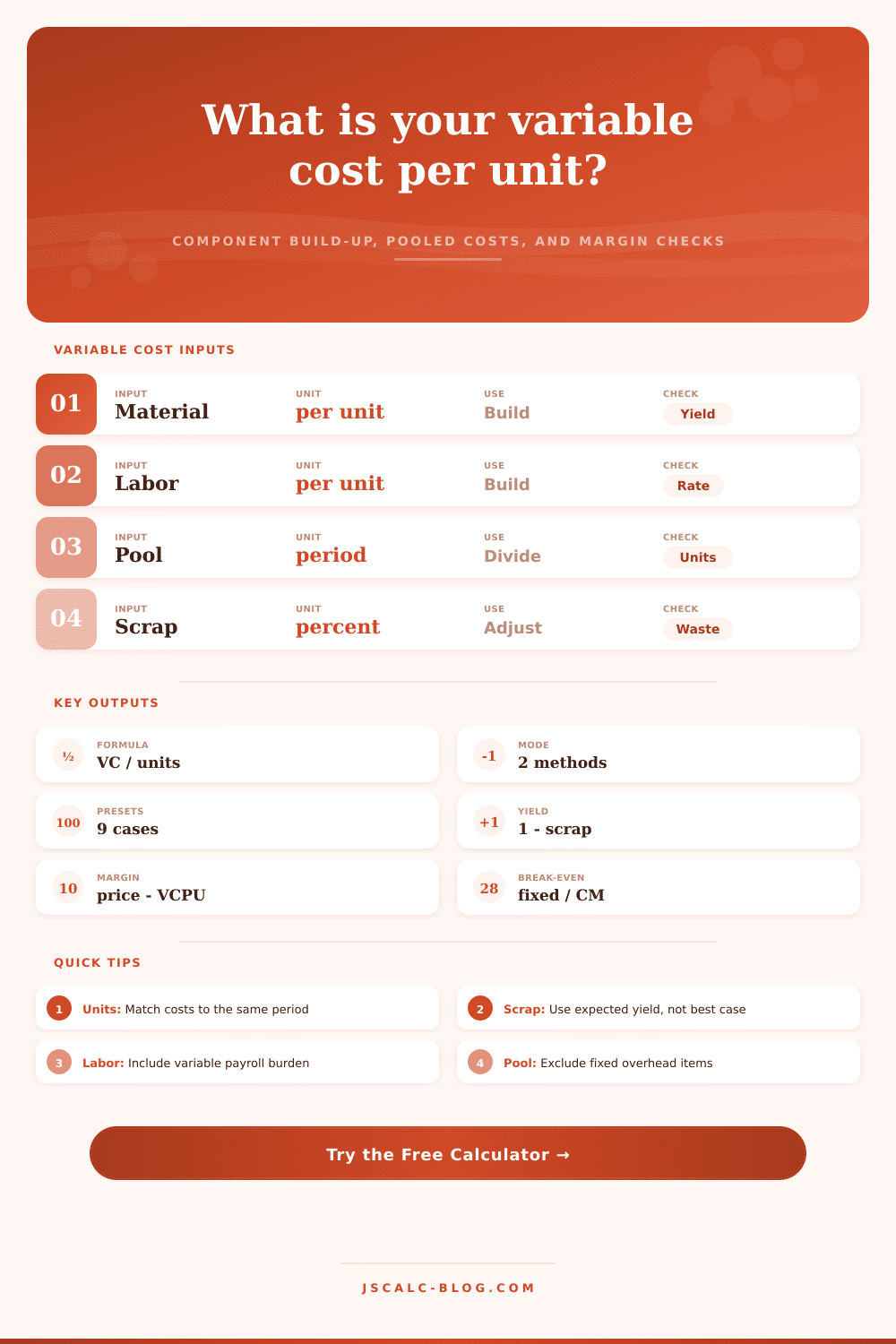
Estimate variable cost per unit from a component build-up or from a total variable expense pool. The calculator shows yield-adjusted unit cost, period variable cost, contribution per unit, break-even units, and the exact formula path used.
🎯Production Presets
🧮Variable Cost Inputs
Use build-up for planning; use pool mode when period totals are already known.
The profile applies a small variable complexity factor to the base result.
Only labels change; the calculator does not convert exchange rates.
Rounding is shown separately from the raw calculated cost.
Enter saleable units for the same period as the variable expenses.
Used for contribution per unit and contribution margin percent.
Used only for break-even units; it is not added to variable cost.
Include only costs that move with output in this period.
Ingredients, parts, substrates, fabric, components, or consumables.
Piece-rate labor, variable payroll burden, or production time cost.
Power, supplies, machine wear, payment processing, or usage fees.
Boxes, labels, inserts, mailers, seals, or per-order pack materials.
Pick fees, freight pass-through, cloud usage, or per-delivery charges.
Add commissions not tied to sale price, royalties, returns allowance, or fees.
Build-up mode divides started-unit costs by yield. Pool mode reports it as a diagnostic.
Payment processing, marketplace commission, sales royalty, or channel fee.
🔢Current Cost Snapshot
📐Formula Breakdown
📊Cost Behavior Profile Grid
📋Preset Comparison Table
| Scenario | Units | Method | Material | Labor | Overhead | Scrap | Revenue Fee | Typical Use |
|---|---|---|---|---|---|---|---|---|
| Bakery muffin batch | 1,200 | Build-up | $2.15 | $0.95 | $0.42 | 3.0% | 2.9% | Food production batch with spoilage allowance |
| Screen-printed shirt | 300 | Build-up | $4.80 | $2.25 | $0.70 | 5.0% | 3.5% | Small apparel run with rejects and payment fees |
| SaaS seat delivery | 8,000 | Build-up | $0.00 | $0.18 | $0.42 | 0.5% | 2.7% | Usage-based cloud and support cost per account |
| Small assembly run | 950 | Build-up | $11.20 | $4.15 | $1.85 | 2.4% | 1.8% | Parts, bench labor, and variable shop supplies |
| Subscription box | 2,400 | Build-up | $13.50 | $1.20 | $0.55 | 1.0% | 3.1% | Kitted package with fulfillment and inserts |
| Roasted coffee bag | 1,800 | Build-up | $3.10 | $0.62 | $0.38 | 8.0% | 2.9% | Weight loss and packaging for retail bags |
| Custom print order | 700 | Build-up | $1.85 | $0.90 | $0.55 | 4.0% | 2.6% | Paper, ink, spoilage, and per-order handling |
| Monthly cost pool | 5,600 | Pool | n/a | n/a | n/a | 1.5% | 0.0% | Accounting period with variable expenses separated |
| Prototype scrap run | 140 | Build-up | $22.00 | $9.50 | $4.00 | 18.0% | 0.0% | Early production where yield loss is material |
🔍Variable vs Fixed Cost Classification
| Cost Item | Usually Variable? | How To Enter | Review Cue | Common Mistake |
|---|---|---|---|---|
| Direct material or ingredients | Yes | Material per started unit | Moves with output volume | Ignoring scrap or spoilage |
| Piece-rate production labor | Yes | Variable labor per started unit | Paid per unit or per batch hour | Mixing in salaried supervision |
| Machine power and consumables | Often | Variable overhead per unit | Rises with machine time | Using full factory overhead rate |
| Packaging and labels | Yes | Packaging per good unit | Needed for each shipped unit | Entering bulk box spend twice |
| Payment processing fee | Yes | Revenue-linked variable fee | Percentage of selling price | Forgetting the fee on every sale |
| Warehouse rent | No | Fixed costs to cover | Same across normal volume range | Dividing it into variable cost |
| Base software subscription | No | Fixed costs to cover | Flat monthly charge | Confusing it with usage fees |
| Cloud usage metering | Often | Fulfillment or overhead per unit | Scales with requests or seats | Using a blended annual average only |
⚖Yield and Scrap Reference
| Scrap Rate | Good Yield | Started Units For 1,000 Good | Cost Multiplier | Best Fit |
|---|---|---|---|---|
| 0% | 100.0% | 1,000 | 1.000x | Digital delivery or perfectly metered service |
| 2% | 98.0% | 1,021 | 1.020x | Mature repeatable production process |
| 5% | 95.0% | 1,053 | 1.053x | Print, apparel, food, or hand assembly |
| 8% | 92.0% | 1,087 | 1.087x | Weight loss, trimming, or batch variability |
| 12% | 88.0% | 1,137 | 1.136x | New line with active quality tuning |
| 18% | 82.0% | 1,220 | 1.220x | Prototype, test run, or rework-heavy process |
🧭Method Selection Guide
| Question | Preferred Method | Data Needed | Output Strength | Watch For |
|---|---|---|---|---|
| Planning a new product | Component build-up | Per-unit bill of materials and variable labor | Shows which cost driver matters most | Understated scrap in early runs |
| Checking a closed month | Total pool | Variable expense total and good units | Fast actual variable cost per unit | Fixed costs mixed into the pool |
| Quoting a custom order | Component build-up | Material, touch labor, spoilage, and fees | Best for order-level decision support | Ignoring setup time if it varies by order |
| Comparing two production lines | Total pool | Separated variable pools for each line | Clean if accounting tags are reliable | Shared variable costs allocated unevenly |
| Testing a price floor | Either method | Selling price and variable cost per unit | Shows contribution per unit quickly | Treating contribution as net profit |
| Estimating scale effect | Component build-up | Cost driver changes at planned volume | Useful for sensitivity review | Step-fixed costs hidden as variable |
💡Variable Cost Tips
Most people think they know their profit margin until they try to price a product for real. You have your materials, your man-hours, and your overhead estimate. It seems straightforward, but it do not help much. Fixed cost plus variable cost equals inaccurate pricing. Rent should of not be combined with raw materials. When volume shift, so does the price of your product if you don’t distinguish between these two type of costs.
Enter in your costs and units and this calculator will do math for you. No more guesses on checking margins or adjusting yields.
Why You Should Use This Calculator
Here’s the idea. When you produce something, some of your costs vary (up and down). If you don’t bake any muffin, you won’t pay for flour. But if you bake ten thousand muffins, your flour bill will increase. Some cost remain fixed. Whether you only sell one thing or ten thousand things, you’ll still pay the same warehouse rent.
Most small business owners takes their total monthly bills and divide them by number of units they’ve sold. The result is a blended cost per unit. It is good for accounting but bad for decision making. To make good decisions, you want to know the actual variable floor, what’s the lowest price you can charge while staying out-of-the-red on every sale?
Price of materials is simple. Ten pounds of coffee beans cost X dollars. Price of labor is less straightforward. A salary is a fixed cost. Piece rates and hourly wages are variable costs. How do you split this out? That’s where the tool comes in.
It asks what your direct variable labor cost is by started units. In other words: how much does it take, in terms of time and wage burden, to create an item? That takes into consideration packaging and fulfillment, too. Those come into play once you’re shipping a product. And they go away if your warehouse are empty. Adding those to your variable cost per unit ensures your price covers selling, not just making the product.
Loss margin Spoilage = loss. Margin. That’s right; even a seemingly small number like three percent is still a big deal. If you can’t sell three out of every hundred items, those three suckers has to be paid for by the other good ones. So the calculator accounts for that by taking your started-unit cost and dividing it by your yield rate. For example, if your yield rate is 97 percent, then you’re really paying more than sticker price for each unit. Your “effective” cost per good unit go up. Businesses don’t account for this, and they go bust. Yeah, you might think you get five bucks a pop. But then again, you might only get four seventy-five after factoring in waste. And that’s what keeps you alive or dead.
For day-to-day ops, it’s important to pay attention to something called contribution margin. That’s selling price minus variable cost. Contribution margin is the amount of cash that every single unit will provide toward fixed costs. If your contribution margin is narrow, you’ll need high volume to break even. If your contribution margin is thick, you can afford to be slow. The tool spits out your contribution margin immediately. And it also uses that information to estimate number of units required to break even (i.e., fixed costs / contribution margin). This provides a concrete number; you know exactly how many units you’ll have to sell in order to stop bleeding money.
There’s always a tradeoff when it comes to pricing. If your variable cost is low enough, you could have lower price points that drive more volume. Higher price points mean fewer customers if your variable cost is too high. Make sure your variable side stays lean so that you can adjust as needed.
Pull up the tool presets and check out the cost structures across different industries. The bakery has high material/spoilage risk. The SaaS company has low material costs and a high delivery fee. Get a feel for your own model by comparing these guys.
Simplify, don’t complicate. Don’t worry about being some financial expert to price your product right. Just understand what’s moving and what isn’t. Once you’ve identified your real variable cost per unit, it’s simply a question of how to move forward. It’s no longer guesswork, but strategy. And that alone makes it worthwile to run the numbers.