Torque Wrench Extension & Adapter Calculator
When an inline adapter or crowfoot lengthens your wrench along its axis, the fastener sees more torque than the dial shows. This tool finds the corrected dial setting with Setting = Target × L / (L + E), reports the actual torque delivered, converts between ft-lb, Nm and in-lb, and also solves plain torque as force × lever arm.
🔧Choose a Mode
🎯Real Job Presets
📝Wrench & Adapter Inputs
The spec torque the bolt or nut must actually receive.
Unit for the target torque entered above.
Ratchet pivot to the centre of your hand on the grip.
Extra length the adapter adds along the wrench axis.
A crowfoot at 90 degrees keeps the effective length.
Force you push on the handle, for force mode.
Unit for the applied force above.
Distance from the fastener to where force is applied.
Controls rounding on every result card.
🔢Formula Snapshot
📋Common Fastener Torque Specs
| Fastener | Typical Torque | In Nm | Notes |
|---|---|---|---|
| Passenger lug nut | 100 ft-lb | 135.6 Nm | Star pattern, in stages |
| Spark plug | 18 ft-lb | 24.4 Nm | Check plug maker spec |
| Oil drain plug | 25 ft-lb | 33.9 Nm | New crush washer helps |
| Brake caliper bracket | 80 ft-lb | 108.5 Nm | Slide pins are lower |
| Brake caliper slide pin | 25 ft-lb | 33.9 Nm | Do not overtighten |
| Valve cover bolt | 89 in-lb | 10.1 Nm | Small in-lb wrench |
| Bicycle stem bolt | 6 Nm | 6 Nm | Carbon parts are fussy |
| Engine head bolt | 80 ft-lb | 108.5 Nm | Follow torque sequence |
📏Torque Unit Conversions
| ft-lb | Nm | in-lb | Reads As |
|---|---|---|---|
| 1 ft-lb | 1.36 Nm | 12 in-lb | One foot-pound |
| 5 ft-lb | 6.78 Nm | 60 in-lb | Light fastener |
| 10 ft-lb | 13.56 Nm | 120 in-lb | Small bolt |
| 18 ft-lb | 24.40 Nm | 216 in-lb | Spark plug |
| 25 ft-lb | 33.90 Nm | 300 in-lb | Drain plug |
| 50 ft-lb | 67.79 Nm | 600 in-lb | Suspension bolt |
| 80 ft-lb | 108.47 Nm | 960 in-lb | Head bolt |
| 100 ft-lb | 135.58 Nm | 1200 in-lb | Lug nut |
📐Correction Factor L / (L + E)
| Wrench L | Adapter E | L + E | Factor L/(L+E) | Set 100 ft-lb To |
|---|---|---|---|---|
| 18 in | 1 in | 19 in | 0.947 | 94.7 ft-lb |
| 18 in | 2 in | 20 in | 0.900 | 90.0 ft-lb |
| 18 in | 3 in | 21 in | 0.857 | 85.7 ft-lb |
| 18 in | 4 in | 22 in | 0.818 | 81.8 ft-lb |
| 18 in | 6 in | 24 in | 0.750 | 75.0 ft-lb |
| 12 in | 3 in | 15 in | 0.800 | 80.0 ft-lb |
| 24 in | 3 in | 27 in | 0.889 | 88.9 ft-lb |
| 18 in | 90deg | 18 in | 1.000 | 100.0 ft-lb |
🗃Adapter Correction Comparison Grid
| Target | Wrench L | Adapter E | Setting | Delivered | Note |
|---|---|---|---|---|---|
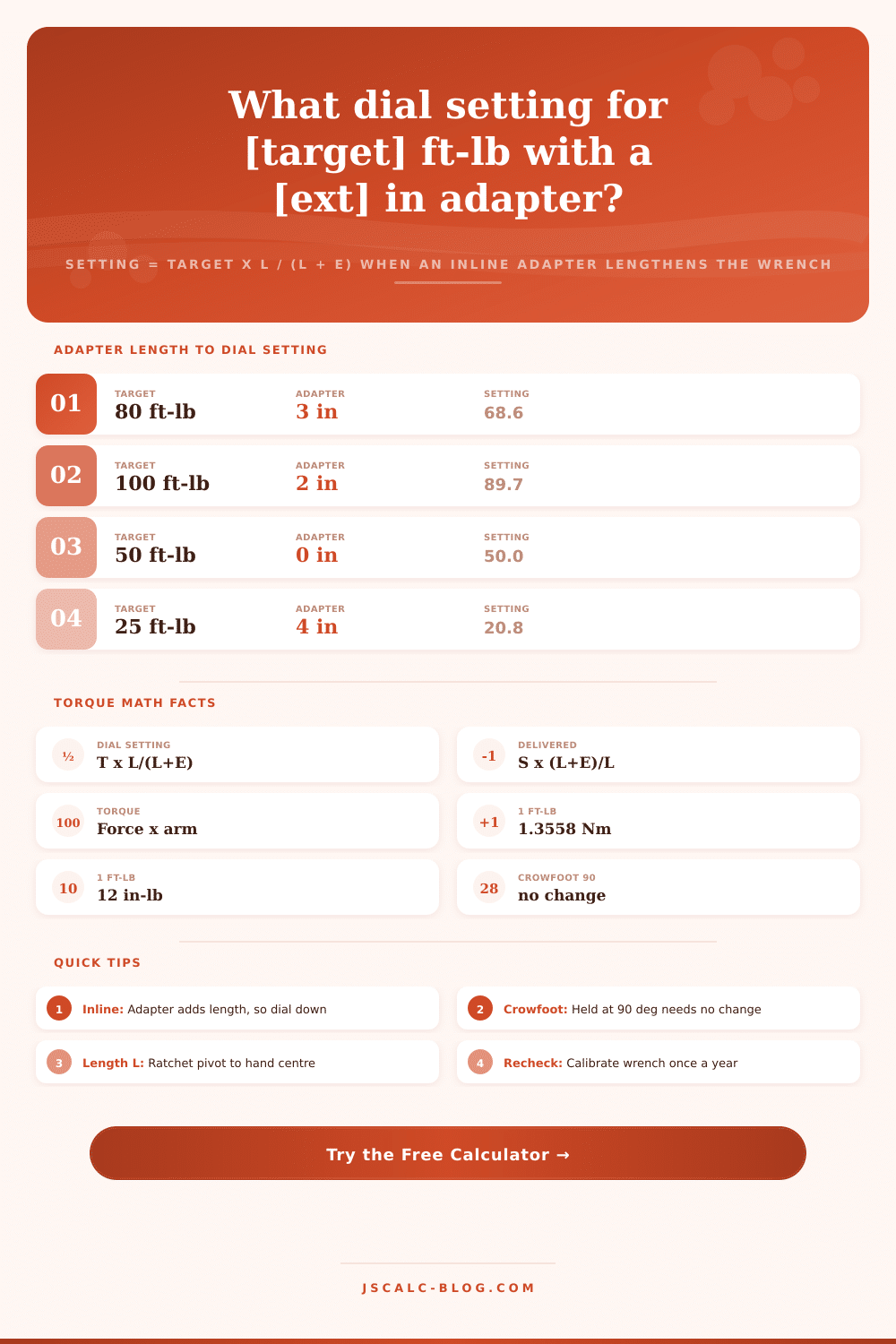
| 100 ft-lb | 18 in | 2 in | 89.7 ft-lb | 100 ft-lb | Lug nut plus adapter |
| 80 ft-lb | 18 in | 3 in | 68.6 ft-lb | 80 ft-lb | Head bolt inline |
| 50 ft-lb | 18 in | 0 in | 50.0 ft-lb | 50 ft-lb | No adapter fitted |
| 25 ft-lb | 18 in | 4 in | 20.5 ft-lb | 25 ft-lb | Caliper deep socket |
| 75 ft-lb | 18 in | 6 in | 56.3 ft-lb | 75 ft-lb | Long extension bar |
| 90 ft-lb | 24 in | 2 in | 83.1 ft-lb | 90 ft-lb | Long-handle wrench |
| 35 ft-lb | 18 in | 90deg | 35.0 ft-lb | 35 ft-lb | Crowfoot at 90 deg |
| 120 Nm | 18 in | 3 in | 102.9 Nm | 120 Nm | Metric spec inline |
| 18 ft-lb | 12 in | 1 in | 16.6 ft-lb | 18 ft-lb | Spark plug short bar |
| 60 ft-lb | 18 in | 5 in | 47.0 ft-lb | 60 ft-lb | Wobble extension |
⚙Formula Breakdown
💡Adapter & Crowfoot Tips
So there’s the head bolt; you’ve torqued it down as indicated by the dial on your wrench to a nice round eighty foot-pounds. You feel confident that the job’s done, but a week later you take it all back apart and discover the gasket blew or the stud’s stripped. Not bad luck. Physics.
In most instances that little bit of steel where your socket meets the wrench drive are the culprit. Using an adapter or an extension bar changes the leverage, resulting in much more force being transferred to the bolt then what your wrist felt. While most mechanics will just take their best guess at correcting this, engine components is not something you can afford to guess about.
How to Fix Torque Wrench Settings When Using Adapters
Torque wrenches measure twisting effort using a set length of lever. The tool use the length from the center of your hand on the handle to the center of ratchet head. It’s calibrated to that length. By adding something like an inline adapter, which sticks straight out, you’re extending the beam. In other words, you’ve increased the length of the lever. Your force at your hand hasn’t changed but it now must go further so the torque at the fastener is higher. Ignore this change in geometry and you’ll consistently be overtightening.
On delicate cylinder liners or aluminum heads, that additional pound of pressure are the difference between a sealed joint and a total failure. It’s simple arithmetic; too bad that it’s hard to do in your head with a big wrench in your hand.
Multiply desired torque (target) by existing wrench length. Divide that figure by the combined length of the wrench plus adapter length. The result is always less than target. Dial it down? It seems backwards to lower your setting in an attempt to tighten something more, but math wins.
Eighty foot-pounds of torque required? Your eighteenth inch wrench now sports a three inch adapter on it. Nope, don’t set it at eighty. Set it about sixty-eight point six. That will account for all the additional reach and make sure you get the full eighty on the bolt when the wrench clicks.
But there is one big thing that tricks us all. If a tool mounts on a crowfoot adapter and sticks out to side at 90 degrees to the handle, it still doesn’t count. It’s still parallel to your hand, and so it hasn’t moved the distance from pivot point to your hand. That means no adjustment necessary. You just dial in target and go.
This is important, because many people think they need to do calculations whenever they add a tool. Anything that lines up along axis of beam of the wrench changes effective length. Tools on sides leave the physics unchanged. That knowledge makes it easier not to second guess yourself.
Once you have those input values, then calculator does the algebra for you, you don’t even have to worry about making a mistake because you’re in a hurry. And it automatically swaps between inch-pounds, foot-pounds, and newton-meters, so there’s no mix-up there either. You can be pulling torque settings based off of a current European sedan while the guy next to you is doing a vintage American muscle car. Mixing units are one more potential cause of thread destruction.
Get in the habit of using one unit as your go-to. Match it to what’s in your book and let this tool do the conversion or correction for you all at once. This removes two more variables from equation.
The sensitivity of the correction is shown by the presets on the tool. Eighteen foot-pounds is a fairly low torque for something like a spark plug. And with a moderate length extension, there’s almost no difference. Whereas a hundred foot-pound lug nut with an extended handle require a dramatic decrease on your dial. The larger the extension compared to the wrench size, the greater the adjustment necessary.
This is what makes it dangerous when you use a really long extension with a really short wrench. Small measurement errors lead to large errors in clamping force. This make the correction factor extreme.
Another quiet killer is calibration drift. A tired click mechanism may give varying amounts of torque even when your calculation is spot-on. Regularly checking your wrench against an established standard mean the tool doesn’t become the weak link. Couple that diligence with a good adapter calculation and you remove two of primary culprits of broken fasteners.
Respect the leverage ratio; when you stretch the beam, shorten the setting. Do it regularly and your bolts will hold exactly like they should of.