Mini Bike & Go-Kart Gear Ratio Calculator
Find the sprocket gear ratio as driven axle teeth divided by drive clutch teeth, add a jackshaft two-stage reduction or a Comet-style torque converter, and read total reduction, top speed at max rpm, and the sprocket combo that hits your target speed on a Predator 212 or any small engine build.
🏁Real Build Presets
🔧Drivetrain Inputs
Direct is one chain; jackshaft and TC add a second reduction.
Stock governed Predator 212 is 3600; unrestricted runs 4800 to 6500.
Teeth on the clutch or engine output sprocket, often 10T to 14T.
Teeth on the big rear axle sprocket, usually 40T to 72T.
Driven sprocket on the jackshaft, fed by the engine sprocket.
Drive sprocket on the jackshaft that turns the rear axle sprocket.
A TAV2 shifts from about 2.68:1 at launch to 0.90:1 at speed.
Overall loaded tire height, not the rim size. Mini bikes run 12 to 15 in.
The tool reports the total reduction needed to reach this speed.
Applies to every speed result and the target field above.
🔢Setup Snapshot
⚙Clutch and Axle Sprocket Ratios
| Drive (Clutch) | Driven (Axle) | Ratio | Character |
|---|---|---|---|
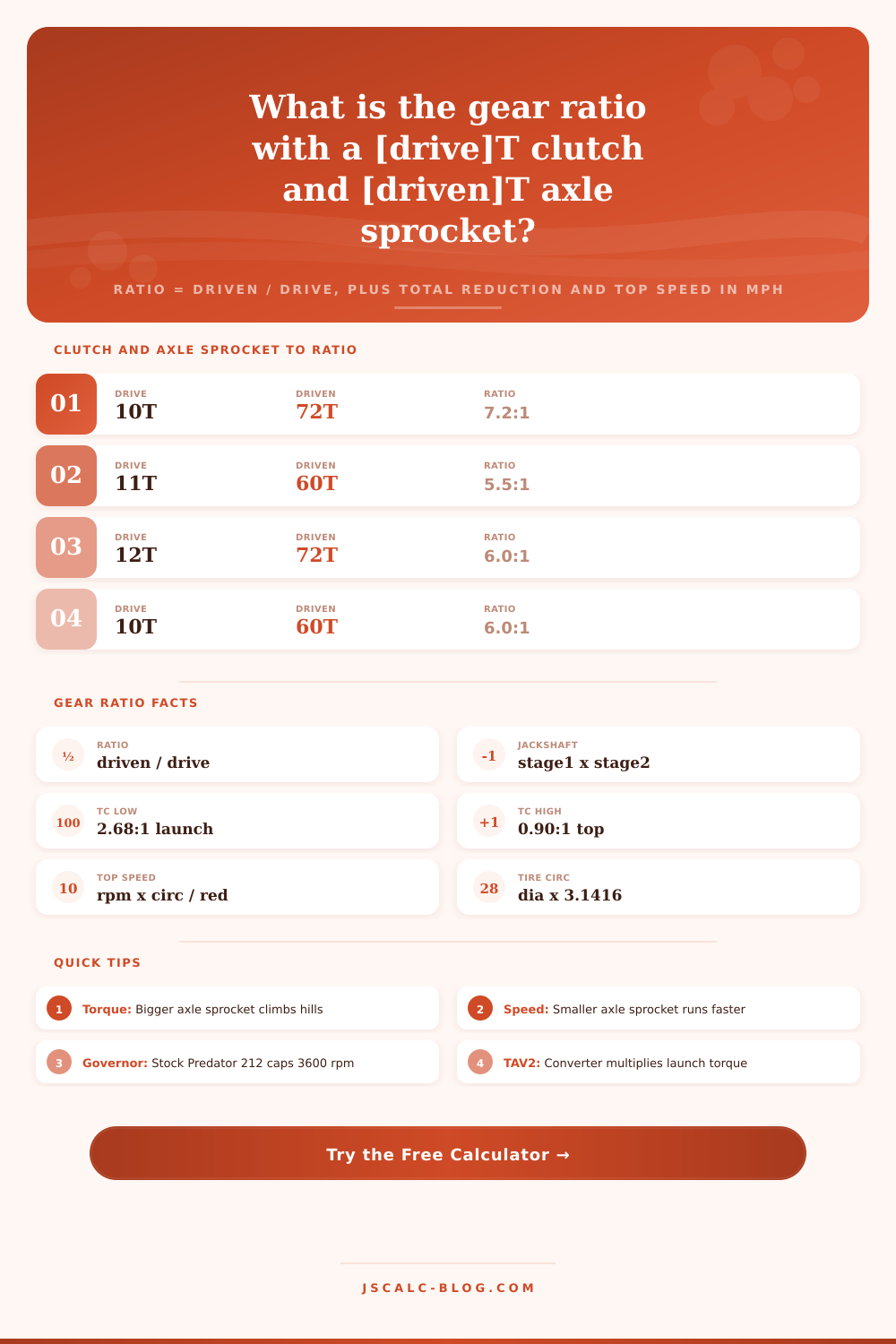
| 10T | 40T | 4.0:1 | Fast, weak launch |
| 14T | 60T | 4.3:1 | Top speed build |
| 12T | 54T | 4.5:1 | Balanced sport |
| 11T | 60T | 5.5:1 | All-round kart |
| 10T | 60T | 6.0:1 | Stock replacement |
| 12T | 72T | 6.0:1 | Strong midrange |
| 11T | 72T | 6.5:1 | Torque-leaning |
| 10T | 72T | 7.2:1 | Hill climb / trail |
🚗Top Speed by Reduction at 3600 RPM
| Total Reduction | Tire 12 in | Tire 14.5 in | Feel |
|---|---|---|---|
| 4.0:1 | 32 mph | 39 mph | Very fast, no grunt |
| 4.5:1 | 29 mph | 35 mph | Sporty cruiser |
| 5.5:1 | 23 mph | 29 mph | Balanced all-round |
| 6.0:1 | 21 mph | 26 mph | Stock mini bike |
| 7.2:1 | 18 mph | 22 mph | Trail and climbing |
| 10:1 | 13 mph | 16 mph | Heavy hauler |
| 16:1 | 8 mph | 10 mph | Crawler / TC low |
| 25:1 | 5 mph | 6 mph | Jackshaft creep |
📏Common Tire Sizes to Circumference
| Tire Marking | Diameter | Circumference | Typical Use |
|---|---|---|---|
| 11x6.00-5 | 11.0 in | 34.6 in | Racing go-kart |
| 13x5.00-6 | 13.0 in | 40.8 in | Off-road kart |
| 145/70-6 | 14.0 in | 44.0 in | Coleman / Baja |
| 15x6.00-6 | 14.5 in | 45.6 in | Mini bike rear |
| 16x6.50-8 | 16.0 in | 50.3 in | Big trail tire |
| 18x9.50-8 | 18.0 in | 56.5 in | Drift trike front |
📊Complete Setup Comparison Grid
| Drive / Driven | Ratio | Reduction | Top mph | Torque | Best For |
|---|---|---|---|---|---|
| 10T / 40T | 4.0:1 | 4.0:1 | 39 | Low | Flat top speed runs |
| 14T / 60T | 4.3:1 | 4.3:1 | 36 | Low | Speed-tuned kart |
| 11T / 60T | 5.5:1 | 5.5:1 | 29 | Medium | All-round riding |
| 10T / 60T | 6.0:1 | 6.0:1 | 26 | Medium | Stock replacement |
| 12T / 72T | 6.0:1 | 6.0:1 | 26 | Medium | Heavier riders |
| 10T / 72T | 7.2:1 | 7.2:1 | 22 | High | Trail and hills |
| 10T / 72T + TC low | 7.2:1 | 19.3:1 | 8 | Very high | Steep climb launch |
| 10T / 72T + TC high | 7.2:1 | 6.5:1 | 24 | Medium | Converter overdrive |
| 12T / 60T jackshaft | 5.0:1 | 25:1 | 6 | Extreme | Rock crawler creep |
| 13T / 60T | 4.6:1 | 4.6:1 | 34 | Low | Lightweight speed |
📝How the Math Works
💡Gearing and Tuning Tips
When it comes time to pick out parts like a clutch or an impeller you realize you bought three sets of sprockets, because they all have different numbers, and then you realize you’re chasing the wrong number. Because the gear ratio is simply teeth on the rear axle divided by teeth on the clutch, which is fine, but most folks building these mini bikes gets hung up trying to interpret what that number means in terms of their bike’s top speed or launch.
Plug in your tire size and your engine’s rpm into the calc above and it does the math for you. You won’t have to guess at numbers or try to convert inches into miles in your head. It presents a clear target to focus on instead of throwing darts at the wall hoping you will eventualy hit something.
How to Choose the Right Gear Ratio for Your Bike
How many times does the engine spin when the wheel turns once? That’s the gear ratio. Typically, a stock Predator 212 feature a 10-tooth drive sprocket paired with a 72-tooth axle. So you have a 7.2:1 reduction. Sounds like a lot. What it means is that the engine will rotate over seven times for every complete turn of the rear tire. Great if you’re trying to climb steep hills or dig in and rip out loose dirt; it greatly increases torque. But you sacrifice top speed because now the wheel isn’t turning nearly as fast (fewer times per minute) different than the engine.
Drop down to a 60-tooth axle sprocket, and you’ll get a 6:1 ratio. You pick up a little bit of velocity on level terrain, but you feel a softer launch. It’s always a delicate balancing act between speed and grunt.
The tire size does make all the difference; something most folks do not remember. You can maintain same sprockets but increase your tire size and cover more ground per revolution. This effectively reduces your gearing. This is why the tool multiplies your tire diameter by pi to get its circumference. Even if two vehicles have the exact same sprocket ratio, a vehicle with tiny 12-inch tires will feel like it is going faster then one with large 15-inch tires. Why? Those little wheels are spinning more times every mile and generating more engine revolutions for every yard traveled. When you put on big knobby tires for increased traction, you’re gonna feel slower too, until you shift up your gears once more.
Beyond just direct drive there’s one more wrinkle: drivetrain configuration. Adding a jackshaft puts your motor through an additional reduction. This multiplies the two ratios together. It gives you extreme low-end torque for crawling but only very little top speed. Think rock crawler.
At the other extreme is a torque converter such as the Comet TAV2 that automatically varies its own ratio. It starts with a deep low gear (around 2.68:1) to help get you going and shifts to overdrive as you accelerate. You get decent cruising speed while maintaining strong acceleration. You don’t have to compromise with fixed gears anymore.
You can input these reductions into the calculator and visualize exactly what kind of torque multiplication you’re getting off the line compared to wide open throttle. You have to read the results by the overall reduction. That’s what matters, not just the single stage number. In the case of a converter or jackshaft, there is more than one stage. And it’s the total reduction that gets the tire down on the ground.
Reverse engineer with the target speed field to get your answer. Want to run 30 mph at governed rpm? The tool will show you the exact reduction required. Now find an existing sprocket set that matches that reduction. It is a small detail, but it makes a difference when you are building for the best performance on a budget. You should of buy right the first time rather than several times in a row.
It all comes back to gearing though. Getting the most power out of an engine requires you match its power band with the type of terrain you will be riding. Engines with smaller displacement such as the Predator 212 has small sweet spots where they create usable amounts of torque. Gear too high and you bog at startup then never reach full speed. Gear too low and you redline early and never hit top speed.
The gearing tables on this page shows typical combinations. They help you get a good idea of what works for you without having to do the math each time. Most builders find that somewhere in the 5:1, 6:1 range offers the best compromise for a variety of riding situations. They are torquey enough to maintain movement over rough sections of trail and still fast enough to feel exhilarating.
The ratio system isn’t so much about a magical number as it is making an informed decision about what you want the machine to do. Want to keep the same speed down a flat stretch of pavement or rip up a hill? That determines the number of teeth. This removes the mystery and converts those abstract ratios into real world speeds. Before you even turn a single bolt, you know exactly how each different sprocket combo will feel and can confidently design your build accordingly. It eliminates the guessing game in the garage so that you can concentrate on riding.