Motorcycle Gear Ratio Calculator
Work out final drive from your front and rear sprocket teeth, combine it with the primary reduction and the selected gearbox ratio to get the overall ratio, then read road speed at any engine rpm or the exact engine rpm needed to hold a target road speed in that gear.
🏍Choose a Mode
🏁Real Bike Gearing Presets
🔧Drivetrain Inputs
The small sprocket on the gearbox output; one tooth here changes the ratio a lot.
The large sprocket bolted to the rear wheel; more teeth shortens gearing.
Crank to clutch reduction, often 1.5 to 2.1; check your service manual.
Loads a typical gearbox ratio; pick Custom to type your own value.
Transmission ratio in the chosen gear; 1.000 is direct drive.
Sets the loaded rear tire outer diameter; choose Custom to type a value.
Overall diameter; circumference used is diameter multiplied by pi.
Applies to the speed card and the target speed field.
Crankshaft rpm; used to find road speed in Speed mode.
Steady road speed you want; used to solve engine rpm in that gear.
🔢Ratio Snapshot
⚙Sprocket Combos to Final Drive Ratio
| Front Teeth | Rear Teeth | Final Drive Ratio | Character |
|---|---|---|---|
| 18 | 40 | 2.22 | Very tall, top speed |
| 17 | 43 | 2.53 | Relaxed highway |
| 16 | 42 | 2.63 | Stock touring |
| 16 | 46 | 2.88 | Balanced |
| 15 | 45 | 3.00 | Stock sport |
| 15 | 46 | 3.07 | Slightly shorter |
| 15 | 48 | 3.20 | Quicker roll-on |
| 14 | 50 | 3.57 | Hard launch, low top |
📊Typical Gearbox Ratios by Gear
| Gear | Sport 6-Speed | Standard | Cruiser 5-Speed | Note |
|---|---|---|---|---|
| 1st | 2.583 | 2.500 | 2.667 | Launch gear |
| 2nd | 1.842 | 1.789 | 1.786 | Big rpm drop |
| 3rd | 1.500 | 1.435 | 1.318 | Mid corners |
| 4th | 1.286 | 1.190 | 1.036 | Roll-on |
| 5th | 1.150 | 1.037 | 0.839 | Highway |
| 6th | 0.958 | 0.913 | — | Overdrive cruise |
| Direct | 1.000 | 1.000 | 1.000 | 1:1 through gear |
📏Rear Tire Size to Circumference
| Tire Size | Diameter (in) | Circumference (in) | Rev per Mile | Use |
|---|---|---|---|---|
| 120/70-17 | 24.3 | 76.3 | 830 | Front-style sport |
| 180/55-17 | 24.9 | 78.2 | 810 | Sport rear |
| 190/55-17 | 25.4 | 79.8 | 794 | Superbike rear |
| MT90-16 | 25.0 | 78.5 | 807 | Cruiser rear |
| 150/70-18 | 26.0 | 81.7 | 776 | Adventure |
| 140/80-18 | 27.2 | 85.5 | 741 | Enduro |
| 120/90-18 | 27.5 | 86.4 | 734 | Dirt knobby |
🗃Sprocket Change Comparison Grid
| Sprockets F/R | Final | Overall 6th | mph @ 6000 | rpm @ 60mph | Effect |
|---|---|---|---|---|---|
| 18 / 40 | 2.22 | 3.68 | 121 | 2952 | Tallest, weak launch |
| 17 / 43 | 2.53 | 4.20 | 106 | 3369 | Relaxed cruiser |
| 16 / 42 | 2.63 | 4.36 | 102 | 3497 | Mild highway |
| 16 / 46 | 2.88 | 4.78 | 93 | 3831 | Balanced stock |
| 15 / 45 | 3.00 | 4.98 | 90 | 3990 | Baseline sport |
| 15 / 46 | 3.07 | 5.09 | 88 | 4079 | Slightly quicker |
| 15 / 48 | 3.20 | 5.31 | 84 | 4256 | Snappy roll-on |
| 14 / 48 | 3.43 | 5.69 | 79 | 4560 | Strong launch |
| 14 / 50 | 3.57 | 5.93 | 76 | 4750 | Quickest, low top |
| 15 / 43 | 2.87 | 4.76 | 94 | 3812 | Taller than stock |
🔬Formula Breakdown
💡Gearing Setup Tips
Everything from your launch to your cruising comfort at seventy miles per hour can be traced back to the simple math of gears. Is it just me or is my mind playing tricks on me? Does a bike with a one-tooth change in front sprocket really feel different? That’s the question; is it placebo mechanics? No, there are no small number/big number rules. That is the big picture.
There’s more going on than selecting larger or smaller numbers for faster/sooner acceleration or top speed. The actual math starts by multiplying chain drive by the final gear in the box. Then you multiply that by main reduction, the chosen gear. Finally, all these figures is multiplied together. The result is exactly how many times the crankshaft turn for every single revolution of the rear wheel.
How to Calculate Gear Ratios Correctly
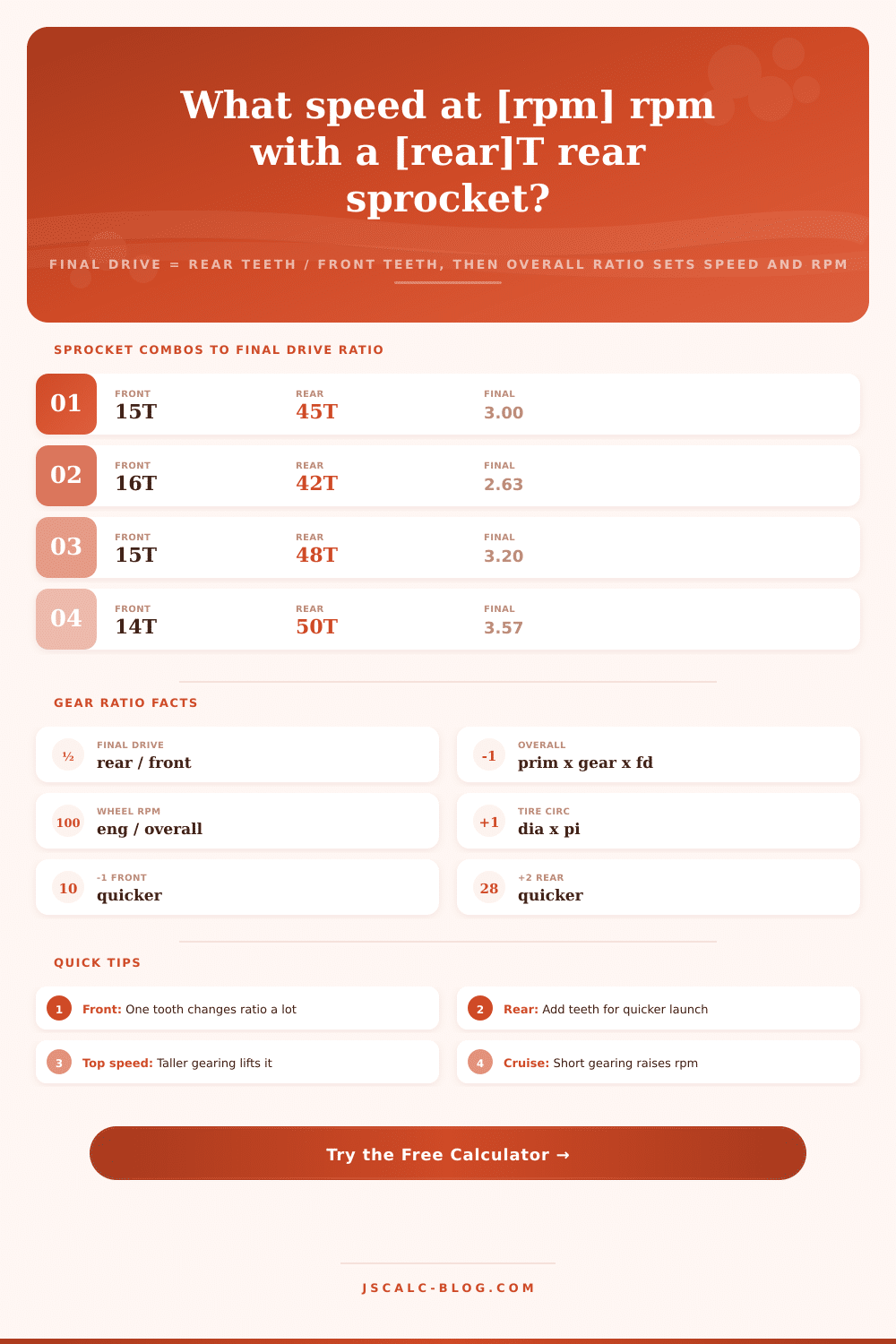
Get this calculation incorrect and you’ll buy a bunch of parts that look good on paper but feel bad on the road. The final drive ratio is the base from which all our math begins. Simply divide number of teeth on front by number on back and there’s your final drive. Let’s say you’ve got a 15 tooth front and a 45 tooth rear. Your final drive would be three to one. In other words, for every turn of the countershaft, the chain move three links for every one turn of the wheel. Simple enough right?
Well, don’t forget that this ratio is not in a vacuum. First it must go through primary reduction where it is stepped down again before it reaches the clutch. Next, the transmission kicks into play with whatever special ratio it’s programmed to provide depending on which gear you’re in. Finally, final drive gets the power and pushes tire forward.
Most people who get hung up on this multiplicative chain only pay attention to sprocket numbers and completely ignore the remainder of their drivetrain. They’ll find a sportbike with an overdrive sixth gear that allows engine to spin slowly relative to wheels in top gear. Then they’ll shorten their final drive to improve acceleration, but they won’t realize they’ve increased their cruising rpm so much that it makes the bike unridable on the highway.
The calculator above does all the complicated multiplication for you. It considers your tire size, the gear ratio you select, and the initial reduction between your engine and primary gears. So you don’t have to juggle five variables inside your skull simultaneousy. Instead, it converts those airy-fairy ratios into something real, the number of revolutions per minute (rpm) of your engine and the actual speed down the road. That way you can know how something feels before bolting it on.
This one is actually pretty big, tire diameter makes a difference in the equation, specifically because of its circumference (how many miles it moves forward per wheel rotation). So if you have a taller or wider tire, it essentially rounds up in gear ratio math, and it can make the bike seem like it’s in higher gears than it realy is. For example, a 190 series rear tire will make the bike feel like it has higher gearing than a 180 series in the same sprocket set-up. This means if you switch tires and don’t change your rpm and speed expectations, you may be surprised at lower max speeds. It’s not huge but something to keep in mind when dialing-in your rig for efficiency and comfort.
And the tool breaks all those relationships out nicely in their included reference tables. This way you can consider that factor first instead of halfway through the process.
Keep in mind when weighing front vs. Back sprockets swaps, the front have fewer teeth, so even small changes make big percent differences per tooth. One tooth off on the front is about equal to 3 teeth off on the back. A front swap will give you the biggest bang for your buck if you need quicker acceleration, but it can mean a bigger mechanical adjustment and a potentially longer chain. The rear allows for finer tweaks without as much fuss. This is also a better way to get a bike dialed for low RPM touring or a faster launch off the line if you like track days.
Bottom line: Match the bike’s gearing to its power band and not some fad. To conclude. Gear ratios are all about compromises. There’s no magic number that will give you instant off-the-line action as well as relaxed high-speed cruising. That’s just math. Math doesn’t lie, but it won’t tell you what to get. It isn’t a one-size-fits-all solution.
Running this math before you buy prevents the cost and headache of buying the wrong stuff and figuring out through trial-and-error at the parts counter. With what you’ve got now, adjust the teeth count and see what those rpms shifts at your normal speed ranges. You should of checked it first. It takes the mystery out of what can be a scary mechanic modification and makes it a simple exercise in planning. When you go and do it, remember that it’s all about tradeoffs rather than finding a single right answer.