Torque Conversion Calculator
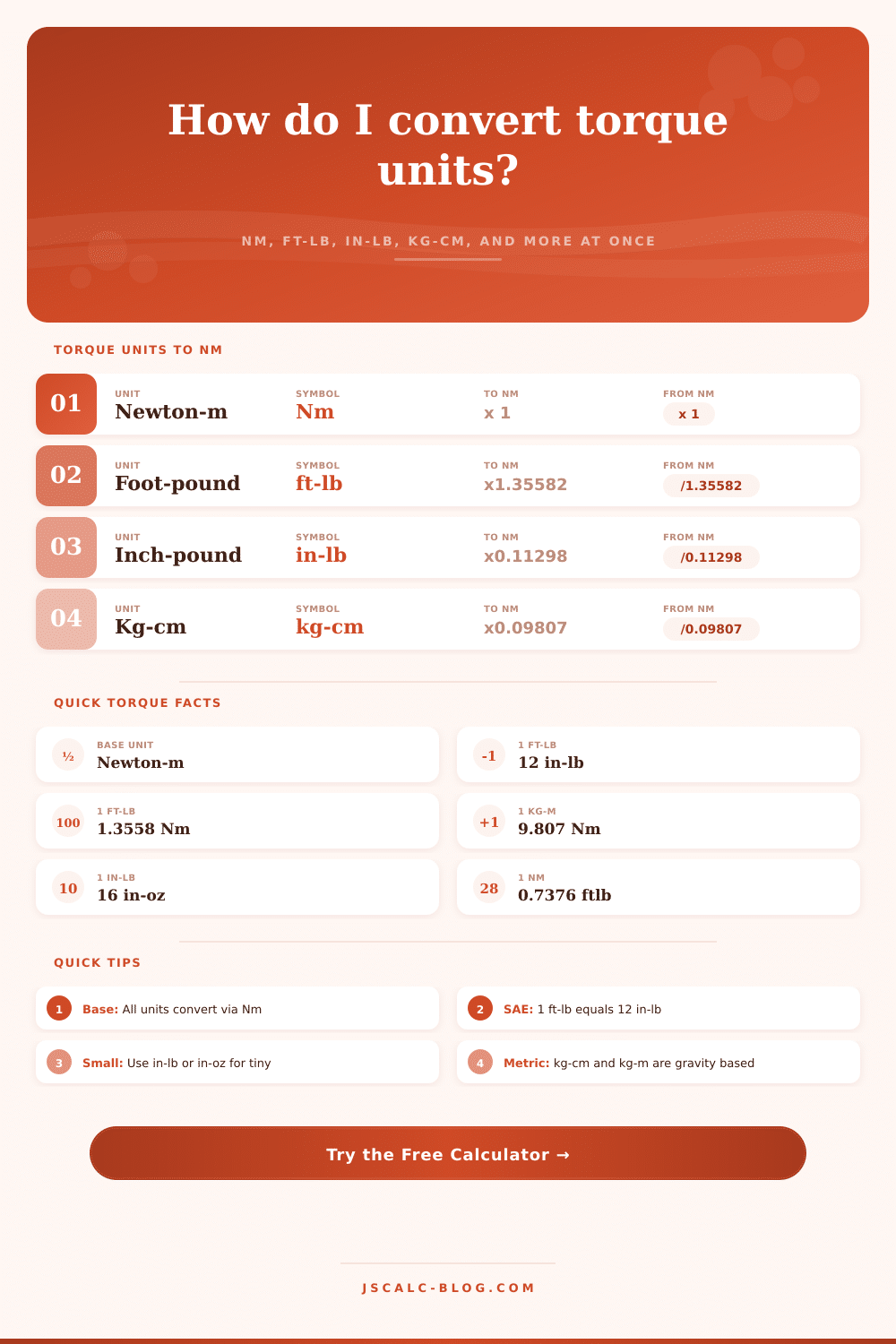
Convert between newton-meters, foot-pounds, inch-pounds, inch-ounces, kilogram-centimeters, kilogram-meters, and dyne-centimeters. Every value is canonicalized to Nm, then shown in all common torque units at once.
🎯Real Torque Presets
📝Conversion Inputs
Enter any positive or negative value. Sign is preserved.
🔢Conversion Method
📊All Units At A Glance
| Unit | Symbol | Converted Value | Share Of Base Nm |
|---|---|---|---|
| Enter a value above to see it expressed in every supported unit. | |||
🗂Torque Conversion Factor Table
| Unit | Symbol | 1 Unit In Nm | 1 Nm In Unit | Family |
|---|---|---|---|---|
| Newton-meter | Nm | 1.0000000 | 1.0000000 | SI metric |
| Foot-pound | ft-lb | 1.3558179 | 0.7375621 | Imperial SAE |
| Inch-pound | in-lb | 0.1129848 | 8.8507458 | Imperial SAE |
| Inch-ounce | in-oz | 0.0070616 | 141.611933 | Imperial small |
| Kilogram-centimeter | kg-cm | 0.0980665 | 10.1971621 | Gravitational metric |
| Kilogram-meter | kg-m | 9.8066500 | 0.1019716 | Gravitational metric |
| Dyne-centimeter | dyn-cm | 0.0000001 | 10000000 | CGS metric |
🔩Common Fastener Torque Reference
| Fastener | Typical ft-lb | Nm | in-lb | Notes |
|---|---|---|---|---|
| Passenger car lug nuts | 80 to 100 | 108 to 136 | 960 to 1200 | Star pattern, check placard |
| Truck / SUV lug nuts | 120 to 150 | 163 to 203 | 1440 to 1800 | Larger studs, retorque |
| Spark plugs (aluminum head) | 13 to 22 | 18 to 30 | 156 to 264 | Never overtighten threads |
| Oil drain plug | 18 to 30 | 24 to 41 | 216 to 360 | Replace crush washer |
| Cylinder head bolt (final) | 60 to 90 | 81 to 122 | 720 to 1080 | Often plus angle turn |
| Bicycle stem / seatpost | 4 to 6 | 5 to 8 | 44 to 66 | Carbon parts need care |
| Small electronics screw | 0.1 to 0.4 | 0.14 to 0.5 | 1.5 to 4.5 | Measured in in-oz often |
🔧Metric To SAE Wrench Reference
| Nm | ft-lb | in-lb | kg-cm | Range Use |
|---|---|---|---|---|
| 5 | 3.69 | 44.25 | 50.99 | Delicate trim, bicycle |
| 10 | 7.38 | 88.51 | 101.97 | Interior, brackets |
| 25 | 18.44 | 221.27 | 254.93 | Spark plugs, small bolts |
| 50 | 36.88 | 442.54 | 509.86 | Suspension, brakes |
| 100 | 73.76 | 885.07 | 1019.72 | Lug nuts, axle bolts |
| 150 | 110.63 | 1327.61 | 1529.57 | Heavy suspension |
| 250 | 184.39 | 2212.69 | 2549.29 | Crank pulley, hubs |
| 350 | 258.15 | 3097.76 | 3569.01 | Large axle, flywheel |
⚙Full Formula Breakdown
📋Unit Family Reference
| Unit | Where Used | Best For | Watch Out For |
|---|---|---|---|
| Newton-meter | Global, service manuals | Auto, industrial, SI work | Confused with joules by name |
| Foot-pound | United States automotive | Lug nuts, large bolts | Do not mix with lb-ft weight sense |
| Inch-pound | US small fasteners | Trim, electronics, brackets | 12 in-lb equals 1 ft-lb |
| Inch-ounce | Very light precision work | Instruments, tiny screws | 16 in-oz equals 1 in-lb |
| Kilogram-centimeter | Asian metric wrenches | Motorcycles, small engines | Gravity based, not pure SI |
| Kilogram-meter | Older metric manuals | Larger metric fasteners | 1 kg-m equals 100 kg-cm |
| Dyne-centimeter | Physics, CGS system | Lab and academic use | Tiny value, 1e-7 Nm each |
💡Practical Torque Tips
A lot of times, it’s panic when you’ve got this thing and they list something different on service manual. Your tools say one unit and their engine block says something else. They requires newton-meters, but you have a wrench set calibrated to foot-pounds. Maybe the bike is an old one that requires kilogram-centimeters or maybe your only adjustable wrench is set for inch-pounds. All of these units makes routine maintenance turn into some kind of mental math.
Once you plug in the numbers, the calculator does the math for you. It spares you having to guess at conversions and coefficients. The confusion come from the fact that torque is a force that’s measured at a distance, but cultures measure that force differently. In SI terms, that’s called a newton-meter. It’s the standard base used in engineering. One newton of force applied to a one-meter-long lever arm equal one newton-meter. This is the metric used by most moddern cars, it integrates cleanly with other SI measurements.
Why Torque Conversion Matters for Safety
But North American automotive culture are rooted in imperial units. U.S. Service manuals often use foot-pounds. Interior trim or small fasteners such as spark plugs will be measured in inch-pounds. They is both just different measurements of the exact same physical thing. The pound-foot just makes sense since it’s a measurement of both feet (leverage) and pounds of force. These are units we experience every day.
A kilogram-centimeter, on the other hand, is based off gravity using metric standards. This require a different way of thinking when converting from system to system, especially if you think more in terms of “force” than “mass. Each unit in the table on the page relates to base measure of newton-meter. Looking at them all together will also help you see that a foot-pound is equal to 1.35582 newton-meters. That’s pretty close to 1.4, good enough for ballpark guesses, but not precise enough for final adjustments with critical engine part.
That’s why precision is important, over-torquing can crack the aluminum head and strip out threads; under-torquing leaves you with a loose bolt and potentially a safety issue. Rounded numbers or just “going by feel” are risky. It may take exactly 18 foot-pounds to tighten a spark plug. That equates to about 24 newton-meters. And if you round down to 20 Nm based off a vague sense of “less torque,” you is leaving the seal under pressure. Now that bolt remains under pressure and there’s no seal. But what happens when you round up? Crushed gasket… yikes!
The converter displays everything at once. So not only do you know how much torque you want, but you know exactly where it falls in relation to the scale of your tool. You no longer have to hunt around for a different conversion chart or scroll through dropdowns. Smaller fasteners can be a problem as it becomes difficult to see small numbers on a scale and visualize what it mean.
When you work with precise instruments like bike parts, delicate electronics, or the screws that hold them together, units like the inch-ounce or dyne-centimeter becomes important. A fraction of a pound makes all the difference between breaking something apart or tightening it down properly. Unless you are a physicist most folks has never heard of dyne-centimeters. For those that deal with tiny machines every day, accuracy become a priority. These smaller units is supported by the tool. Otherwise you’re forced to guess fractions of foot pounds and errors creep in there.
You should of checked it first. It’s not so much math as respect: The spec tells you what torque to use to convert, and manufacturers test those fasteners in particular circumstances. They know how hard they should of turned them to get good clamping without deforming. Your part? Match that number, whatever the language it comes in. Eliminate the units conversion problems and concentrate on the mechanics, not the arithmetic.
Small thing, yes; important if the engine depends on each bolt being precisely where it’s supposed to be.