Net Force Calculator
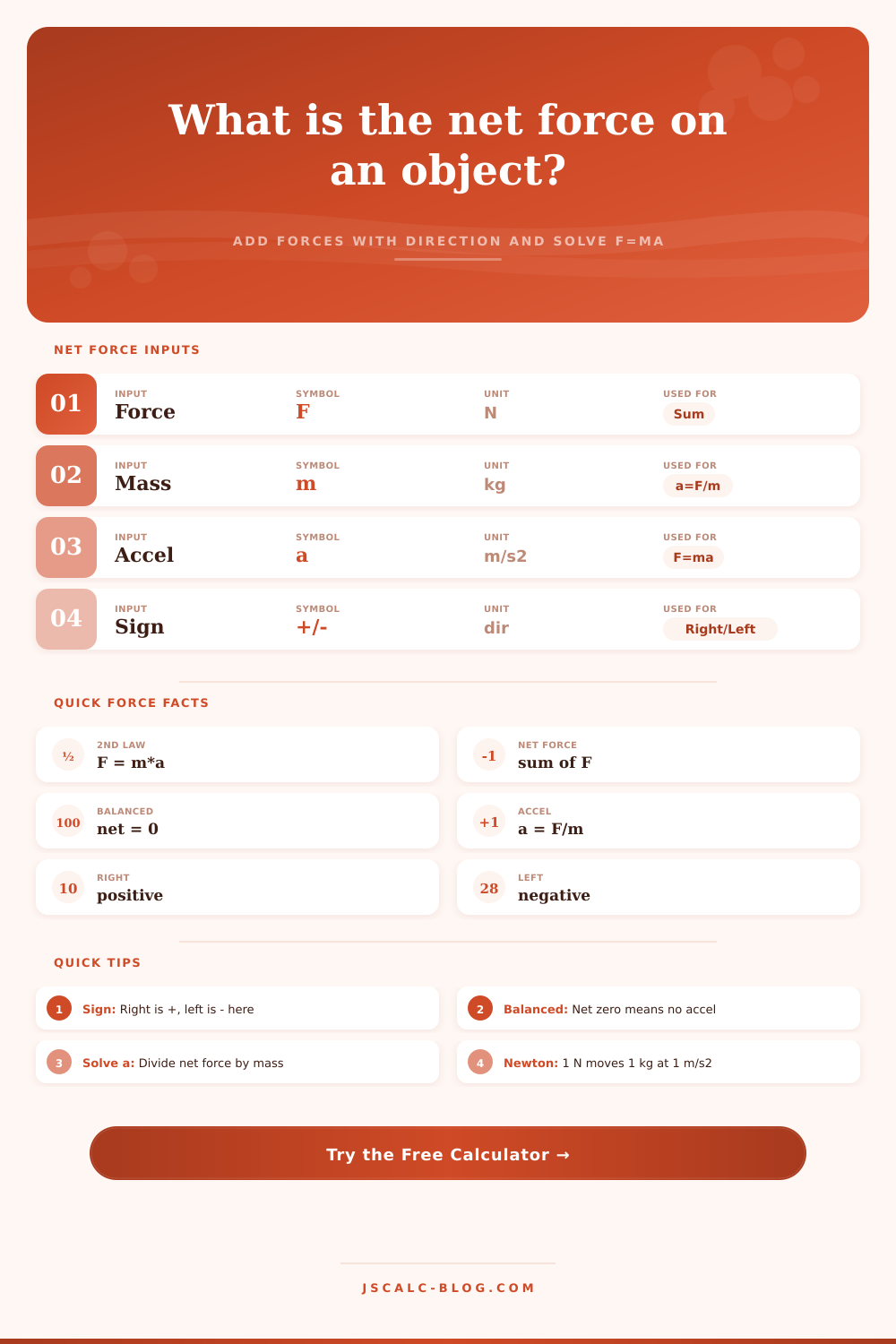
Add up to four forces with their directions to find the net force, apply Newton's second law F = m×a, and read the resulting acceleration plus whether the object is in balanced equilibrium or unbalanced motion.
🎯Real Physics Presets
📝Force and Motion Inputs
Sum mode adds Force 1–4; F=ma mode uses mass and acceleration below.
Used only in F=ma mode. Negative means left.
Weight = mass × 9.81 shown for context, not added to horizontal sum.
🔢Formula Snapshot
➕Force Direction Sign Convention
| Direction | Sign | Meaning | Example |
|---|---|---|---|
| Right | Positive + | Points toward the positive axis | Push to the right |
| Left | Negative – | Points toward the negative axis | Friction opposing motion |
| Up | Positive + | Vertical positive if mapped here | Lift or normal force |
| Down | Negative – | Vertical negative if mapped here | Weight, gravity pull |
| Zero | 0 | No contribution to the sum | Object at rest, no push |
⚖Net Force Interpretation
| Net Force | Condition | Motion Result | Newton's Law |
|---|---|---|---|
| Exactly 0 N | Balanced forces | No acceleration, equilibrium | First law applies |
| Greater than 0 | Unbalanced right | Accelerates to the right | a = F/m, positive |
| Less than 0 | Unbalanced left | Accelerates to the left | a = F/m, negative |
| Constant, object moving | Steady net force | Uniform acceleration | Velocity changes |
| Net 0, object moving | Balanced in motion | Constant velocity | Inertia continues |
📐F = m×a Quick Reference
| Mass (kg) | Accel (m/s²) | Force (N) | Note |
|---|---|---|---|
| 1 | 1 | 1 N | Definition of a newton |
| 2 | 5 | 10 N | Light cart pushed |
| 10 | 3 | 30 N | Box on smooth floor |
| 70 | 2 | 140 N | Person sprinting off block |
| 1000 | 4 | 4000 N | Small car accelerating |
| 1500 | 0.5 | 750 N | Heavy vehicle easing forward |
🗂Common Force Scenario Grid
| Scenario | Force A | Force B | Net Force | Mass | Result |
|---|---|---|---|---|---|
| Tug of war | 500 N right | 450 N left | 50 N right | 80 kg | 0.63 m/s² right |
| Balanced push | 30 N right | 30 N left | 0 N | 10 kg | No motion |
| Same direction | 40 N right | 60 N right | 100 N right | 20 kg | 5.0 m/s² right |
| Box vs friction | 80 N right | 25 N left | 55 N right | 15 kg | 3.67 m/s² right |
| Opposing pull | 120 N left | 70 N right | 50 N left | 25 kg | 2.0 m/s² left |
| Rocket thrust | 9000 N right | 2000 N left | 7000 N right | 500 kg | 14.0 m/s² right |
| Stalled sled | 200 N right | 200 N left | 0 N | 40 kg | Equilibrium |
| Three forces | 60 N right | 90 N mix | 10 N left | 12 kg | 0.83 m/s² left |
⚙Full Formula Breakdown
📋Reference Values and Units
| Quantity | Symbol | Unit | How It Is Used |
|---|---|---|---|
| Force | F | newton (N) | Magnitude with a direction sign |
| Mass | m | kilogram (kg) | Resists acceleration in a = F/m |
| Acceleration | a | m/s² | Result of net force on the mass |
| Net force | Fnet | newton (N) | Algebraic sum of all forces |
| Weight | W | newton (N) | W = m × 9.81, downward pull |
💡Practical Net Force Tips
Suppose two teams pull on an identical rope in opposite directions equally hard. Nothing happen. The rope doesn’t budge. It feels as if no forces are present, but according to physics something quite different is going on: there are indeed lots of force at play, and they happen to cancel out precisely! That’s what net force means, and why just plugging numbers together so frequently give the incorrect answer.
Direction matters, it’s a vector quantity, requiring vector addition instead of simple arithmetic. The thing above take care of that algebraic sum for you, freeing you to focus on real-world set-up instead of your own sign errors that plague most homework problem.
Why Direction Matters for Force
We’re all familiar with Newton’s second law: $F=ma$. But we often get it wrong in practice. We look at that equation and assume that it mean that force equals speed. No. Force equals acceleration. Speed is just the combined effect of that acceleration over time. Why do I point this out? It shifts your perspective on what to expect when you observe an object that appears to be at rest. When you pull up next to a parked car at a stoplight, it has no net force acting upon it. The force of the engine pushing it forward is being canceled by the force of drag/friction pulling it backward. Therefore, when you plug those numbers into your calculator, if they’re equal, you’ll find answer is clear; there can be enormous forces involved in something having no acceleration. That insight is what sets apart calculation from intuition.
People tend to fall off when choosing a direction. Typically, left is negative, right is positive. Down is negative, up is positive. It’s an arbitrary choice, but sticking to it is non-negotiable. Halfway into solving a problem, if you reverse those directions, the answer will make no sense at all. The reference table I placed on page outlines that choice for you to match your thinking with mathematics.
As you input each force, you have to choose which way it goes. Pushing something with 50 Newtons to the right isn’t the same thing as pulling it with 50 Newtons to the left. One is going to add to total momentum in one direction; the other will subtract from it. You cannot treat them like they are both of equal size or else you is ignoring reality.
The answer here is mass. It’s like trying to accelerate a heavy truck with the same amount of force as a bike. It’ll take far more effort. That’s why mass input is important. If there’s a huge net force on an object then yes, it will accelerate, but if that object has enough mass, acceleration may well not be detectable at all. Try pushing a car that won’t start. Even though you’re straining and applying hundreds of Newtons, it doesn’t realy move. The resistance to movement is just too great. The point is that without dividing that net force by your mass, you aren’t getting the whole picture. That division show you how much velocity actualy changes per second.
In the real world, there are not only two force acting on something. There’s friction, air resistance, gravity and any push you put on it, competing for control. Take a skydiver in free-fall. It’s constant downward force from gravity. Upward force from air resistance that increases with speed. This continues until they balance. There is zero net force. There is no more acceleration. Terminal velocity is reached and she plummets at a constant speed. This is dynamic equilibrium. The forces are still there; they’re just not changing their state of motion anymore. And that allows you to go beyond the static nature of textbook examples and recognize moving systems whose balance is temporary or a function of speed.
It’s a simple matter of understanding that certain forces are opposing others, and that some forces are aligned. You don’t need to memorize the drag constants or coefficients of friction. You only need to understand how those trade-offs work. For example, preset values in the calculator such as rocket thrust or tug-of-war show the trade off immediately. The combined effect of atmospheric drag and mass of the rocket requires huge upward thrust to overpower them. Take away the drag part in your mind, and the calculation gets easier, but now it isn’t realistic for launch, so be careful when relying on it fully.
Net force is meant to be calculated with one purpose: Prediction. Will this thing begin moving? Stop moving? Speed up? Slow down? That’s what we’re trying to find out. Net force helps us diagnose motion. Whether analyzing a sports injury or designing a new vehicle suspension, the unbalanced force indicates where there is stress and strain. Is the sum zero? Then the system is stable as it is. Is it non-zero? Change must occur. How violent will that change be? That’s what magnitude indicates.
Begin with the simplest case; introduce complexity as required. First get your feet wet with directionality and the signs. After you can handle one dimensional sums, the multi-dimensional ones are just an extension of that reasoning. This isn’t so much advanced math as it is careful bookkeeping. Every force must be given a seat at the table and a sign on their name tag. After all, physics is nothing more than a catalog of tugs and pulls.
With the calculator at the top of this page, you see a visualization of that tug-of-war without having to do the math yourself. Plug in the forces and masses, select your directions, and watch as the second law takes over. The rope will move. Or not. And now you’ll know precisely why.