Harmonic Frequency Calculator
Build a complete harmonic series from a fundamental frequency using f_n = n x f0, pinpoint any single nth harmonic, filter to odd or even overtones, and read the wavelength of each partial from your chosen wave speed. Works for musical tones, room acoustics, radio harmonics, and physics homework.
🎵Choose a Mode
🎯Real Fundamental Presets
📝Harmonic Inputs
The 1st harmonic. Every partial is an integer multiple of this.
Applies to the fundamental above.
How many partials the series table shows, from 1 to N.
Single mode: which harmonic to solve, f_n = n x f0.
Odd-only mirrors a stopped pipe or clarinet spectrum.
Wavelength of each partial is speed / frequency.
Used only when the medium is set to Custom.
Controls rounding on the cards and the series table.
| Harmonic n | Frequency f_n | Wavelength | Cents vs f0 |
|---|
🔢Formula Snapshot
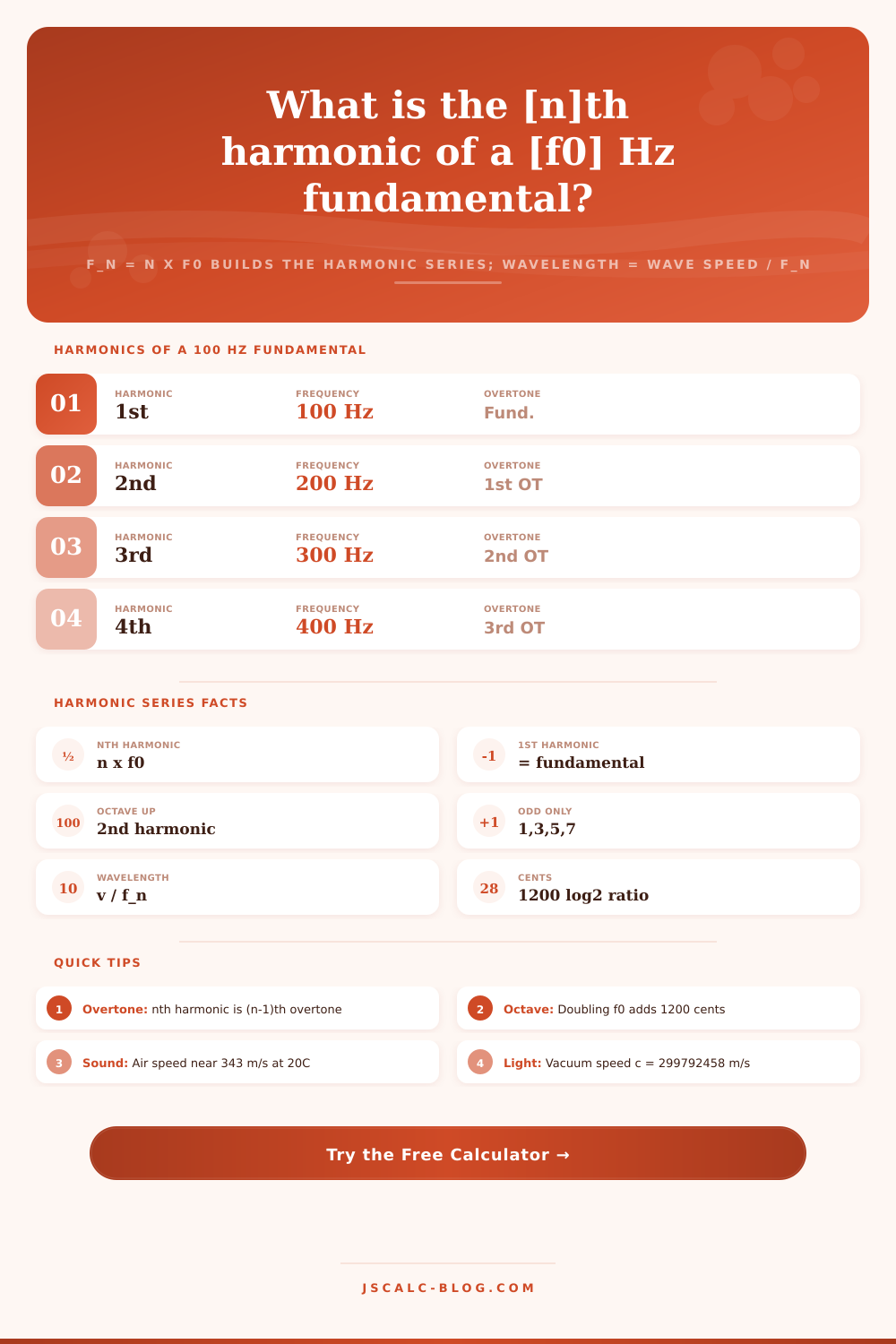
📋Harmonic Series of a 100 Hz Fundamental
| Harmonic n | Frequency n × 100 | Overtone Name | Interval Above f0 |
|---|---|---|---|
| 1st | 100 Hz | Fundamental | Unison |
| 2nd | 200 Hz | 1st overtone | Octave |
| 3rd | 300 Hz | 2nd overtone | Octave + fifth |
| 4th | 400 Hz | 3rd overtone | Two octaves |
| 5th | 500 Hz | 4th overtone | Two oct + major third |
| 6th | 600 Hz | 5th overtone | Two oct + fifth |
| 7th | 700 Hz | 6th overtone | Two oct + flat seventh |
| 8th | 800 Hz | 7th overtone | Three octaves |
📊Harmonic Number to Musical Interval
| Ratio f_n / f0 | Harmonic Pair | Just Interval | Cents | Nearest Note From C |
|---|---|---|---|---|
| 2 / 1 | 2nd over 1st | Octave | 1200 | C up one octave |
| 3 / 2 | 3rd over 2nd | Perfect fifth | 702 | G |
| 4 / 3 | 4th over 3rd | Perfect fourth | 498 | F |
| 5 / 4 | 5th over 4th | Major third | 386 | E |
| 6 / 5 | 6th over 5th | Minor third | 316 | E flat |
| 7 / 4 | 7th over 4th | Harmonic seventh | 969 | B flat (flat) |
| 9 / 8 | 9th over 8th | Major second | 204 | D |
📏Wave Speed by Medium
| Medium | Wave Type | Speed (m/s) | Lambda of 100 Hz |
|---|---|---|---|
| Air at 20 C | Sound | 343 | 3.43 m |
| Air at 0 C | Sound | 331 | 3.31 m |
| Fresh water | Sound | 1482 | 14.82 m |
| Steel | Sound | 5960 | 59.6 m |
| Vacuum | Light / radio | 299792458 | 2997 km |
🧬Odd Versus Even Harmonic Content
| Source | Dominant Harmonics | Spectrum | Timbre |
|---|---|---|---|
| Open pipe / string | All (1,2,3,4) | Full series | Bright, rich |
| Stopped pipe | Odd (1,3,5,7) | Missing evens | Hollow, dark |
| Clarinet | Odd dominant | Weak evens | Woody, reedy |
| Square wave | Odd (1,3,5) | 1 / n falloff | Buzzy |
| Sawtooth wave | All (1,2,3) | 1 / n falloff | Harsh, full |
| Triangle wave | Odd only | 1 / n squared | Soft, mellow |
🗃Fundamental to Harmonic Comparison Grid
| Fundamental f0 | 2nd Harmonic | 3rd Harmonic | 4th Harmonic | 5th Harmonic | 10th Harmonic |
|---|---|---|---|---|---|
| 16.35 Hz (C0) | 32.70 Hz | 49.05 Hz | 65.40 Hz | 81.75 Hz | 163.5 Hz |
| 41.20 Hz (E1) | 82.40 Hz | 123.6 Hz | 164.8 Hz | 206.0 Hz | 412.0 Hz |
| 82.41 Hz (E2) | 164.8 Hz | 247.2 Hz | 329.6 Hz | 412.1 Hz | 824.1 Hz |
| 110.0 Hz (A2) | 220.0 Hz | 330.0 Hz | 440.0 Hz | 550.0 Hz | 1100 Hz |
| 261.6 Hz (C4) | 523.3 Hz | 784.9 Hz | 1046 Hz | 1308 Hz | 2616 Hz |
| 440.0 Hz (A4) | 880.0 Hz | 1320 Hz | 1760 Hz | 2200 Hz | 4400 Hz |
| 50 Hz (mains) | 100 Hz | 150 Hz | 200 Hz | 250 Hz | 500 Hz |
| 60 Hz (mains) | 120 Hz | 180 Hz | 240 Hz | 300 Hz | 600 Hz |
| 1000 Hz (1 kHz) | 2000 Hz | 3000 Hz | 4000 Hz | 5000 Hz | 10000 Hz |
| 100 MHz (FM) | 200 MHz | 300 MHz | 400 MHz | 500 MHz | 1000 MHz |
⚙Formula Breakdown
💡Practical Harmonic Tips
Consider that you might know that playing exact same note on a piano will sound different then that played by a violin. This is because of how sound are structured. All tones has a harmonic series. The fundamental frequency sits at the bottom of this series.
When we think about a violin, for example, or a vibrating string, we are aware that what we hear is not just one single frequency but many. What we hear is a stack of frequencies each one being a multiple of the very first one (the lowest). That is the fundamental. Those other ones is called harmonics. There’s a strict mathematical rule that governs them all: that the nth harmonic is equal to n times the fundamental frequency. This rule give rise to ladder of partials that are the core of resonance and timbre in engineering as well as music.
Understanding Harmonics and Overtones
To help with that, I created a calculator above. Here’s how it works: Enter your initial frequency. Select your desired number of partials. The calculator generates the full series once you enter a fundamental frequency and choose how many partials to list. The calculator will produce complete set.
Some people gets confused by the term harmonic vs. Overtone. Though similar, harmonics and overtones is related but count differently. Here’s why: The fundamental is the first harmonic, but it isn’t an overtone because overtones only counts frequencies above the base. To be precise, the fundamental equals the first harmonic. Overtones are all frequencies higher than original note, so the fundamental has no overtone counterpart.
The second harmonic is also known as the first overtone. The third harmonic is also called the second overtone, etc. In short, the n’th harmonic is the (n-1)’st overtone. Mistaking one for the other can lead to mistakes in physics and audio engineering. That’s why the tool shows both terms so you don’t lose your way.
So why does it matter? Because it is a component of what you hear. An open pipe at both ends supports all harmonics. Think about organ pipes or flutes. The tone is rich and bright with a full range of energy.
If a pipe is closed at one end, it then suppresses the even-numbered harmonics. (Think clarinet). Then only odd harmonics exist. The half of the harmonic spectrum is missing. The sound of instrument becomes hollow and woody. Turn off the evens on the filter switch in the calculator and see how the table change without these notes present. Look at the gaps widening, look at the shifts in the musical intervals. That is a physical constraint. It completely defines the voice of the instrument.
This structure support our ability to perceive pitches. An octave is simply a doubling of frequency. The next harmonic (the second) is precisely one octave above the fundamental. Two octaves up is the fourth. Three octaves is the eighth. All harmonics whose number is a power of two has the same note name as the root. Hence A440 and A880 both receive the name A. It is their relative height in pitch that differs.
As you ascend the harmonics, they becomes more closely spaced. The interval from fundamental to the second harmonic is a whole octave. The interval from the eighth to the ninth harmonic is very slight. This causes the feeling of density at higher register pitches. Mathematically the spacing is linear, but we hear it different.
A second approach to exploring sound involves wavelength. Wave speed relates frequency to wavelength. A higher frequency correspond to a shorter wavelength. On the calculator you get to choose the medium. The calculator lets you select the medium, whether it is air, water, steel, or vacuum for radio waves. Why? Because that makes a difference in practicaly terms.
One problem often encountered with an audio system is mains hum. Power runs at 60 Hz. The third harmonic of that is 180 Hz. If you see that on your spectrum analyzer, you know what it is. It is not a musical note. It is an unwanted signal from electrical infrastructure. In order to avoid getting into hot water legally, radio engineers ensures that the third harmonic of their transmitter does not fall within one of the bands they are allocated.
The same equation applies whether we’re talking about concert halls or antenna farms. It is used in many areas. It applies to physics students seeing resonance modes in pipes or rooms, audio technicians troubleshooting distortion and hum, and musicians discovering what overtone colors their instrument. In each instance, the same formula apply.
The calculator spares you the math. It gives you a window on all the values at once. It gives a glimpse at just how fast the frequencies rise. It shows how fast the wavelength shortens. Brings the ideas down to real numbers. It is invaluable, whether you are trying to diagnose a problem or create a design, or whether you are building a synth patch or tracking down noise.
The sequence is predictable, the pattern universal. It’s connected to our perception of the material world. You should of used a calculator earlier.