Angular Frequency Calculator
Convert frequency, period, or RPM into angular frequency omega in radians per second using omega = 2 pi f. The tool also reports the ordinary frequency in hertz, the period in seconds, the rotational speed in RPM, degrees per second, and the tangential speed when you supply a radius.
🔄Choose an Input Mode
🎯Real-World Angular Frequency Presets
📝Motion Inputs
Cycles per second in the chosen frequency unit.
Applies to the frequency field above.
Time for one complete cycle, in the unit below.
Applies to the period field above.
Revolutions per minute of the rotating object.
Set above zero for tangential speed and centripetal accel.
Controls rounding on every result card.
🔢Formula Snapshot
📋Frequency to Angular Frequency
| Frequency f | Period T | Omega (rad/s) | Reads As |
|---|---|---|---|
| 0.5 Hz | 2 s | 3.142 | Slow swing |
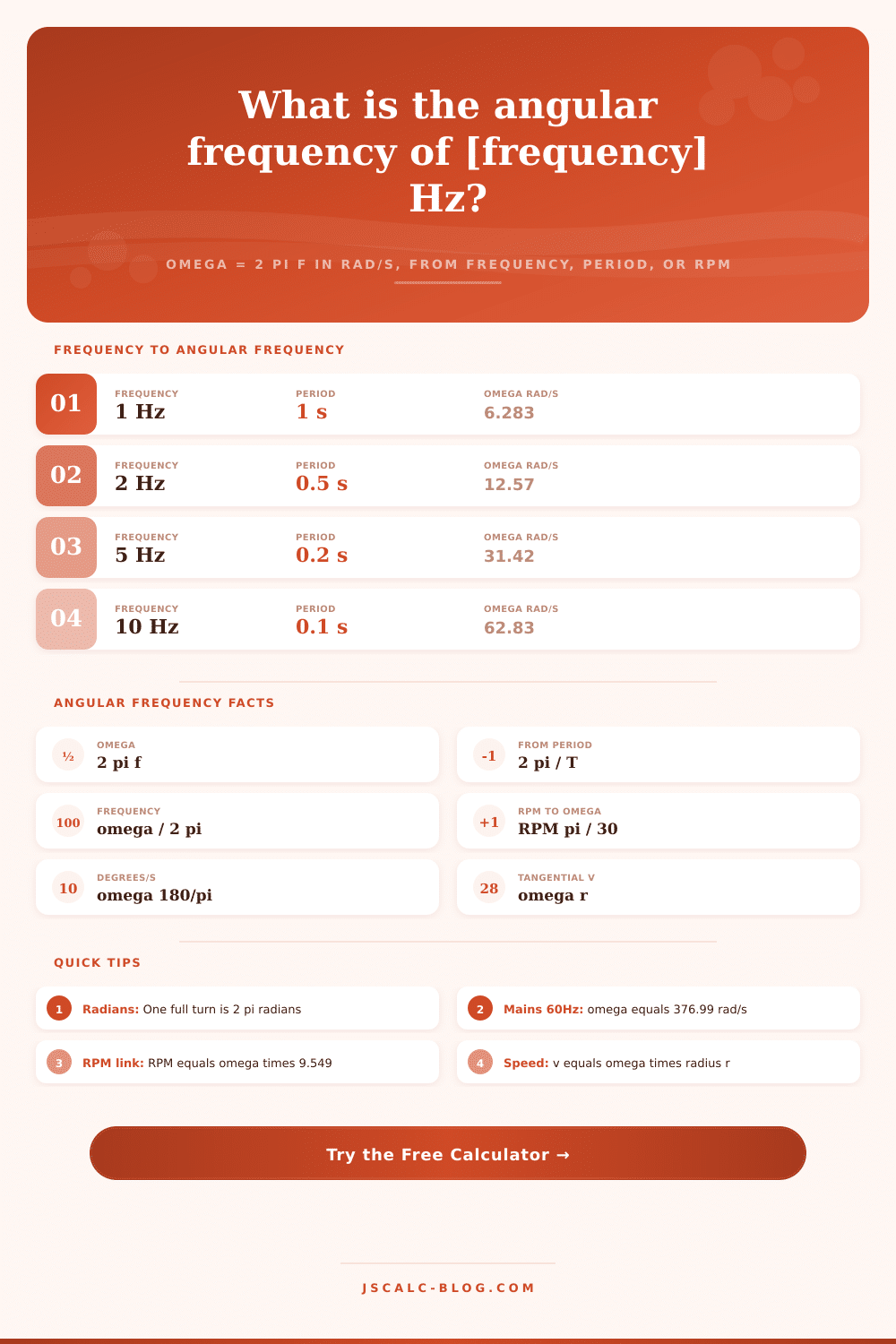
| 1 Hz | 1 s | 6.283 | One per second |
| 2 Hz | 0.5 s | 12.57 | Two per second |
| 5 Hz | 0.2 s | 31.42 | Fast wobble |
| 10 Hz | 0.1 s | 62.83 | Ten per second |
| 50 Hz | 20 ms | 314.2 | EU mains |
| 60 Hz | 16.67 ms | 376.99 | US mains |
| 100 Hz | 10 ms | 628.3 | Low audio |
📊RPM to Angular Frequency
| RPM | Frequency f (Hz) | Omega (rad/s) | Period T (s) | Example |
|---|---|---|---|---|
| 33.33 | 0.5556 | 3.491 | 1.800 | LP vinyl record |
| 45 | 0.750 | 4.712 | 1.333 | 7 inch single |
| 60 | 1.000 | 6.283 | 1.000 | Clock second hand |
| 500 | 8.333 | 52.36 | 0.120 | Optical disc drive |
| 1200 | 20.00 | 125.7 | 0.050 | Washing machine spin |
| 3000 | 50.00 | 314.2 | 0.020 | 2-pole motor at 50 Hz |
| 7200 | 120.0 | 753.98 | 0.008333 | Hard disk platter |
📏Angular Units and Conversions
| Quantity | Equals | In Base Unit | Note |
|---|---|---|---|
| 1 revolution | 2 pi rad | 6.28319 rad | Full turn |
| 1 rad | 57.2958 deg | 57.2958 deg | Radian to degree |
| 1 rad/s | 9.5493 RPM | 9.5493 RPM | Omega to RPM |
| 1 rad/s | 57.2958 deg/s | 57.2958 deg/s | Angular speed |
| 1 kHz | 1000 Hz | 1000 Hz | Kilohertz |
| 1 MHz | 1000000 Hz | 1000000 Hz | Megahertz |
🗃Frequency, Omega, RPM and Speed Comparison Grid
| Source | Frequency f | Omega (rad/s) | Period T | RPM | Degrees/s |
|---|---|---|---|---|---|
| 2 s Pendulum | 0.5 Hz | 3.142 | 2 s | 30 | 180 |
| Clock Second Hand | 0.01667 Hz | 0.1047 | 60 s | 1 | 6 |
| LP Vinyl 33 RPM | 0.5556 Hz | 3.491 | 1.8 s | 33.33 | 200 |
| EU Mains 50 Hz | 50 Hz | 314.2 | 20 ms | 3000 | 18000 |
| US Mains 60 Hz | 60 Hz | 376.99 | 16.67 ms | 3600 | 21600 |
| Washer Spin | 20 Hz | 125.7 | 50 ms | 1200 | 7200 |
| Car Engine Idle | 13.33 Hz | 83.78 | 75 ms | 800 | 4800 |
| Hard Disk 7200 | 120 Hz | 753.98 | 8.333 ms | 7200 | 43200 |
| Guitar A String | 110 Hz | 691.15 | 9.091 ms | 6600 | 39600 |
| Ferris Wheel | 0.008333 Hz | 0.05236 | 120 s | 0.5 | 3 |
⚙Formula Breakdown
💡Practical Angular Frequency Tips
Enter your frequency value here, then tap the calculate button. This angular frequency calculator will convert your inputted frequency into angular frequency. This is how physics and engineers measures rotation. It’s expressed as ω (or simply omega).
In other words, angular frequency are the rate at which the phase angle rotates, measured in radians per second, while normal frequency is measured in cycles per second or Hertz. There’s a simple equation connecting these two values: omega = 2 pi f. This calculator solves it for you and displays related quantities: tangential speed, period, RPM, and even degrees per second.
How to Use This Calculator
What is angular frequency? Suppose you have a point traveling in a circle. For every complete lap it takes it goes through an angle of 2 pi radians or 360 degrees. What we call angular frequency is how many radians the point sweeps out every second. So if something makes 1 cycle per second (it has a frequency of 1 Hz), then it must sweep out 2 pi radians (or approximately 6.283 rad/s). That is why omega will always be bigger than your regular old frequence.
The reason it’s important is that when you do the math of alternating current or other waves they use omega, not regular frequency. The core formula are omega = 2 pi f. Omega equals 2 pi f. This formula forms the basis for the tool.
Enter your frequency into the box either in Hertz, Kilohertz, or Megahertz. Then multiply that by 2 pi. The result will be angular frequency expressed in Radians per Second. A frequency of 60 Hz results in an omega equal to 376.99 rad/s. You see this in AC circuits all the time when analyzing them.
You can also use this tool to go backwards if you know how fast something oscillates and want to find out what its standard frequence is. If something oscillates at 314.16 rad/s then the standard frequency will be exactly 50 Hz.
Sometimes you aren’t given the frequency, but you know the time for a single cycle; this is called the period. That relationship is:omega = 2 pi / T. If it took 2 seconds for a pendulum to complete one cycle its angular frequency would of been 3.142 rad/s. The calculator can takes periods entered in microseconds, milliseconds or seconds. This is handy when we’re dealing with rapid electronic signals which are frequently expressed as their period and not their frequency.
RPM stands for Rotations Per Minute. The tool provides a mode to calculate rotating devices in terms of revolutions per minute. You can easily convert that to cycles/second or standard frequency, which is simply RPM divided by 60 (because there are 60 seconds in a minute). This is your shortcut: Omega is RPM times pi divided by 30. For example, a motor turning 3000 RPM turns at 314.2 rad/s. To convert from angular frequency to RPM, you can use the formula: omega x 9.549
More Conversions Besides converting radians to degrees and vice versa, it will calculate tangential speed as well as conversions from degrees to degrees per second. Since there are pi radians in 180 degrees, multiply your omega times 180 / pi for degrees per second. Exactly 360 degrees per second is equal to an angular frequency of 6.283 rad/s.
Enter your radius and it’ll compute linear speed of any point on the rim: v = omega x r. And centripetal acceleration: a = omega squared x r. A rotor turning at 3000 RPM with a radius of 0.05 meters would result in rim speed of 15.71 m/s.
You are viewing the results. Each calculation has four result cards. These include angular frequency in rad/s and degrees per second, the standard frequency in hertz, the period in seconds and milliseconds, and the rotational speed in RPM. Below those cards is a breakdown panel where each of the numbers used in the calculations is listed step-by-step. It will also add rows for centripetal acceleration or tangential speed if you input a radius into the calculator. That way you can double-check your own math.
Angular frequency shows up all over the place. It’s used in alternating current (voltage is expressed as v(t) = V sin(omega t)). It figures into the reactance of inductors: an inductor with a 0.1 H inductance at 60 Hz has reactance equal to 37.7 ohms. It shows up in a mass-spring system, where omega is square root of k over m. It relates to the wave number in waves and is used in orbital mechanics as mean motion. Radians per second are also extensively used in signal processing. Being able to convert between these quantities is handy in both engineering and physics.
How to use it well. Begin by using a pre-set that matches the issue at hand (e.g., 1200 RPM spin cycle or 50 Hz mains). Input the relevant details for your situation. Change between modes as you are most familiar with whatever information is available to you (the tool will display everything it has). Set the number of significant digits according to the accuracy necessary. If you require information about linear motion, enter a radius into the appropriate field. View the breakdown of every calculated number to understand where they came from.
For both rotation and oscillation, the calculator return results quickly and accurately.