Period From Frequency Calculator
Convert a frequency in Hz, kHz, MHz, or GHz into its period using T = 1 / f, with the answer auto-scaled to seconds, milliseconds, microseconds, or nanoseconds. Flip the mode to turn a period back into frequency, and read the angular frequency and electromagnetic wavelength as bonus outputs.
⏱Choose a Mode
🎯Real Signal Presets
📝Signal Inputs
The number of cycles per second before applying the unit.
1 kHz = 1e3, 1 MHz = 1e6, 1 GHz = 1e9 Hz.
The time for one full cycle before applying the unit.
1 s = 1e3 ms = 1e6 us = 1e9 ns.
Total time = cycles × period. Leave at 1 for a single cycle.
Scales lambda = (VF × c) / f. Applies to EM waves only.
Controls rounding on every result card.
🔢Formula Snapshot
📋Frequency to Period Reference
| Frequency | Period T = 1 / f | Auto Unit | Reads As |
|---|---|---|---|
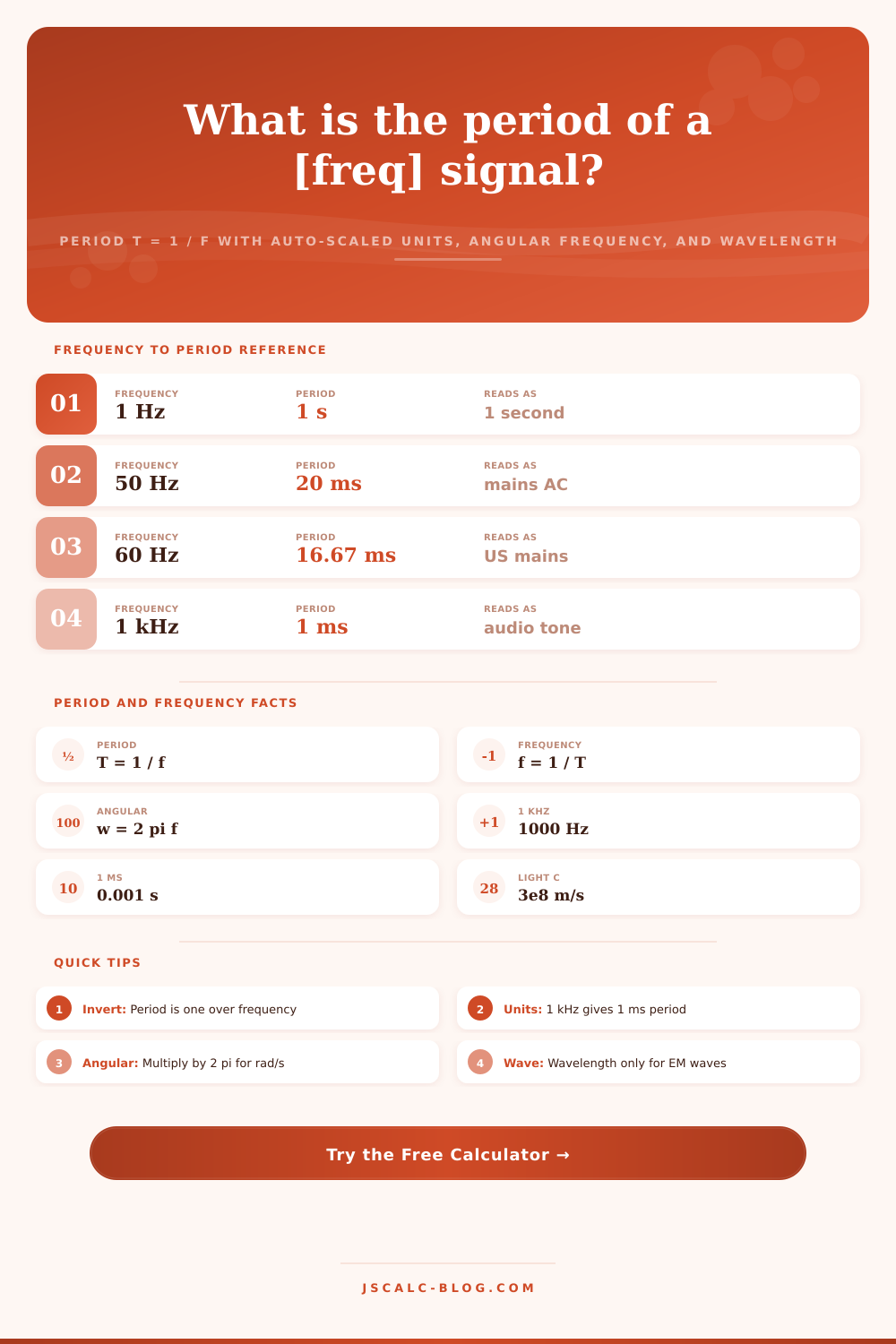
| 1 Hz | 1 s | seconds | One second |
| 50 Hz | 0.02 s | 20 ms | EU mains AC |
| 60 Hz | 0.01667 s | 16.67 ms | US mains AC |
| 440 Hz | 0.002273 s | 2.273 ms | Note A4 |
| 1 kHz | 0.001 s | 1 ms | Audio tone |
| 1 MHz | 0.000001 s | 1 us | AM radio |
| 100 MHz | 1e-8 s | 10 ns | FM radio |
| 1 GHz | 1e-9 s | 1 ns | Microwave |
| 2.4 GHz | 4.167e-10 s | 0.4167 ns | Wi-Fi band |
📏Unit Scaling Chart
| Unit | Symbol | In Base Unit | Applies To |
|---|---|---|---|
| Kilohertz | kHz | 1e3 Hz | Frequency |
| Megahertz | MHz | 1e6 Hz | Frequency |
| Gigahertz | GHz | 1e9 Hz | Frequency |
| Millisecond | ms | 1e-3 s | Period |
| Microsecond | us | 1e-6 s | Period |
| Nanosecond | ns | 1e-9 s | Period |
| Picosecond | ps | 1e-12 s | Period |
📡Period, Angular Frequency, and Wavelength Comparison Grid
| Signal | Frequency | Period T | Angular ω | EM λ (vacuum) | Auto Unit |
|---|---|---|---|---|---|
| Pendulum | 0.5 Hz | 2 s | 3.142 rad/s | 599585 km | seconds |
| EU mains | 50 Hz | 0.02 s | 314.2 rad/s | 5996 km | 20 ms |
| US mains | 60 Hz | 0.01667 s | 376.99 rad/s | 4997 km | 16.67 ms |
| Note A4 | 440 Hz | 0.002273 s | 2765 rad/s | 681.3 km | 2.273 ms |
| Audio tone | 1 kHz | 0.001 s | 6283 rad/s | 299.8 km | 1 ms |
| AM radio | 1 MHz | 1e-6 s | 6.283e6 rad/s | 299.8 m | 1 us |
| FM radio | 100 MHz | 1e-8 s | 6.283e8 rad/s | 2.998 m | 10 ns |
| Wi-Fi | 2.4 GHz | 4.167e-10 s | 1.508e10 rad/s | 0.1249 m | 0.4167 ns |
| CPU clock | 3 GHz | 3.333e-10 s | 1.885e10 rad/s | 0.09993 m | 0.3333 ns |
⚙Formula Breakdown
💡Practical Period Tips
Period is the time between events occurring. Frequency is number of events that occur per second. To get period from frequency, just divide 1 by the frequency. It’s a perfect mathematical relationship.
But using large exponent numbers means it’s easy to make mistake when doing math manually. That’s where calculator comes in. Then you are able to focus on what the numbers mean as signal or in a circuit.
How Period and Frequency Are Linked
The two words period and frequency refers to the same repetitive action. In this example of tuning fork that vibrates at 440 hertz, it will goes through 440 vibrations in one second. That is its frequency. When you take one complete swing, from beginning to end, you gets an answer that is about 2.27 millisecond. This is its period.
Both apply to each oscillation. And, as you would expect, they are reciprocals. The lower the frequency then the longer the period. The higher the frequency the shorter the period.
Choose your unit so number is easy to read. The range is huge. The prefixes are important. A thousand hertz is one kilohertz. One million hertz is a megahertz. One billion hertz is a gigahertz. A millisecond is one thousandth of a second. A microsecond is a millionth. A nanosecond is a billionth.
The tool chooses the unit so that number stays clean. You never have to read six zeros past the decimal. It doesn’t say 0.000001 seconds; it says 1 microsecond. The auto-scaling avoids mis-counting places, that’s the most frequent mistake with these conversions.
Perhaps you know the rate but would like the period. Maybe you’ve measured pulse width and now want the rate. The calculator works both ways. Want to calculate frequency from time? Done. Want to calculate seconds from hertz? Done.
An optional field for cycle count is there too, which come in handy if you’re dealing with a burst of data. Just multiply single period times number of cycles to get total duration. When your timing budget’s tight, it matters.
In radio and other AC power theory, people uses angular frequency. That’s a measure of the speed with which phase is advancing… In units of radians per second. Angular frequency is related to normal frequency by multiply by factor 2 pi. For example, for a typical 50 hertz mains supply, the angular frequency would of been roughly 314 radians per second.
The tool computes that on its own result card. There’s no need to multiply it again yourself. In reactive components, it’s useful for computing impedance.
Wavelength adds another dimension to electromagnetic waves. Divide speed of light by the frequency. Gives you physical length of one wave cycle (in a vacuum). So, an FM signal with a frequency of 100 megahertz would have a wavelength of approximately 3 meters. That’s why car antennas is about that size.
Signals travel more slow through fiber or cable. The tool lets you adjust result using velocity factor selector. Acoustically, sound waves travel at differnt speeds. It is not applicable to acoustics. It is indispensable for RF work.
The other part covers familiar signals like 2.4 gigahertz Wi-Fi or 60 hertz household power. It’s a visual representation of why time contracts with increasing frequency. A Wi-Fi signal has a period on the order off fractions of nanoseconds. Household power lasts tens of milliseconds. That difference establish the intuition.
Switching scales also does much more than just alter figures. Moving up the spectrum makes it feel like time itself is shrinking. Showing both periods in seconds, with units changing to match, eliminates the friction, the math isn’t hard but the scale is enormous. Perspective make up half the fight.