Doppler Shift Frequency Calculator
Find the observed frequency when a source or observer is moving, for both sound waves in a medium and light or radio waves in a vacuum. Enter the emitted frequency, the source and observer speeds, and the direction, and the tool returns the shifted frequency f', the frequency shift, the wavelength shift, and the percent change using the correct sound or Doppler light formula.
🚉Choose a Wave Type
🎯Real Doppler Scenario Presets
📝Doppler Inputs
Frequency of the wave at the source, before any motion.
Scales the emitted frequency into Hz for the math.
Approaching raises pitch; receding lowers it.
Speed of sound in the medium the wave travels through.
Auto-set from the medium; edit for a custom speed.
Chooses which speeds enter the sound Doppler formula.
Speed of the wave source along the line of sight.
Speed of the listener along the line of sight.
Closing or separating speed between source and observer.
Auto switches to the exact form at high speeds.
Controls rounding on every result card.
🔢Formula Snapshot
🔊Approaching Source, Sound in Air
| Source Speed | Emitted f | Observed f' | Shift |
|---|---|---|---|
| 0 m/s | 1000 Hz | 1000 Hz | 0 Hz |
| 10 m/s | 1000 Hz | 1030 Hz | +30 Hz |
| 20 m/s | 1000 Hz | 1062 Hz | +62 Hz |
| 30 m/s | 1000 Hz | 1096 Hz | +96 Hz |
| 50 m/s | 1000 Hz | 1171 Hz | +171 Hz |
| 100 m/s | 1000 Hz | 1412 Hz | +412 Hz |
| 150 m/s | 1000 Hz | 1777 Hz | +777 Hz |
| 200 m/s | 1000 Hz | 2399 Hz | +1399 Hz |
📣Receding Source, Sound in Air
| Source Speed | Emitted f | Observed f' | Shift |
|---|---|---|---|
| 0 m/s | 1000 Hz | 1000 Hz | 0 Hz |
| 10 m/s | 1000 Hz | 972 Hz | -28 Hz |
| 20 m/s | 1000 Hz | 945 Hz | -55 Hz |
| 30 m/s | 1000 Hz | 921 Hz | -79 Hz |
| 50 m/s | 1000 Hz | 873 Hz | -127 Hz |
| 100 m/s | 1000 Hz | 774 Hz | -226 Hz |
| 150 m/s | 1000 Hz | 696 Hz | -304 Hz |
| 200 m/s | 1000 Hz | 632 Hz | -368 Hz |
🌊Wave Speed by Medium
| Medium | Wave Speed | Wave Type | Note |
|---|---|---|---|
| Air at 0 C | 331 m/s | Sound | Cold dry air |
| Air at 20 C | 343 m/s | Sound | Room temperature |
| Helium gas | 965 m/s | Sound | Raises voice pitch |
| Fresh water | 1480 m/s | Sound | Used in sonar |
| Sea water | 1531 m/s | Sound | Salt raises speed |
| Steel rail | 5120 m/s | Sound | Solid conducts fast |
| Vacuum | 299792458 m/s | Light | Speed of light c |
📡Relativistic Light Doppler by Speed
| Speed v | Beta v/c | Approach f'/f | Recede f'/f | Model |
|---|---|---|---|---|
| 300 km/s | 0.001 | 1.00100 | 0.99900 | Classical |
| 3000 km/s | 0.010 | 1.01005 | 0.99504 | Relativistic |
| 0.1 c | 0.100 | 1.10554 | 0.90453 | Relativistic |
| 0.3 c | 0.300 | 1.36277 | 0.73380 | Relativistic |
| 0.5 c | 0.500 | 1.73205 | 0.57735 | Relativistic |
| 0.7 c | 0.700 | 2.38048 | 0.42008 | Relativistic |
| 0.9 c | 0.900 | 4.35890 | 0.22942 | Relativistic |
🗃Doppler Shift Comparison Grid
| Scenario | Wave Type | Emitted f | Speed | Observed f' | Percent Shift |
|---|---|---|---|---|---|
| Ambulance nearing | Sound air | 700 Hz | 25 m/s toward | 755 Hz | +7.9% |
| Ambulance leaving | Sound air | 700 Hz | 25 m/s away | 652 Hz | -6.8% |
| Train horn passing | Sound air | 440 Hz | 40 m/s toward | 498 Hz | +13.2% |
| Race car flyby | Sound air | 800 Hz | 80 m/s toward | 1044 Hz | +30.4% |
| Sonar in water | Sound water | 50000 Hz | 10 m/s toward | 50340 Hz | +0.68% |
| Radar on car | Light EM | 24 GHz | 30 m/s toward | 24.0000048 GHz | +0.00002% |
| GPS satellite | Light EM | 1575 MHz | 3874 m/s | 1575.02 MHz | +0.0013% |
| Receding galaxy | Light EM | 500 THz | 0.05 c away | 487.6 THz | -2.47% |
| Relativistic probe | Light EM | 100 MHz | 0.5 c toward | 173.2 MHz | +73.2% |
| Fast jet toward | Sound air | 1000 Hz | 200 m/s toward | 2399 Hz | +139.9% |
⚙Formula Breakdown
💡Doppler Effect Practical Tips
In just a few seconds, this Doppler shift frequency calculator at JSCalc-Blog.com makes a familiar physics phenomenon into something you can apply. When one object emits waves and another object moves either closer or farther away from it, the frequency detected by the second object will be different then what was originally emitted. Why does a siren get higher-pitched as it approaches, then drop immediately after passing? The same principle applies when light from a far-off galaxy shifts towards red.
The calculator covers electromagnetic side, which is radio waves and light moving across open space. It also covers the mechanical side, where sound are transmitted through a medium. It gives you frequency shift, wavelength shift, observed frequency and percent change.
How to Use the Doppler Shift Calculator
When you hear a siren or see something approaching, what happens to its perceived sound? That’s because of the Doppler effect: when you observe any wave and you move compared to its source, the wavelength appears compressed (and vice versa). For instance, if it moves toward you, more crests hits you every second; its observed frequency increases. Conversely, if it moves away from you, fewer crests hit you every second; the frequency decreases. But nothing has changed with the source itself. An atom continues emitting the same color of light. A car horn keeps vibrating at the same rate. All that happened is a geometric change in how emitter and receiver moved relative to one another. That is why the same tool can be used for a receding star, a submarine sonar ping, and an ambulance.
For sound, the general relationship involves the speed of sound in the medium, the observer speed, and the source speed. It’s the sign convention that gets folks. Source speed is counted positive if it’s moving towards the observer, and the observer speed are counted positive if he/she/it is moving toward the source. You just choose with the calculator who’s moving and whether they are approaching or receding and it does the rest.
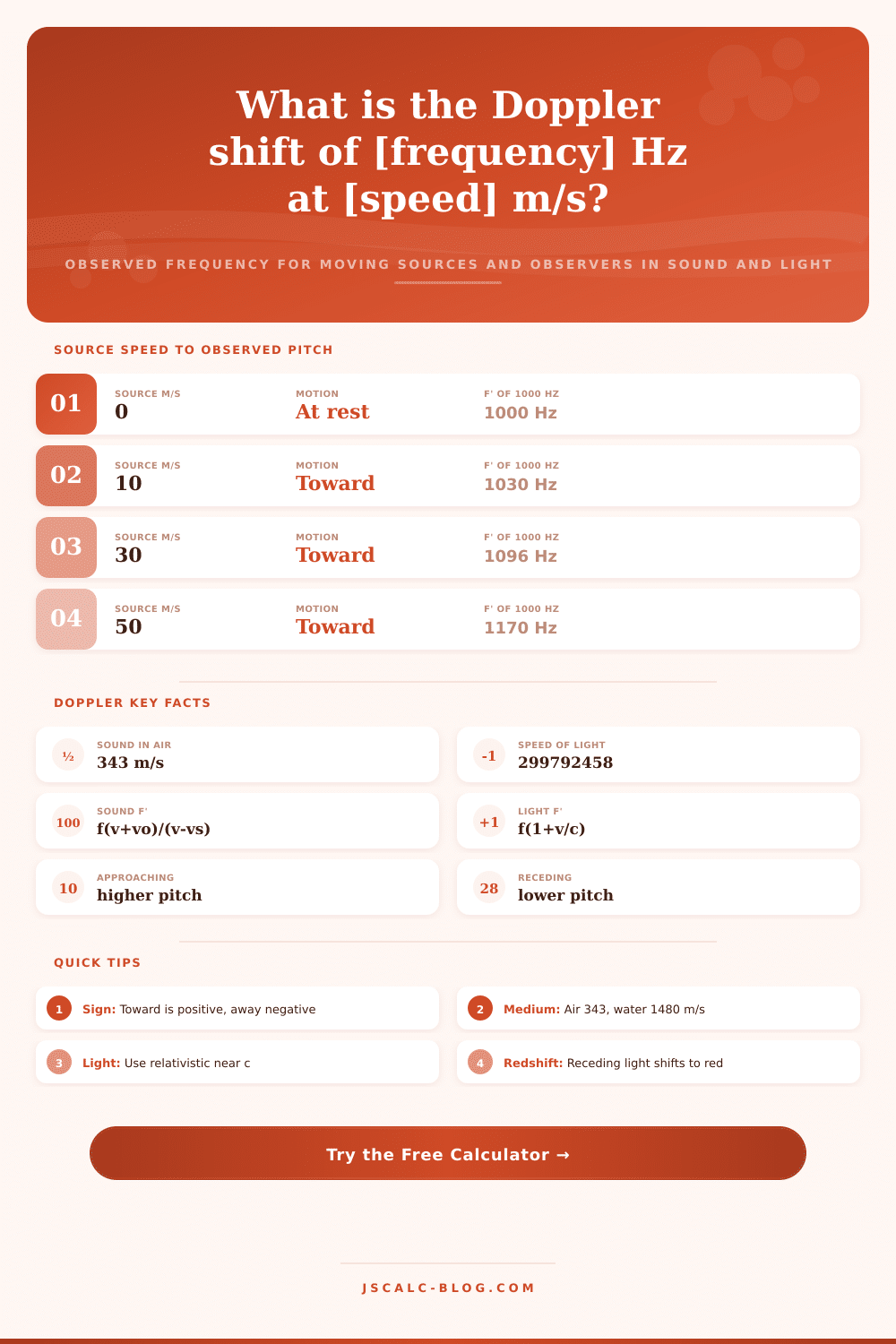
You hear a 1000 Hz siren traveling at 30 m/s towards you while you stand still in 343 m/s air? Answer: roughly 1096 Hz. Another small point: Even if your observer’s speed matches the source’s, the results are not identical. This is because sound is actualy traveling in a medium, and only the relative motion of either matters. For example, when the source approaches with a speed of 30 m/s, we observe a higher frequency, around 1096 Hz. Conversely, if you approach a fixed source with a speed of 30 m/s, you’ll experience roughly 1087 Hz. This difference increase at higher speeds. On the calculator, you can select only the source, only the observer, or both moving. This allows you to view this asymmetry directly, without assuming the two scenarios would yield the same result.
A Medium May Be Required The medium-free nature of light and radio waves means that their Doppler shifts are purely radial in origin, depending on nothing more than the relative velocity between the observer and the source. The simple formula with this behavior (and it works quite well at everyday speeds) is: In this case, v is positive when approaching, and c = 299,792,458 meters/second is the speed of light. For all things orbiting above us, for planes and cars being tracked by radars, this is just fine.
But as the speed gets up into one percent of c or so, the approximation starts to diverge, and we have to go to the full-blown relativistic formula. That’s what this calculator does, switching over to that equation at high velocities. So a receding galaxy moving at five percent of the speed of light reports an actual redshift equal to ~2.47 percent rather than the slightly inaccurate classical formula.
There are four cards for every calculation. First, the observed frequency card indicates the blueshift or the amount the pitch was shifted. Second, the frequency shift card indicate the difference between what was observed and what was emitted. It includes the +/- sign so it’s clear if it went up or down. Third, the wavelength shift card tells us how the wavelength was affected because wavelength = wave speed / frequency. When the frequency goes up, then, the wavelength shrink. Fourth, the percent shift card divides the difference by the emitted frequency. That way, we can easily see something dramatic like a relativistic shift and something subtle like a radar shift. They are all expressed as a single number.
Scenarios loaded from preset buttons display the range of the effect. The ambulance and train horn presets show familiar sounds of the road. The Formula race car preset push the source speed high enough to shift a tone about a third. The sonar preset shows sonar by switching the medium to water at 1480 meters per second, illustrating how the numbers change due to a denser medium. Electromagnetic effects include the police radar and GPS satellite presets which generate tiny but real shifts. The receding galaxy preset illustrates cosmological redshift, while the relativistic probe preset use the exact formula for moving at half the speed of light. You can start from a real case and adjust, each preset filling in the form and calculating instantly.
The wave speed ties the wavelength with the frequency, so both are reported by the calculator. It reports c for light, and the medium speed for sound. This makes the tool practical for anything from a 24 GHz radar beam to a 440 Hz musical note. You can enter the emitted frequency in hertz, kilohertz, megahertz, or gigahertz.
The most intuitive output may be the percent shift. Even if the raw frequencies differ by many orders of magnitude, a minus 2.47 percent redshift on a galaxy and a plus 7.9 percent change on an ambulance siren are instantly comparable.
From medical ultrasound to astronomy to physics classrooms and engineering labs, the Doppler effect is everywhere. But where it gets confusing is the mix of classical and relativist formulas and sign conventions for each form. This calculator makes it easy by splitting out light from sound so that the proper signs always apply, and jumping to the relativistic formula when the speeds call for it. Simply select which sort of wave you want to use. Specify whether your moving object is the source or receiver, then provide a direction. Input your pre-sets or key in your values to see the shift, change in wavelength, and percentage difference all displayed with workings.
If you’re a researcher trying to estimate a spectral shift or a student wanting to know why a horn sounds different as it passes, the result comes back in seconds with workings explained. The siren wails away as ever at its starting tone, but the ears hear differently and it’s all about motion.