Degree to Radian Converter
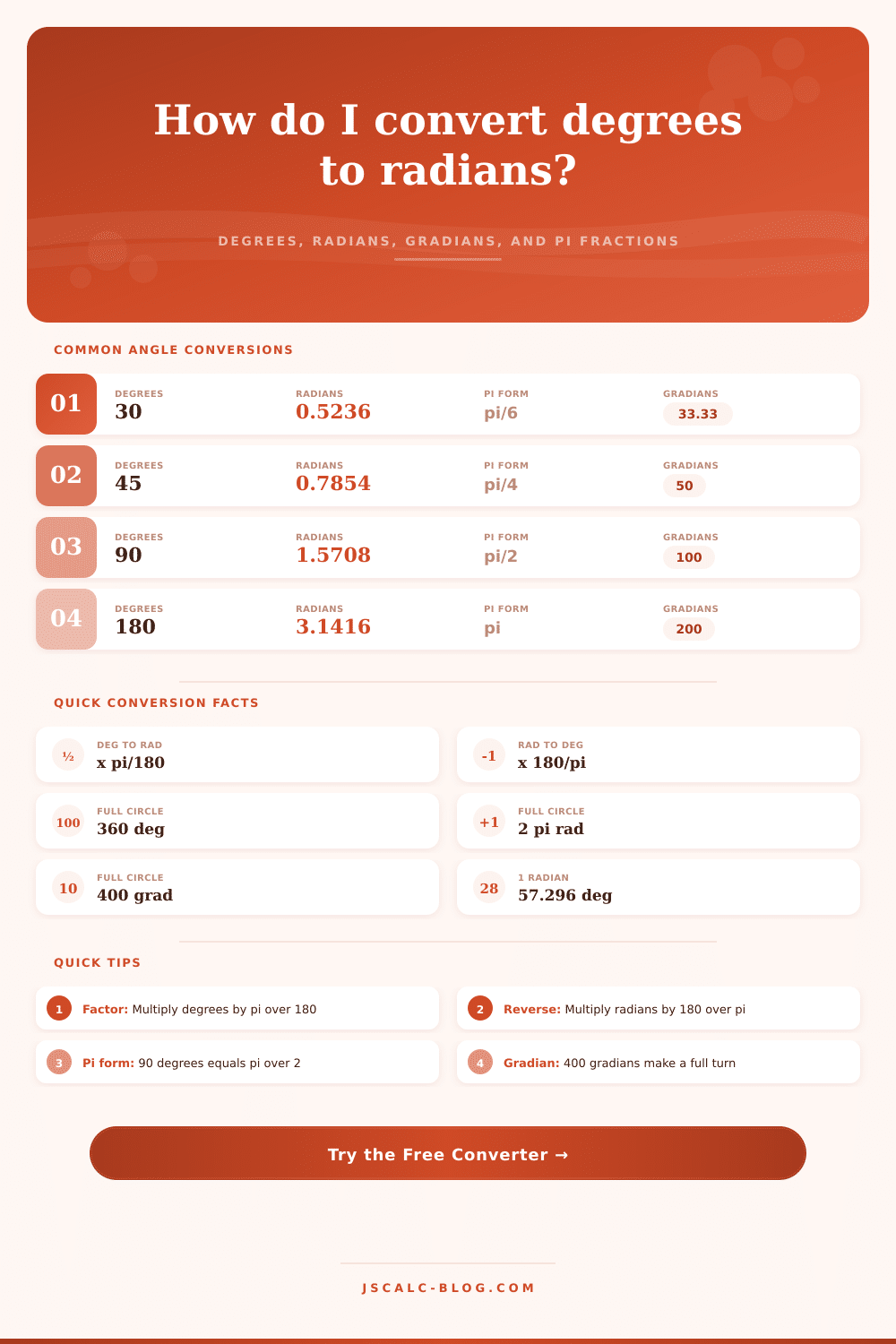
Convert any angle between degrees, radians, gradians, and revolutions. See the radian value as a simplified π fraction, view all four unit equivalents at once, and compare common reference angles.
📍Common Angle Presets
🔢Angle Inputs
The number to convert from the chosen source unit.
🌐Full-Circle Reference
📊Common Angle Conversion Table
| Degrees | Radians (π) | Radians (decimal) | Gradians | Revolutions |
|---|---|---|---|---|
| 0° | 0 | 0.0000 | 0 | 0 |
| 30° | π/6 | 0.5236 | 33.33 | 1/12 |
| 45° | π/4 | 0.7854 | 50 | 1/8 |
| 60° | π/3 | 1.0472 | 66.67 | 1/6 |
| 90° | π/2 | 1.5708 | 100 | 1/4 |
| 120° | 2π/3 | 2.0944 | 133.33 | 1/3 |
| 135° | 3π/4 | 2.3562 | 150 | 3/8 |
| 150° | 5π/6 | 2.6180 | 166.67 | 5/12 |
| 180° | π | 3.1416 | 200 | 1/2 |
| 270° | 3π/2 | 4.7124 | 300 | 3/4 |
| 360° | 2π | 6.2832 | 400 | 1 |
🔁Radian to Degree Quick Reference
| Radians | Degrees | Gradians | Revolutions |
|---|---|---|---|
| 0.5 rad | 28.6479° | 31.831 | 0.0796 |
| 1 rad | 57.2958° | 63.662 | 0.1592 |
| π/4 rad | 45° | 50 | 0.1250 |
| π/2 rad | 90° | 100 | 0.2500 |
| 2 rad | 114.5916° | 127.324 | 0.3183 |
| π rad | 180° | 200 | 0.5000 |
| 3 rad | 171.8873° | 190.986 | 0.4775 |
| 2π rad | 360° | 400 | 1.0000 |
📐Trig Values at Common Angles
| Degrees | Radians | sin | cos | tan | Quadrant |
|---|---|---|---|---|---|
| 0° | 0 | 0 | 1 | 0 | Axis |
| 30° | π/6 | 0.5 | 0.8660 | 0.5774 | I |
| 45° | π/4 | 0.7071 | 0.7071 | 1 | I |
| 60° | π/3 | 0.8660 | 0.5 | 1.7321 | I |
| 90° | π/2 | 1 | 0 | undefined | Axis |
| 120° | 2π/3 | 0.8660 | -0.5 | -1.7321 | II |
| 180° | π | 0 | -1 | 0 | Axis |
| 270° | 3π/2 | -1 | 0 | undefined | Axis |
⚖Angle Unit Comparison Grid
| Unit | Full Turn | Right Angle | Symbol | 1 Unit in Degrees | Common Use |
|---|---|---|---|---|---|
| Degree | 360 | 90 | ° | 1° | Everyday, navigation |
| Radian | 2π ≈ 6.2832 | π/2 | rad | 57.2958° | Calculus, physics |
| Gradian | 400 | 100 | gon | 0.9° | Surveying, geodesy |
| Revolution | 1 | 0.25 | turn | 360° | Rotations, gears |
| Arcminute | 21600 | 5400 | ′ | 0.01667° | Astronomy, optics |
| Arcsecond | 1296000 | 324000 | ″ | 0.000278° | Precision astronomy |
⚙Full Formula Breakdown
📋Unit Definitions Reference
| Unit | Definition | Relation to Degree | Notes |
|---|---|---|---|
| Degree | 1/360 of a full circle | Base reference | Splits into minutes and seconds |
| Radian | Arc length equal to the radius | 1 rad = 180/π deg | SI unit of angle, dimensionless |
| Gradian | 1/400 of a full circle | 1 gon = 0.9 deg | Also called gon or grade |
| Revolution | One complete turn | 1 turn = 360 deg | Used for rotation counts |
| Arcminute | 1/60 of a degree | 1′ = 1/60 deg | Fine navigation and optics |
💡Practical Conversion Tips
Working on engineering sketches means working with angles. For example, you measure roof pitch in degrees (because that’s what a protractor does), yet a spreadsheet want radians (for those sine and cosine functions). Mismatch city! That’s why good converter is necessary for all your technical workflow needs. Working through this conversion isn’t simply math… It’s converting between our intuitions as humans and the demands of math.
Why do degrees “feel” natural? Well, they are based off our intuition to cut a circle up into three hundred sixty pieces. That number was decided upon by ancient astronomers who liked how easily it could be divided. On the other hand, radians are rooted in geometry itself. A radian is defined as the number of times a radius fit around some arc. It makes calculus both intuitive and clean.
Why You Need an Angle Converter
Changing units change how you see a given shape. These conversions all work easy through the converter. Switching between revolutions, radians, degrees, and gradians is no more complicated then algebra. That is why you should of known these units.
Every day we use degrees. Degrees is simple to draw. A right angle is ninety degrees, a straight line one hundred eighty, and a complete circle three hundred sixty. That makes them simple to divide up without getting into ugly decimal fractions. For advanced math and physics, the unit of choice are radian. It’s free of the historical weight left by base thirty-six system. It relates the angle directly to the radius of the circle. From there, the derivative of a trigonometric function (like cosine or sine) is just the other function. In degrees, you has to add some ugly conversion factor at every step. Math people like radians because it look nice. Yes, it might be difficult to imagine as a student, but mathematicians prefer them anyway.
There are other places you may encounter gradians, such as in surveying. A gradian is one-hundredth of a right angle. Because it works with base ten and makes decimal arithmetic convenient, it’s handy on jobsites where people thinks in base ten. But those are still only a few cases where a degree would work. Gradians exist as a curiosity, a niche tool used in specialized fields like surveying.
And yet there it remains on the calculator just so that I don’t have to remember the conversion factor (10/9). I’m fine if most folks never use gradians. And yet there it remains on the calculator just so that I don’t have to remember the conversion factor (10/9). I’m fine if most folks never use gradians. Their presence next to degrees and radians reminds us that all measurement systems are arbitrary. We choose some, formalize them, then must translate back and forth between them.
The ability to enter angles as fractions of pi is useful for teachers and student alike. Many times an angle expressed as 3pi/2 or pi/6 can be clearer than a string of digits. It draws your attention away from the number itself and toward the geometric concept it represents. It transforms what could be any old number into a point of reference in our mental picture of the whole circle.
In fields like signal processing and robotics, software expects radians while humans type in degrees. Without thinking, it’s easy to make a mistake that will send your computation from right to working-well to oh-no-we’re-flying-into-a-building-and-surely-there-is-a-bigger-problem-here-than-my-calculation being off by 180 degrees. This one little habit, always double check the units before typing anything into a program, make debugging easier down the road. These reference tables provide all of common values so you can easily check yourself. It lets you know where forty-five degrees sits on the radian dial without having to do any mental math during crunch time.
Learning to convert angles isn’t really about learning some formulas; it’s about gaining a feel for the size. If I see an angle, I ought to be able to guesstimate if it’s a fat arc or a narrow wedge. That doesn’t change just because we’ve labeled the measurement with a degree symbol. The hundred-and-eighty-degree-to-pi-radians thing settles once you’ve got that in your head and then everything else about the circle slots into position from there. Instead of seeing numbers as separate symbols to work with individually, you begin to see where they sits on an ongoing line. Rather than just doing rote math, you’re doing some actual geometry when you work with angles. And while the converter does most of the work for you, what it’s using means you’ll get it right. It is a tiny detail, but it counts.