Electric Force Calculator
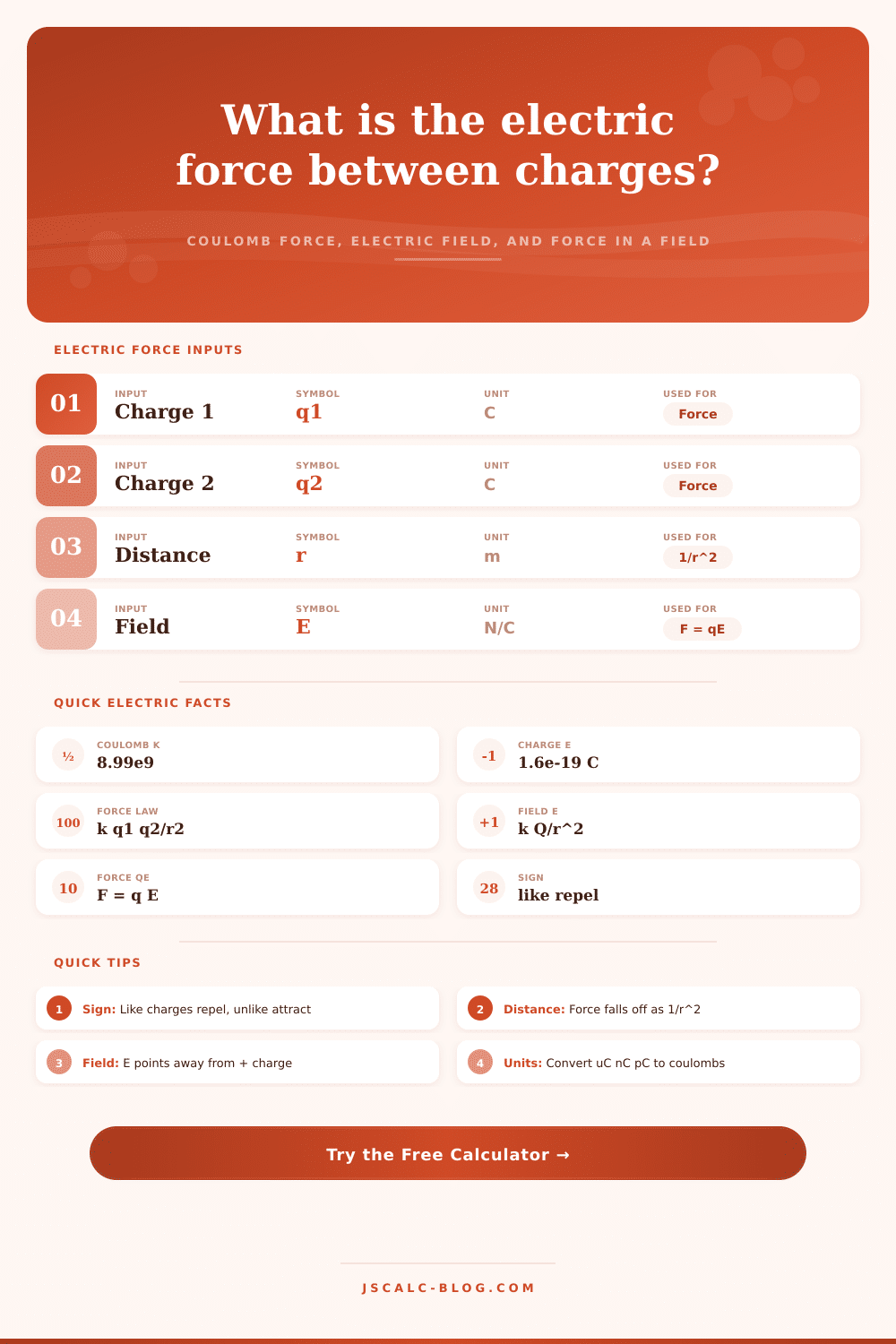
Find the Coulomb force between two point charges, the electric field of a single charge with E = kQ/r², and the force on a charge placed in a field using F = qE. Signs show attraction or repulsion.
⚡Physics Presets
🔌Charge & Field Inputs
Inputs show and hide to match the selected mode.
Used only for the F = qE mode.
🔢Formula Snapshot
📏Constants & Elementary Charge
| Quantity | Symbol | Value | Where It Appears |
|---|---|---|---|
| Coulomb constant | k | 8.9875 × 10⁹ N·m²/C² | F = k q1 q2 / r² |
| Permittivity of free space | ε₀ | 8.854 × 10⁻¹² F/m | k = 1 / (4πε₀) |
| Elementary charge | e | 1.6022 × 10⁻¹⁹ C | Charge of proton |
| Electron charge | –e | –1.6022 × 10⁻¹⁹ C | Negative sign |
| Proton mass | m_p | 1.6726 × 10⁻²⁷ kg | Gravity compare |
🔄Charge Unit Conversions
| Unit | Symbol | In Coulombs | Example Source |
|---|---|---|---|
| Coulomb | C | 1 C | Large lab charge |
| Millicoulomb | mC | 1 × 10⁻³ C | Charged capacitor |
| Microcoulomb | µC | 1 × 10⁻⁶ C | Static balloon |
| Nanocoulomb | nC | 1 × 10⁻⁹ C | Small droplet |
| Picocoulomb | pC | 1 × 10⁻¹² C | Piezo sensor |
| Elementary | e | 1.602 × 10⁻¹⁹ C | Single proton |
🌦Field Strength Examples
| Situation | Field E (N/C) | Note |
|---|---|---|
| Fair-weather atmosphere | ≈ 100 N/C | Points downward |
| Inside a wire (typical) | ≈ 0.01 N/C | Drives current |
| Near charged comb | ≈ 1,000 N/C | Static charge |
| Breakdown of dry air | ≈ 3 × 10⁶ N/C | Spark occurs |
| At a proton, 0.5 Å | ≈ 6 × 10¹¹ N/C | Atomic scale |
⚖Attraction vs Repulsion & Scenario Grid
| Scenario | q1 | q2 | r | Sign | Result |
|---|---|---|---|---|---|
| Two electrons | –e | –e | 1 nm | Like | Repel |
| Proton & electron | +e | –e | 0.053 nm | Unlike | Attract |
| Two protons | +e | +e | 1 fm | Like | Repel |
| Balloon & hair | –1 µC | +1 µC | 5 cm | Unlike | Attract |
| Two + spheres | +2 µC | +3 µC | 10 cm | Like | Repel |
| Oil-drop charges | –5 nC | –5 nC | 2 mm | Like | Repel |
| 1 C pair | +1 C | +1 C | 1 m | Like | Repel |
⚙Full Formula Breakdown
💡Practical Electric Force Tips
Electricity is an invisible thing; yet you might not realize just how much force is present between tiny charges. Those seemingly annoying static shocks is in fact quite dramatic physics. If both your hands held one coulomb of charge and were separated by one meter, there would be about nine billion newtons of repulsive force. Enough to launch a mountain range into orbit or crush a battleship. It’s a huge amount of power which you don’t witness every day.
Unless it gets out of balance when nature works hard to control charges. The potential energy from such interactions is huge. Realizing this helps explain what makes electricity so dangerous. Not only does the voltage matter, but also the separation distance and charge density are important.
Understanding Electric Force and Calculator Use
But never fear. That’s what the calculator above does for you. You don’t need to do the math. However, this still requires some exponent math and people is always putting their zeroes in the wrong place. It works based off Coulomb’s Law, where the force between two charged objects are proportional to one charge times another. It is also inversely proportional to distance between them squared.
See that “squared”? That’s the important part: If you have two charged objects and halve the distance between them, it isn’t simply twice as strong than before; it’s four times as strong. You can see how accuracy becomes very important here whether working with high voltages or microscopic components.
The tool lets you choose various medium (water, glass, oil, vacuum, air). In doing so, it models the real world. The reality is that environment doesn’t always look like a textbook diagram with an idealized vacuum. If charges reside within glass or some other type of dielectric material (such as oil), the molecules aligns and polarize in response. Some of the electric field lines align along these dipoles, shielding them from others. As a result, the net force between charges is reduced.
Specifically, water has a relative permittivity of about eighty. That means it reduces the effective Coulomb force by a factor of eighty compared to air. Because of this shielding effect high-voltage transformers are filled with oil. How the charges interact depend on the medium.
Another stumbling block is unit conversions. It’s not uncommon for physics equations to call out nanocoulombs, picocoulombs, and microcoulombs while asking for standard coulombs. A microcoulomb is a millionth of a coulomb. Drop the decimal point, and what was once a workable force becomes something planetary-scale in your calculation. Know where the units is shifting. Check the reference table (above) for the prefixes that scale. Before relying on its answer, double-check your units setting. A mistake between nanos and micros makes your result a thousand times off.
The calculator does all this for you behind-the-scenes but knowing how large the shifts can be lets you eyeball the output and make sure it checks out.
So how does this idea of an electric field link motionless charges to moving ones? Instead of computing the force between each pair of charge, physicists compute a field produced by the source charge. The strength of the field at any point create a push or pull on any other charge within its area. For situations involving multiple interacting particles, this is a convenient abstraction. Imagine a capacitor plate or a comb with charge on it. Compute the field just one time and then use it to figure out the force on whatever object happens to be near it. What was a lattice of two-way interactions becomes a field of influence mapped in one go.
The power of electricity is not found in the charge but rather in space between charges. From the stability of atoms to the efficiency of our power grid, it’s all about distance, medium, and magnitude. Whether you’re testing a doorknob shock or troubleshooting a circuit, keep in mind that even slight differences in distance results in exponential changes in force. You should of seen how much it varies. These unseen forces are both strong and delicate. They quietly wait for the distance to close.