Tire Size to Gear Ratio Calculator
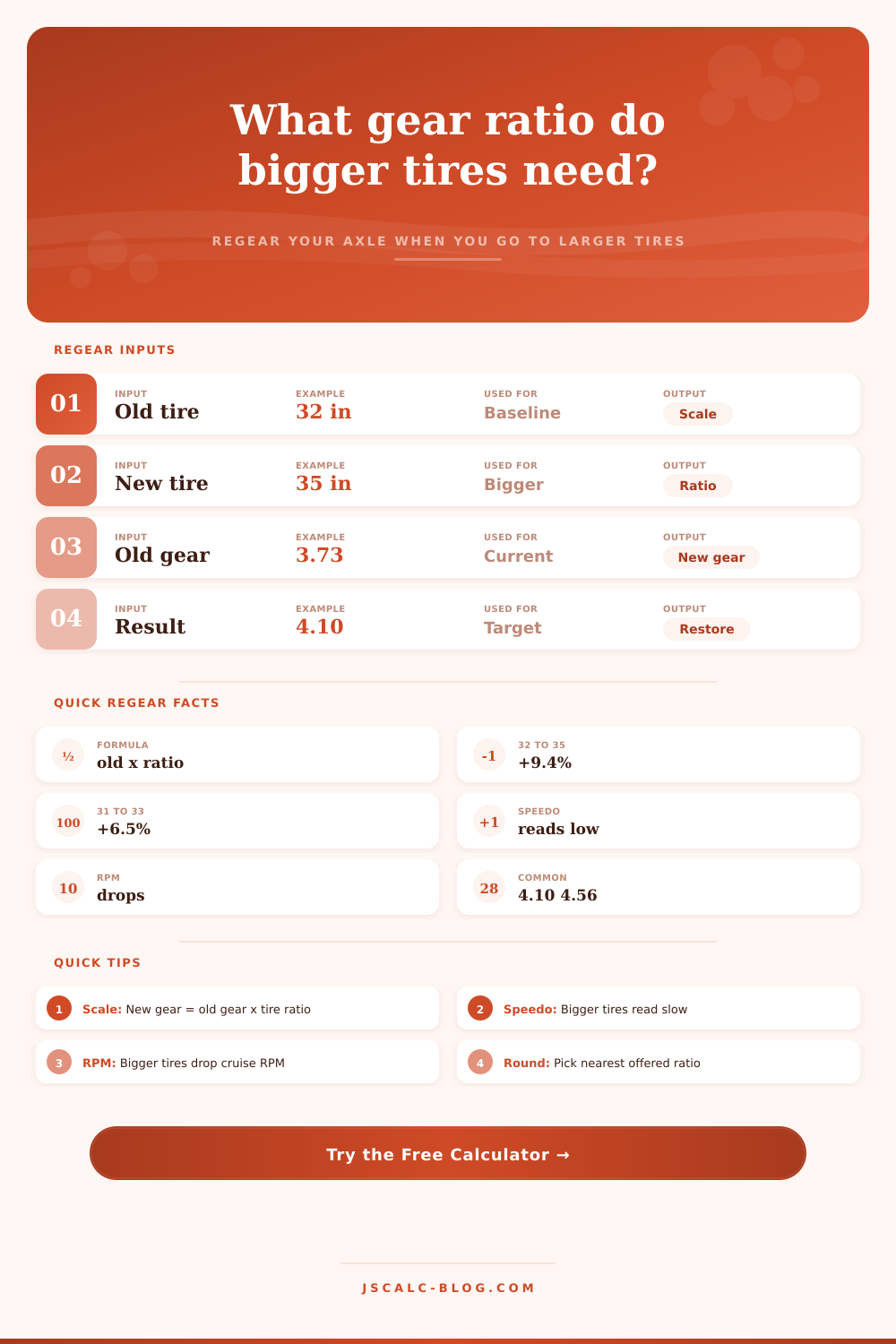
Going to bigger tires? Find the new axle gear ratio that restores your original effective final drive, then see how much your speedometer reads low and how far your cruise RPM drops if you keep the old gears.
🎯Real Regear Presets
📝Tire and Gear Inputs
Used when method is diameter in inches.
Example 265/70R17. Used in metric mode.
🔢Regear Snapshot
📊Equivalent Gear Ratios for Your Tire Change
| Old Ratio | New Tire Scale | Ratio To Match | Nearest Offered | Result vs Stock |
|---|---|---|---|---|
| Enter values above to build the equivalent ratio table. | ||||
🛞Tire Size to Diameter Reference
| Flotation Size | Diameter | Metric Equivalent | Revs per Mile | Common Use |
|---|---|---|---|---|
| 30x9.50R15 | 30.0 in | 235/75R15 | 704 | Stock light truck |
| 31x10.50R15 | 31.0 in | 265/75R15 | 681 | Mild all-terrain |
| 32x11.50R15 | 32.0 in | 285/75R16 | 660 | Popular AT upgrade |
| 33x12.50R15 | 33.0 in | 285/75R17 | 639 | First real lift tire |
| 35x12.50R17 | 35.0 in | 315/70R17 | 603 | Serious off-road |
| 37x12.50R17 | 37.0 in | 355/70R17 | 570 | Rock and trail rig |
| 40x13.50R17 | 40.0 in | 395/70R17 | 528 | Extreme crawler |
🗂Regear Recommendation Grid
| Tire Change | Scale | From 3.55 | From 3.73 | From 4.10 | From 4.56 | Speedo Off |
|---|---|---|---|---|---|---|
| 31 to 33 in | 1.065 | 3.78 | 3.97 | 4.37 | 4.86 | +6.5% |
| 32 to 35 in | 1.094 | 3.88 | 4.08 | 4.48 | 4.99 | +9.4% |
| 33 to 35 in | 1.061 | 3.77 | 3.96 | 4.35 | 4.84 | +6.1% |
| 33 to 37 in | 1.121 | 3.98 | 4.18 | 4.60 | 5.11 | +12.1% |
| 35 to 37 in | 1.057 | 3.75 | 3.94 | 4.33 | 4.82 | +5.7% |
| 35 to 40 in | 1.143 | 4.06 | 4.26 | 4.69 | 5.21 | +14.3% |
| 37 to 40 in | 1.081 | 3.84 | 4.03 | 4.43 | 4.93 | +8.1% |
🕑Speedometer Error by Tire Change
| Old to New | Scale | Speedo Reads Low | Indicated 60 = True | Indicated 70 = True | Fix |
|---|---|---|---|---|---|
| 32 to 33 in | 1.031 | +3.1% | 61.9 mph | 72.2 mph | Recalibrate |
| 32 to 35 in | 1.094 | +9.4% | 65.6 mph | 76.6 mph | Tuner or box |
| 33 to 35 in | 1.061 | +6.1% | 63.6 mph | 74.2 mph | Tuner or gears |
| 33 to 37 in | 1.121 | +12.1% | 67.3 mph | 78.5 mph | Regear + tune |
| 35 to 37 in | 1.057 | +5.7% | 63.4 mph | 74.0 mph | Tuner |
| 31 to 35 in | 1.129 | +12.9% | 67.7 mph | 79.0 mph | Regear + tune |
⚙Full Formula Breakdown
📋Reference Values
| Item | Common Entry | How It Is Used | Regear Effect |
|---|---|---|---|
| Old tire diameter | 30 to 35 in | Baseline for the scale factor | Sets the reference final drive |
| New tire diameter | 33 to 40 in | Divided by old for scale | Larger means more ratio needed |
| Current gear ratio | 3.55 to 4.10 | Multiplied by tire scale | Anchors the new target ratio |
| Available ratio set | Common steps | Snaps target to a real gear | Picks a ratio you can buy |
| Cruise RPM | 1800 to 2400 | Scaled by old over new dia | Shows lugging risk if unchanged |
💡Practical Regear Tips
Big tires are a good idea; right? Well that depends. If you want more “power” in your vehicle (i.e., better gas mileage or more off-road capability), then maybe big tires is a good idea for you. However, if you’re like most people and have larger tires just because you think it makes your truck look cool, then all those big tires will gives you mechanical problems. Your truck will drag in highway traffic, the speedo won’t be accurate, etc.
The reason is simple: larger tires alter dynamic of the vehicle. It’s like driving with different gear ratios on an axle. You need to alter axles to reflect tire size. Otherwise, when you put load on engine it fights against itself.
Why You Should Change Your Gears When You Get Big Tires
Here’s where underlying science gets tricky. Bigger tires provides greater leverage around wheel. That means each time the wheel turn, it moves further, spinning fewer times in a given mile. Because the speedometer tracks how many times the wheels turns per mile, it reports that you’re going slower when really you’re moving faster. This is dangerous because you might not realize you’re speeding.
And that’s where this website’s calculator enters the picture. Plug in your existing tire size and ratio plus your desired tire size, then the calculator will recommend an axle ratio that feels just like before. For good engine health, you want to maintain a proper cruising RPM. Too low an RPM stresses out parts and reduces fuel economy. It will lug the engine in a less efficient range if the tire size are too big. This results in a reduced RPM, which you can see on the calculator by looking at how the ratio change at same speed.
You want torque and you want it useable if you are going to drive well. Selecting proper gear accomplishes this. There is no direct gear match. While there are standard ratios available, commonly a 4.10 or 4.56; manufacturers don’t produce all ratios. You select the one that matches your need best. Check reference table found on this page to see how small differences can translate into big results.
For off-road use, going up in numerical ratio help. It provides more low end and less high-end rpm. That’s a tradeoff based off driving. Do you mostly just commute? In that case precision is most important. Some guys opt to recalibrate their speedometer rather than gear it, which doesn’t require as much money or time. For many vehicle, you don’t even need to remove your transfer case or axles.
Recalibration tunes your speedometer but won’t restore any of the performance that was sacrificed by the new gearing. You can’t tune up what’s been lost in terms of torque. Keep this difference in mind when deciding whether you should of spend money on labor or parts.
Adding tires this large makes sense, but there’s a balance between form and function when lifting your truck. To drive it right, you’ll need to adjust your drivetrain for large tires. Adding bigger tires creates a set of trade-offs, which is calculated out for you. Enter in your own numbers, and it will become clear what the best solution is. Do you need gear changes? Will a tune do it? Will this be a confident upgrade or mistake?